
Nvidia Patents AI That Copies Image Quality in a Single Generation Step
Generating an image with today's AI tools can require dozens of processing steps under the hood. Nvidia is patenting a training method that could cut that down to just one.
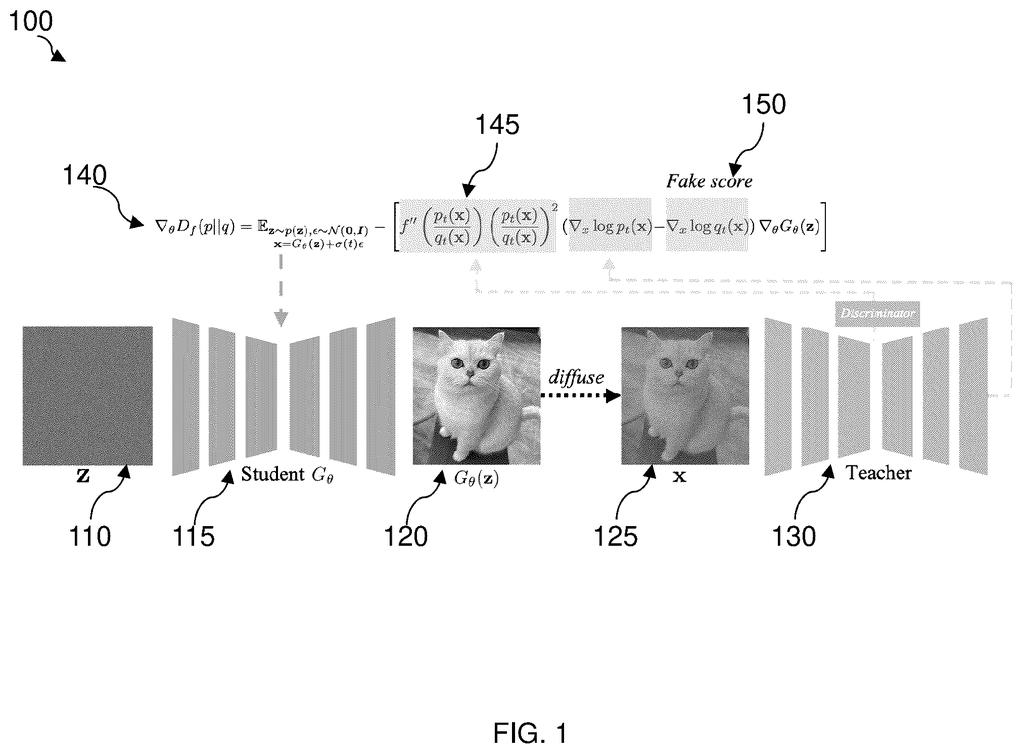
How Nvidia shrinks a slow AI image process into one pass
Imagine teaching a new employee by having them shadow an expert. The expert narrates every decision, and the trainee adjusts until their instincts match. Nvidia's patent works on a similar idea, but for AI image generators.
Today's AI image models (like those behind tools that turn text into pictures) work by repeatedly refining a noisy image, step by step, until something coherent emerges. That back-and-forth is slow. Nvidia's approach trains a "student" model by having it watch a slower, more capable "teacher" model and learn to mimic its outputs in far fewer moves.
The clever part is that instead of comparing the whole image at once, the system scores small regions of the image individually, so errors in one corner don't drag down learning everywhere else. The result is a student model that can produce high-quality images in a single pass, which is a big deal for anything that needs AI-generated visuals quickly.
How the student-teacher scoring loop actually updates the model
The patent describes a training framework Nvidia calls f-distill. It is built around a concept called f-divergence minimization (a mathematical way of measuring how different two probability distributions are, then reducing that difference).
The process works like this:
- A student diffusion model takes a text prompt and generates an image in one step.
- The system divides that image into regions and assigns each region a "student score" (a number representing how confident the student model is about what that region should look like).
- The image is then deliberately blurred with random noise and handed to the teacher diffusion model, which produces its own regional scores for comparison.
- A gradient algorithm (a standard math tool for adjusting model weights) computes the difference between teacher and student scores, region by region, and uses a weighting function to decide how much to trust each region's error signal.
The weighting function is the key innovation. It lets the system down-weight regions where the teacher model's own estimates are uncertain or noisy, so bad data doesn't corrupt the student's learning. The training loop repeats until the student's regional scores are close enough to the teacher's to cross a defined threshold.
What faster diffusion models mean for real-time AI image tools
Diffusion models are the engine behind most serious AI image generators right now, but their multi-step generation process makes them too slow for real-time applications like video games, live video filters, or instant product visualization. A model that produces comparable quality in one step instead of 20 or 50 could open those use cases up.
For Nvidia specifically, faster diffusion inference also means less compute time per image, which directly reduces the cost of running AI services on its own hardware. This patent suggests Nvidia is working at the model-training layer, not just the chip layer, to squeeze more performance out of the same silicon.
This is genuine research work, not a defensive filing. The region-weighted scoring approach addresses a real weakness in existing distillation methods (where noisy teacher estimates corrupt student learning), and the one-step generation goal is something the whole AI image field is actively chasing. Worth watching if you follow generative AI infrastructure.
There are more where this came from
We read every patent application Big Tech publishes and send you the ones worth knowing. Plain English, free, every week.
The drawings
9 drawing sheets from US 2026/0220457 A1 · click any drawing to enlarge


Want this weekly breakdown for a company we don't cover? Patentlyze Pro →
Be the first to weigh in