
Nvidia Patents a Two-Stage Video Compression System That Avoids Quality Degradation
Nvidia has patented a video compression architecture that gets 8 times the compression rate of conventional approaches by letting each video frame learn from the raw, uncompressed version of the frame before it, rather than a degraded copy.
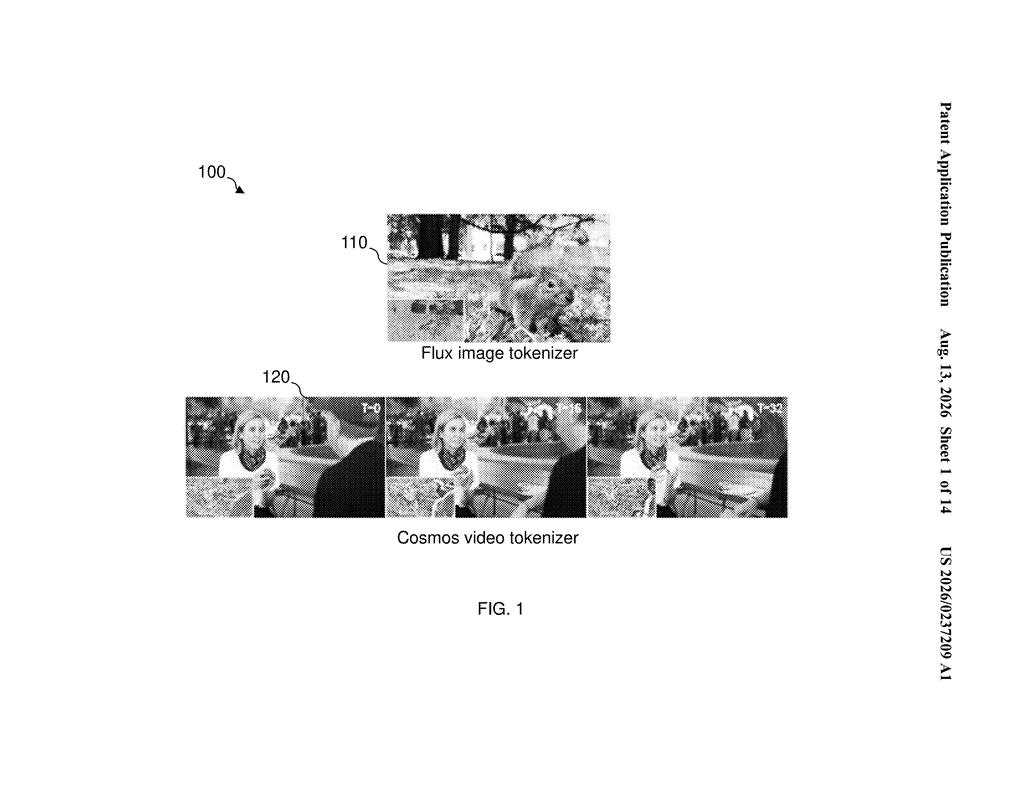
How Nvidia's two-stage video tokenizer cuts file size
Ever tried to stream a high-resolution video only to watch it turn to mush the moment your connection dips? A lot of that quality loss happens before the video even reaches your screen, during the step where AI systems chop footage into compact chunks for processing or storage.
Nvidia's patent describes a system that handles this chopping in two stages. The first stage handles the visual basics, squeezing raw pixel data down to a manageable size. The second stage goes deeper, looking for patterns across frames the way you might notice a slow pan or a recurring background and compresses those patterns too. The key trick is that the second stage feeds each new frame a clean, pre-compression signal from the previous frame instead of an already-degraded one.
The result, according to the filing, is that the system keeps improving the more you train it, whereas older approaches hit a ceiling and stop getting better. That kind of scalability is exactly what you need when you are trying to build AI video tools that work on hour-long footage, not just short clips.
generating a set of first tokens of frames of a video using a convolutional tokenizer in a pixel space, wherein the set of first tokens corresponds to a perceptual compression of the frames of the video; freezing the convolutional tokenizer from further processing …
Translation: The system first compresses video by turning images into digital tokens and then locks that part of the process in place.
Inside the convolutional-then-transformer encoding pipeline
The patent describes what Nvidia calls an autoregressive (AR) video tokenizer, a system for converting video into compact numerical codes (tokens) that an AI model can work with efficiently.
Most existing tokenizers compress a video frame by frame in isolation, then bolt the frames back together. This one uses a two-step pipeline:
- Stage 1 (convolutional tokenizer, pixel space): A standard convolution-based network (think of it as a pattern-finding filter applied to raw pixels) compresses each frame into a mid-level representation called a perceptual token. Once this stage finishes, it is frozen and not updated further.
- Stage 2 (video transformer tokenizer, latent space): A transformer network (the same class of architecture behind large language models) takes those mid-level tokens and compresses them further into semantic tokens, using context from previous frames. Crucially, it uses the pre-compression signal from prior frames rather than the already-quantized (digitally rounded) version, preserving more information.
The phrase temporal causality here just means the system treats video the way it actually works: frame 47 is shaped by frame 46, which is shaped by frame 45. By wiring that dependency into the compression step, the system avoids re-encoding information that hasn't changed, which is most of any given frame in most videos.
The filing claims the architecture continues to improve as training compute scales up, a property it contrasts with conventional discrete tokenizers that plateau. That scaling behavior is the central engineering claim.
By bypassing the quantization layer for these continuous tokens, the video quality can be enhanced during reconstruction compared to conventional solutions. AR tokenizer can exploit the temporal causality between video frames by conditioning each frame's decoding on previous frames'pre-bottleneck features …
Translation: The system improves video clarity by using data from previous frames to predict the next one instead of rounding off details.
What this means for AI video generation at scale
For AI video generation tools, the tokenizer is the bottleneck nobody talks about. If the compression step degrades quality before the generative model even starts working, no amount of fine-tuning the generator recovers it. A tokenizer that preserves more signal at higher compression rates means the AI has better raw material to work with, which translates to sharper, more coherent output video.
For Nvidia, which sells the hardware that runs these workloads, a tokenizer that scales with compute is also a commercial argument: the more GPU time you spend training, the better the results get, with no ceiling in sight. The filing sits inside a busy category of new Big Tech patents targeting AI video infrastructure, where the compression layer is increasingly the competitive differentiator between systems that can handle long, high-resolution footage and those that can't.
The design trade here is real and deliberate: by freezing the first-stage tokenizer after training and never letting the second stage touch the quantization output of the first, Nvidia bets that a clean continuous signal is worth more than end-to-end joint optimization. That bet is defensible because quantization errors compound across frames in ways that are hard to unlearn, but it also means the two stages can't correct each other's mistakes. If the first-stage perceptual tokens are systematically wrong about something, the second stage inherits that blindspot permanently. Whether that trade pays off depends heavily on how well-calibrated the convolutional stage is before freezing, and the patent is quiet on how you know when it's ready to lock.
There are more where this came from
We read every patent application Big Tech publishes and send you the ones worth knowing. Plain English, free, every week.
The drawings
14 drawing sheets from US 2026/0237209 A1 · click any drawing to enlarge


Want this weekly breakdown for a company we don't cover? Patentlyze Pro →
Be the first to weigh in