
Samsung Patents a Projector That Repositions Itself Based on Your Phone
Instead of physically adjusting your projector every time you want to move the image, Samsung's new patent lets you drag a box on your phone and have the projector reposition itself automatically.
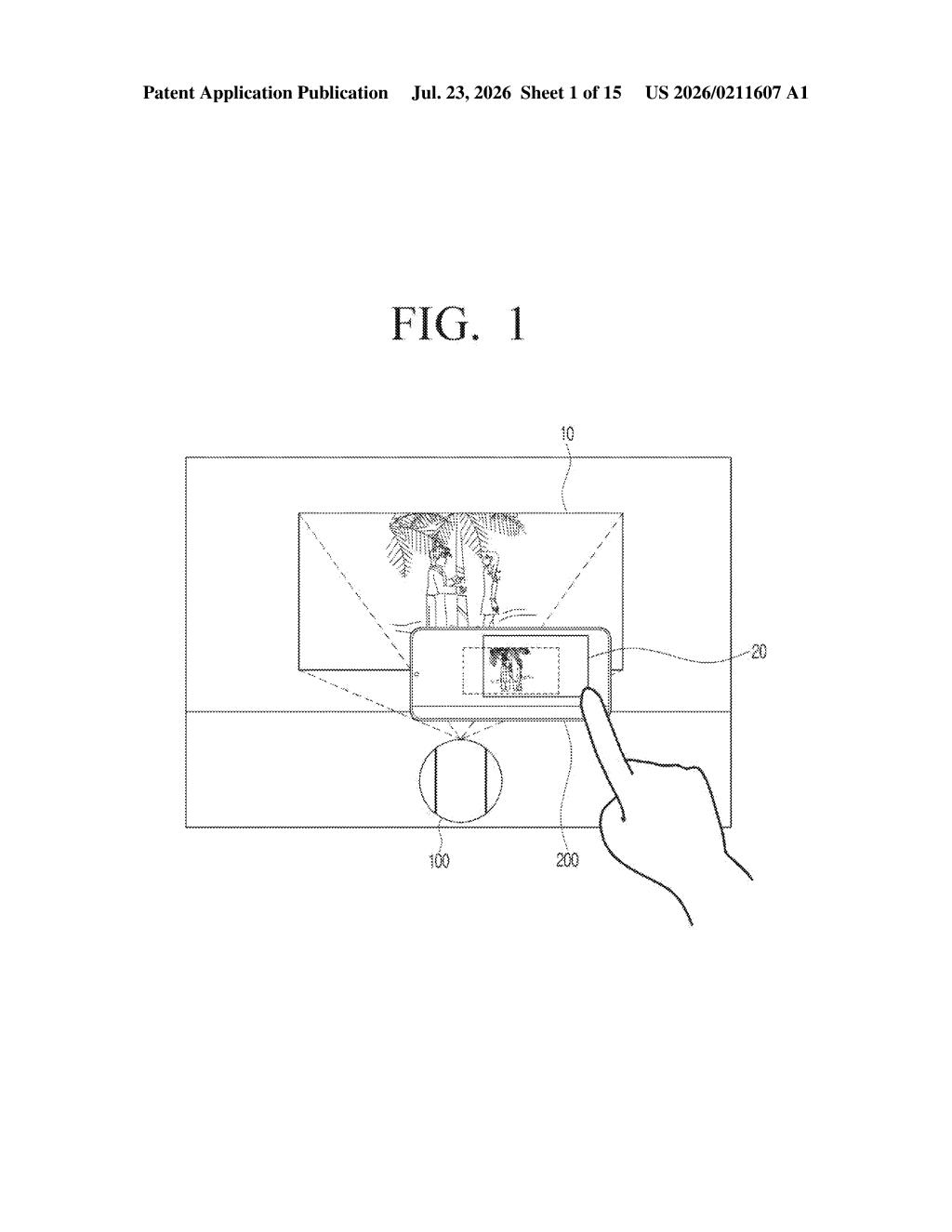
What Samsung's self-moving projector actually does
Imagine you've set up a projector to show a movie, but the image is slightly off to one side. Right now, your options are to physically rotate the projector, fiddle with its lens, or dig through on-screen menus. It's fiddly, and it's annoying.
Samsung's patent describes a projector that fixes this by connecting to your phone. You open an app, see a representation of where the image is being projected, and drag or resize that area on screen. The projector then moves itself, adjusts its angle, or changes how it's projecting to match what you drew.
The projector has a built-in motor to physically move or pivot itself, so the adjustment isn't just digital cropping. You edit on the phone; the projector responds in the real world. Think of it like pinching and dragging a photo, except the projector actually shifts to follow your instruction.
How the app edit triggers the projector's motor and lens
The patent describes a self-moving projector system with four main components working together:
- A communication interface that receives data from a paired phone or tablet
- A driving part (a motor or actuator) that physically moves or rotates the projector
- A projection part that controls how the image is thrown onto the surface, including angle and position
- A processor that translates the phone input into physical and optical adjustments
The user interacts through a UI element on a terminal device (meaning a phone, tablet, or similar device) that visually represents the current projection area. When you edit that UI element, the change is sent to the projector over the communication interface.
The processor then calculates a new projection angle and projection position from the data it received and instructs the driving part, the projection part, or both to move accordingly. The result is that the projected image lands where you indicated on your phone.
The claim covers controlling the motor, the projection optics, or a combination of both, which means the system could physically rotate the projector's body, adjust internal lens elements, or do both at once to hit the target.
What this means for phone-controlled home projection
For anyone who has ever spent ten minutes nudging a projector to line up with a screen or a wall, this is a real quality-of-life change. The patent puts the setup interface on your phone, which is almost always within reach, rather than on the projector itself or a separate remote.
Samsung already sells a line of portable projectors (including the Freestyle) where portability is the whole point. A projector you can reposition from your phone without touching the device fits that product direction naturally. If this makes it into a product, it could also make projectors more practical in shared spaces like offices or classrooms, where the projector position needs to change depending on who's presenting.
This is a practical idea, not a flashy one. The core insight, that repositioning a projector is annoying and that your phone is a better interface for it than a physical dial, is correct. Whether Samsung can make the motor-driven repositioning quiet, accurate, and fast enough to feel effortless is the real engineering question the patent doesn't answer.
There are more where this came from
We read every patent application Big Tech publishes and send you the ones worth knowing. Plain English, free, every week.
The drawings
15 drawing sheets from US 2026/0211607 A1 · click any drawing to enlarge


Want this weekly breakdown for a company we don't cover? Patentlyze Pro →
Be the first to weigh in