
Qualcomm Files Patent for Driver-Assist Tech That Reads Brake Lights Through Fog and Glare
Qualcomm's patent application teaches driver-assist software to read another car's brake lights and turn signals. It weighs three kinds of sensors, a guess at the other driver's next move, and the rhythm of the blinking itself.
What Qualcomm's brake-light reader actually does
Ever tried to tell whether the car ahead is braking when the sun is blasting off its bumper, or when fog turns every taillight into a smear? You guess, and the cameras in driver-assist systems have the same problem.
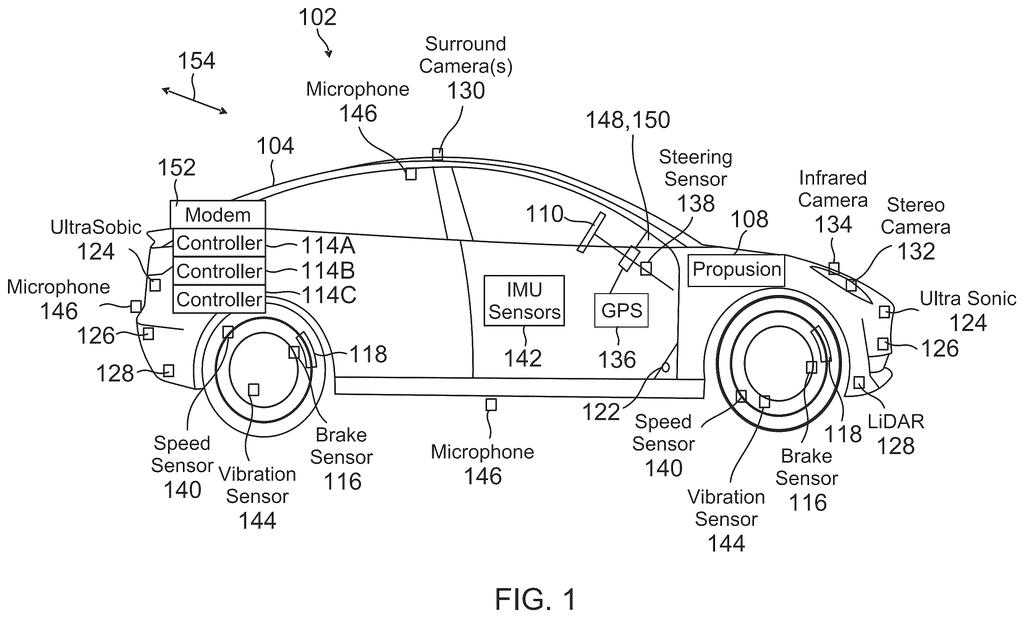
Qualcomm's patent application describes a system that doesn't rely on any single sensor. It pulls in a regular camera, an infrared camera and a laser scanner (LiDAR), then gives more say to whichever one is most reliable at the moment. Infrared at night is the example the filing gives. It also checks whether two glowing spots sit at the right height and distance apart to be a pair of taillights, and whether they blink like a turn signal.
Finally, it guesses what the car is probably about to do and combines all of those clues into one answer: left signal, right signal, brake or reverse.
… performing, based on the plurality of combined features, spectral and temporal signal analysis; and concatenating, using a hierarchical attention-based fusion, prediction of the behavior of the vehicle with results of the geometric consistency analysis and results of the spectral and temporal signal analysis to generate a classification of indicator lights of the vehicle.
Translation: The system analyzes light patterns over time and across different frequencies to accurately classify the brake lights.
How three analysis branches vote on a blinker
The claims cover a method run by a vehicle assistance system (the software behind features like adaptive cruise control and automatic emergency braking). It collects data from several sensors, extracts features from each (compact numerical summaries of what the sensor sees), and merges them into one set of combined features.
From that merged data, three separate analyses run:
- Behavior prediction: estimates the chance the other vehicle is turning left, turning right, braking or reversing, based on how it has been moving.
- Geometric consistency: finds bright candidate regions and checks that pairs of them sit at a plausible spacing and height for a vehicle's lights.
- Spectral and temporal analysis: studies how each bright spot's intensity changes over time, including flicker (using a Fast Fourier Transform, a math tool that splits a signal into its rhythms), to tell a real blinker from a reflection.
A final step called hierarchical attention-based fusion (a learned weighting scheme that decides which of the three analyses to rely on most) joins the three results into a classification of the vehicle's indicator lights.
The dependent claims add camera, near-infrared and LiDAR encoders, adjustments for ambient conditions, adaptive brightness thresholds, and a history buffer that lines up the sensors in time.
Why fog and glare are the hard part for cars
Cars with driver-assist already follow the vehicle ahead and brake for it. If the system thinks a car is braking when it isn't, or misses real brake lights, the filing says that can lead to unsafe following distances and rear-end collisions. Turn signals and brake lights also reveal what a driver is about to do, so a system that reads them well could react earlier.
The filing also says the system adjusts its workload to the hardware, using more computing in tough conditions and less when the chip is busy. It is meant to run on everything from powerful units to small embedded ones. That matters to automakers who need a feature to work on whatever chips are in the car. Keep in mind this is a patent application: it describes an approach, not a shipped feature.
Qualcomm's 54th filing we've tracked since July in the self-driving sensing race adds to a run that includes their sensor fusion patent and their one-lens depth camera patent.
Claim 1 asks for a lot at once. It requires merged data from several sensors, a prediction of what the other vehicle is doing, a check on whether candidate lights are laid out like a real pair, an analysis of flicker and timing, and a final learned weighting that joins all three. Every one of those steps sits in the same claim, so it describes one tightly interlocked recipe.
On sensors, the wording is wide open. Claim 1 says only "a plurality of sensors," and the naming of cameras, near-infrared and LiDAR waits until claim 2. A system built on a different mix of sensors would still match that language, which makes the sensor list the loosest part of the claim.
If granted, the claim would cover a pipeline that blends all three clues. A simpler light checker that skips the behavior prediction would not match its wording. Verdict: an ambitious, research-style design whose best idea is the adaptive weighting in the dependent claims, where conditions decide which clue gets the most say.
Get our take in your Top Stories
Liked this breakdown? Add Patentlyze as a preferred source on Google, and our plain-English take shows up more often in your Top Stories the next time Qualcomm patent news breaks.
There are more where this came from
We read every patent application Big Tech publishes and send you the ones worth knowing. Plain English, free, every week.
The drawings
4 drawing sheets from US 2026/0351004 A1 · click any drawing to enlarge


Want this weekly breakdown for a company we don't cover? Patentlyze Pro →
Be the first to weigh in