
Qualcomm Patents a Method to Scale AI That Reads Physical Space Consistently
Training an AI to understand 3D space is hard enough. Scaling that AI up without it losing track of which way is 'up' is the problem Qualcomm's latest patent is trying to solve.
What Qualcomm's 3D-geometry AI trick actually does
Ever tried to explain directions to someone who keeps getting turned around? That's roughly the problem 3D AI models face: they need to understand objects and spaces in a way that doesn't fall apart when everything is rotated or shifted.
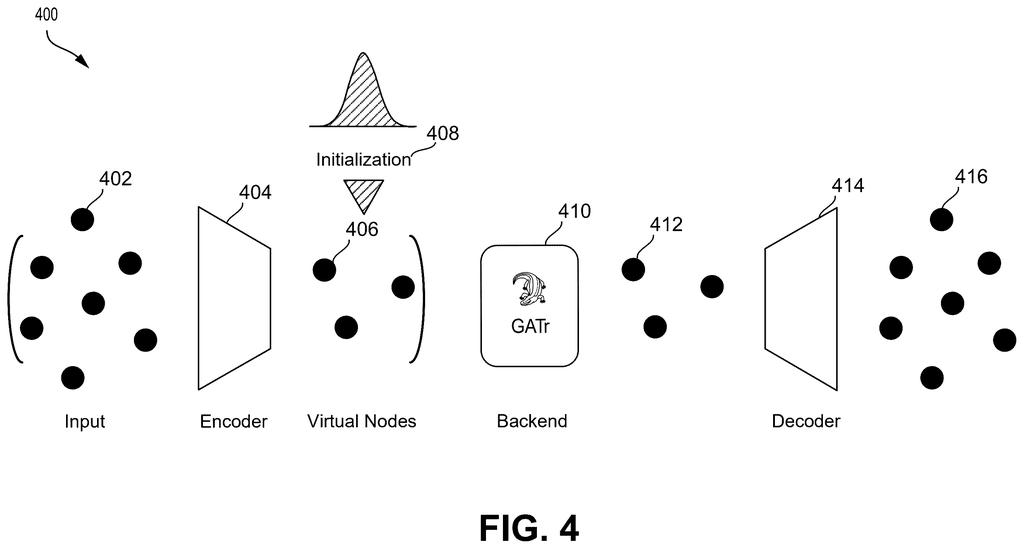
Qualcomm's patent describes a technique where the AI uses something called a virtual node, a kind of shared notepad that all parts of the model can read and write to at the same time. Instead of each piece of the scene passing messages back and forth the slow, old-fashioned way, they all communicate through this central hub. The result is a model that can grow larger and handle more complex scenes without the extra size causing it to lose its sense of direction in 3D space.
This matters most for tasks like mapping a room, recognizing objects from different angles, or understanding a physical environment from sensor data on a device. If you've ever used a phone or headset that seemed to understand the space around you, this is the kind of math running under the hood.
embed information generated from multivector inputs processed from input data associated with a three-dimensional space to a virtual node; process the multivector inputs using the virtual node to obtain a set of virtual tokens …
Translation: The system converts raw 3D spatial data into digital building blocks that the AI can easily understand and manipulate.
How virtual nodes keep rotations and translations consistent
The patent centers on a type of AI model called a geometric algebra transformer (GAT), which is an architecture designed to process 3D data while respecting the physics of real space. Specifically, it keeps its answers consistent whether the input is rotated or shifted, a property called equivariance (meaning: rotate the input, and the output rotates the same way, rather than giving you a different answer).
The core invention is the virtual node: an extra computational node that doesn't correspond to any real point in 3D space. Instead, it acts as a global information broker. All the real data points (called multivectors, which are mathematical objects encoding position, direction, and other geometric properties) feed their information into this virtual node, which then broadcasts a summary back to everyone.
- Embedding step: geometric information from the real input points is packed into the virtual node.
- Processing step: the model uses the virtual node alongside the real points to produce a richer set of virtual tokens (chunks of information ready for transformer processing).
- Transformer step: a geometric algebra transformer processes these tokens and produces outputs that remain spatially consistent, equivariant with respect to both translations (sliding things around) and rotations (spinning them).
The practical gain is that this global communication channel lets the model scale to larger, more complex 3D inputs without the usual accuracy trade-offs that come from making such models bigger.
… processing, via a geometric algebra transformer, the set of virtual tokens to generate a set of output virtual tokens that are equivariant with respect to translations and rotations to the input data.
Translation: The AI uses a special mathematical tool to ensure that if an object moves or spins in real life, the data stays accurate.
What this means for AI running on Qualcomm chips
For anyone using a device powered by Qualcomm silicon, such as a high-end Android phone, an XR headset, or an automotive sensing system, this kind of work sits upstream of features like spatial awareness, object recognition in 3D, and real-time scene understanding. A model that stays accurate as it scales means those features can get more capable without requiring more power or separate hardware.
The filing fits into a broader Qualcomm push to make AI inference run efficiently on-device rather than in the cloud, and the emphasis on geometric consistency points toward applications in robotics, AR/VR, and autonomous systems. Qualcomm is clearly betting that the next wave of on-device AI will need to reason about 3D space, and tracking new Big Tech patents in geometric AI and on-device inference shows this kind of spatial-reasoning architecture is becoming a serious engineering priority across the industry.
If you're the person using a Qualcomm-powered headset or a phone doing real-time 3D mapping, the payoff from this patent is that future versions of those features could handle messier, more complex scenes without draining your battery or dropping accuracy. The virtual node trick is a relatively clean architectural fix to a real scaling problem, and preserving rotational and translational consistency throughout means the AI won't start hallucinating directions as inputs get bigger. Structural work like this surfaces later as 'why does this phone handle 3D so well.'
There are more where this came from
We read every patent application Big Tech publishes and send you the ones worth knowing. Plain English, free, every week.
The drawings
7 drawing sheets from US 2026/0236553 A1 · click any drawing to enlarge


Want this weekly breakdown for a company we don't cover? Patentlyze Pro →
Be the first to weigh in