
Qualcomm Files Patent to Help Robot AI Focus on What It Holds and Skim the Rest
Qualcomm's patent application has a robot's AI study its own gripper in fine detail while treating everything else in the camera view as a rough sketch. In its example, that cuts 256 pieces of image data down to 16.
What Qualcomm's gripper-first image trick does
Ever reached for a mug on a cluttered desk? You study the mug and your own hand closely, while the stapler, notebook and pens just register as "stuff over there." That is the trick behind this Qualcomm patent application.
Robot AI that reads camera images usually chops the picture into a grid of small squares and examines every one separately. In the filing's example that is 256 squares, and it takes a lot of computing power. Qualcomm's approach outlines the objects first, picks the one that matters (say, a robot's gripper), and keeps its detail intact. Every other object gets boiled down to a single summary, so 256 pieces become 16.
The AI model that decides what the robot does next then has far less to chew through. The filing says that could let a training job run on one graphics-processor node instead of eight.
… identify a first subset of patches from a set of patches of the image that corresponds to an object of interest from the plurality of objects; extract features from each patch of the first subset of patches corresponding to the object of interest to generate visual tokens representing the object of interest …
Translation: The system zeroes in on the main item being held to analyze it in high detail.
How Qualcomm shrinks 256 image pieces to 16
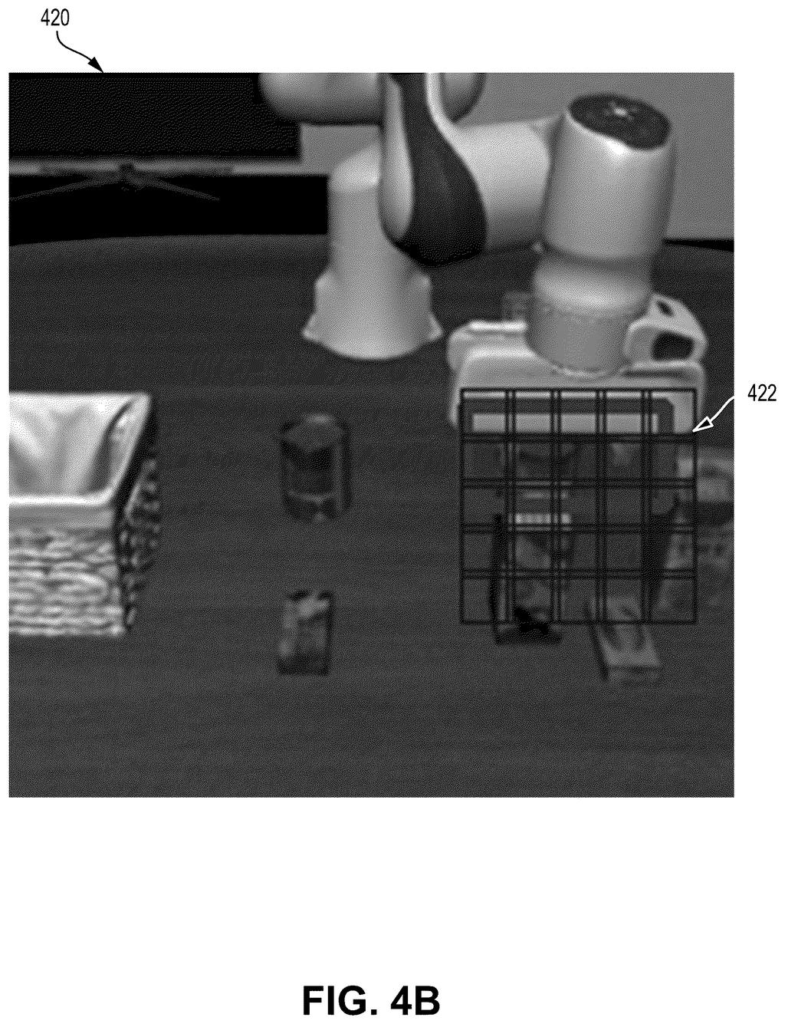
The system starts with a camera image of a scene, such as a robot arm over a cluttered table. A segmentation model (software that outlines which pixels belong to which object) makes a mask for each object. The image is also cut into a grid of patches, 16 by 16 in the example, and an image encoder (a neural network that turns each patch into a list of numbers) summarizes each patch as a visual token.
Then the objects get different treatment:
- Object of interest (the gripper): every patch it covers keeps its own token. A 3×3 patch grid gives nine tokens with little or no compression.
- Every other object: its patch tokens are merged into one, by averaging, max-pooling (keeping the strongest values), attention pooling, or a small transformer.
The example ends up with sixteen tokens. A projector (a translation step that makes image data readable to a language model) passes them to a large language model along with the user's text instruction, such as "pick up the red block." The output can be movement, angle or grip measurements, or control signals for a motor, valve, solenoid, actuator or electromagnet.
The filing also describes folding several video frames of one object into a single "history token," giving the model a memory. Eight frames at 256 tokens each would otherwise mean 2,048 tokens.
… combines the extracted features from each patch of the second subset of patches to generate a combined visual token representing the additional object …
Translation: Everything else in the background gets lumped together into a single simplified summary.
Why cheaper robot vision matters for Qualcomm chips
The practical payoff is computing cost. Image-reading AI slows down and gets hungrier as the data it handles grows, and a robot that pauses before every move is not much use. By cutting image data from 256 pieces to 16, the filing says, a training job that needed eight graphics-processor nodes could run on one. The description also says the savings should help most on edge devices (hardware that runs the AI locally, not in a data center).
Qualcomm designs chips for phones, cars and headsets, and the filing names robots, self-driving cars and AR or VR headsets as places this could apply. It even mentions steering and braking commands from vehicle cameras. If the idea works, you might notice it as a device that reacts sooner and needs less computing power to do so.
This is the 24th Qualcomm filing in Enterprise AI we've tracked since May, joining work like faster chip data loading and one to sharpen grainy photos.
If this works, you would never see it. What you would notice is a robot arm or a car camera system that reacts a beat sooner because its AI is not studying every corner of every frame. That is the failure it targets: a machine that stalls while chewing through a cluttered scene.
The catch is the squeezed background. Folding a whole object into one summary can drop fine detail. The filing's answer is to keep full detail on the thing being controlled and anything close to it, and it describes treating objects within 10 centimeters of the gripper that way. The text we saw gives no test of whether that holds up when a small, unexpected object suddenly matters.
Overall it is a sensible efficiency upgrade. The clearest value goes to the people who build and train these systems, and everyone else gets the payoff later, as speed.
Get our take in your Top Stories
Liked this breakdown? Add Patentlyze as a preferred source on Google, and our plain-English take shows up more often in your Top Stories the next time Qualcomm patent news breaks.
There are more where this came from
We read every patent application Big Tech publishes and send you the ones worth knowing. Plain English, free, every week.
The drawings
14 drawing sheets from US 2026/0340974 A1 · click any drawing to enlarge


Show the other 6 sheets


Want this weekly breakdown for a company we don't cover? Patentlyze Pro →
Be the first to weigh in