
Nvidia
Rivian · Automotive · Filed May 14, 2025 · USPTO published Nov 19, 2026 · This week's release
Rivian Files Patent for Front Lights Built to Break Away in a Pedestrian Crash
Rivian's patent application turns the center lamp on the front of a truck or SUV into a part that gives way. Small plastic tabs are built to snap when a pedestrian is struck.
- Publication number
- US 2026/0365100 A1(US20260365100A1)
- Applicant
- Rivian IP Holdings, LLC
- Filed · Published
- May 14, 2025 · Nov 19, 2026
- Inventors
- Baha Jehad Husni EL FAR, Daniel CALDER, Siobhan Marie CASEY, Ignacio PEON ZAPATA, Shubham Prakash KULKARNI, Stephen KOWAL
- Status when we published
- Examiner raised objections; the company can respond
- Document
- 22 claims
- US classification
- 362/549
- Examiner
- MAY, ROBERT J (Art Unit 2875)
What Rivian's breakaway center lamp actually does
Ever wondered what happens when a vehicle hits someone and the first thing they meet is a rigid, bolted-down light? That hard point is what Rivian is trying to soften in this patent application.
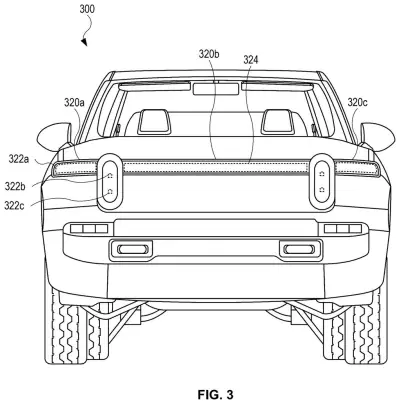
Here is the idea. The lamp in the middle of the front end is held in place by small plastic tabs that are designed to snap when something pushes on the lamp hard enough. Once they break, the lamp and its housing can slide backward into an open space behind them instead of acting like a fixed block. The larger pieces that hold everything to the vehicle stay attached.
The filing also describes a hollow, box-shaped piece behind the lamp that soaks up some of the force, with a gap of roughly 15 millimeters between it and the lamp. The company says the goal is a safer experience for people on foot.
… in response to an applied force, the first tab is configured to break and permit movement of the lamp housing relative to the first portion and the second portion …
Translation: When hit hard, a specific tab snaps so the headlight can move out of the way.
How the snap-off tabs on the lamp bracket work
The filing covers a mounting setup for a vehicle's center lamp, the one that sits between the two headlights. It has three main parts: a carrier (the frame that holds the front lamps), a bracket (a small plastic mount fixed to the carrier), and a lamp housing (the shell that holds the lamp).
The bracket and the housing both have thin tabs, which are small flaps with holes for bolts. Those tabs are the weak points on purpose. When enough force hits the lamp, they break, and the lamp and its housing can move relative to the bracket and carrier.
A few details from the claims and description:
- The bracket has several sections, and the breakable tabs sit at right angles to the main section, with a deliberate gap that gives the lamp room to travel.
- Ribs (raised reinforcing ridges) strengthen other parts of the bracket so they resist force from other directions and stay attached.
- The bracket is plastic, and the claims add embedded fibers for extra strength.
- Two sections of the bracket pass through slots in the carrier, giving more places to secure it.
The filing also describes a hollow rectangular body behind the lamp, meant to absorb force from a pedestrian's pelvis hitting the front end.
Each of the bracket and the lamp housing includes tabs designed to break in response to an applied force to the lamp and/or the lamp housing, thereby permitting movement of the lamp and the lamp housing relative to the carrier and the bracket.
Translation: Special tabs on the headlight parts are meant to snap during a crash so the whole light shifts safely.
Why a softer front end matters for pedestrians
If you walk, bike or cross streets, the shape and stiffness of a vehicle's front end matters. Hard, fixed parts hurt more than parts that give way. This filing goes after one such part, the center lamp, with a cheap mechanical fix: tabs that snap, a gap to move into, and a block behind to absorb force.
For Rivian, the filing's example vehicles are a truck and an SUV, both tall front ends where pedestrian protection is a real design concern. The application is at an early stage: the examiner's first review rejected the claims as filed, which is routine and usually leads to amendments. Nothing here says the design is in any vehicle today.
Source: US 2026/0365100 A1 at the USPTO (PDF). Full patent text and figures are in the official publication.
Get our take in your Top Stories
Liked this breakdown? Add Patentlyze as a preferred source on Google, and our plain-English take shows up more often in your Top Stories the next time Rivian patent news breaks.
Add Patentlyze on Google
One click.
There are more where this came from
We read the new patents from Big Tech, carmakers and more and send you the ones worth knowing. Plain English, free, every week.
The drawings · 11 sheets
11 drawing sheets from US 2026/0365100 A1 · click any drawing to enlarge


Show the other 3 sheets


No comments yet