
Waymo Files Patent for a Car That Notices When a Pedestrian Starts to Fall
Waymo's patent application teaches a self-driving car to read body posture, so it can notice a pedestrian or cyclist slipping before they hit the ground. The car then slows down or steers away instead of reacting after the fact.
What Waymo's fall-detection patent actually does
Every time someone slips on an icy crosswalk or a cyclist clips a pothole, the next couple of seconds decide whether a nearby car makes things worse. A human driver might brake on instinct. A self-driving car has to notice the stumble first.
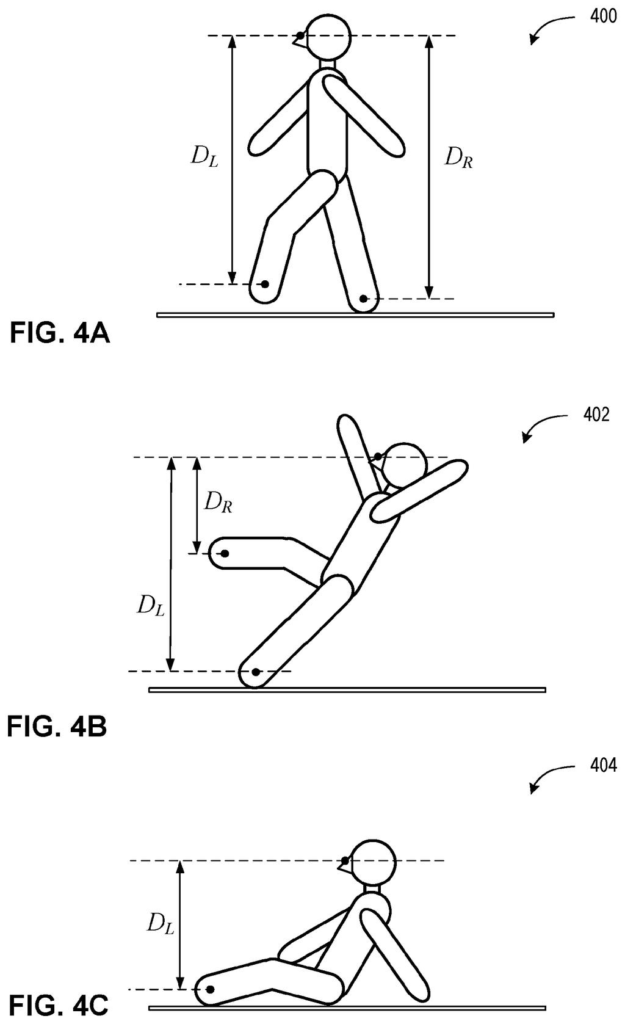
Waymo's patent application describes a way to do that by treating a person's body like a stick figure. The car's sensors pick out points such as the nose and the ankles, then track how far apart they sit vertically. If that gap shrinks suddenly, and the person is also slowing down hard, the car decides they may be falling and eases off or moves away.
The filing also describes a lying-down score from 0 (standing) to 1 (flat on the ground), so the car can react to someone who is already on the pavement. If the car is close, it can stop at the roadside and ask a remote human helper what to do.
… determining that the VRU is at risk of loss of control, based at least on a change of the one or more height differentials, and causing a control system of the autonomous vehicle to perform an avoidance action.
Translation: The vehicle calculates changing height data to recognize when a pedestrian is falling and triggers an emergency response.
How Waymo's car tracks nose-to-ankle height
The car's cameras, lidar (laser-based distance sensors) and radar capture the scene. A machine learning model crops out each vulnerable road user, such as a pedestrian, cyclist, scooter rider or wheelchair user, and marks reference points on the body: nose, chin, top of the head, knees, ankles. For a motorcyclist, it can use points on the helmet instead.
From those points the system computes a height differential, the vertical gap between an upper point and a lower one, and tracks it frame by frame. A sudden drop past a set threshold, or a fast enough rate of change, signals a possible fall. To avoid false alarms from someone bending to tie a shoe, the system also checks for hard negative acceleration (a sudden loss of forward speed).
A second model outputs a prone state score, a number from 0 (upright) to 1 (lying on the ground). The filing says this score can feed the decision alongside height or in its place. Filters skip people who have been tracked too briefly, are too blocked from view, are too far away to matter yet, or are of a type the method handles poorly, such as a child in a stroller.
When a risk is flagged, the vehicle's control system can respond in several ways:
- Brake or ease off the throttle
- Nudge sideways within the same lane
- Move to a lane farther from the person
- Stop at the roadside if within roughly 6 to 10 meters, and ask a remote human assistant for guidance
Why a car that sees falls coming matters
The practical payoff is time. A car that waits until someone is on the ground has less room to stop, while one that reads the first moment of a slip can slow down early. That matters most for people with no steel body around them: walkers, cyclists, scooter riders and motorcyclists.
The filing also points to a legal and ethical wrinkle. A car can cause a fall without touching anyone, say by making a cyclist swerve, and the vehicle may be expected to stay at the scene. The patent describes detecting that situation and pulling over. It also says the same ideas could work in driver-assistance systems that stop short of full self-driving.
Google's 78th filing we've tracked since May on robotaxi sensing work joins earlier applications on blind-spot double turns and zooming in on brake lights.
Claim 1 is written wide. It says an autonomous machine, which covers a delivery robot or a warehouse vehicle as easily as a car. It also says a vulnerable obstacle, and that claim never limits the obstacle to a person. The core test is that points on the obstacle shift along some direction, and a risk event follows from that change.
The narrower details sit in the add-on claims: height as the measurement, a person as the target, one point on the upper body and one on the lower body, thresholds, and acceleration. Claim 17 takes a separate route built on the lying-down score, and it does not require the height measurement at all.
If granted, that breadth would cover any machine that reads body posture to decide it should brake or swerve. The claims say nothing about how well the detection works, so the useful test is how rarely it mistakes a person tying a shoe for a fall.
Get our take in your Top Stories
Liked this breakdown? Add Patentlyze as a preferred source on Google, and our plain-English take shows up more often in your Top Stories the next time Google patent news breaks.
There are more where this came from
We read every patent application Big Tech publishes and send you the ones worth knowing. Plain English, free, every week.
The drawings
8 drawing sheets from US 2026/0346875 A1 · click any drawing to enlarge


Want this weekly breakdown for a company we don't cover? Patentlyze Pro →
Be the first to weigh in