
Apple
Apple · Wearable · Filed Jul 8, 2026 · USPTO published Nov 19, 2026 · This week's release
Apple Files Patent for a Wearable That Hears Words You Never Say Aloud
Apple's patent application describes an earbud or pair of glasses that reads the tiny muscle movements in your face, so you can talk to an AI assistant without making a sound. It even tries to tell whether you paused to think or finished your question.
- Publication number
- US 2026/0369274 A1(US20260369274A1)
- Applicant
- APPLE INC.
- Filed · Published
- Jul 8, 2026 · Nov 19, 2026
- Inventors
- Yonatan Wexler, Asaf Kagan, Oren Amsalem, Michael Doron
- Status when we published
- Waiting for an examiner
- Document
- 20 claims
- US classification
- 704/231
- Parent application
- Continuation of PCT/IB2025/059025 (filed Sep 8, 2025)(PCTIB2025059025)
What Apple's silent-speech wearable actually does
Ever tried to ask your phone a question on a packed train and felt silly speaking out loud? Apple has a patent application for a head-worn gadget that lets you mouth the words with no sound at all and still be understood.
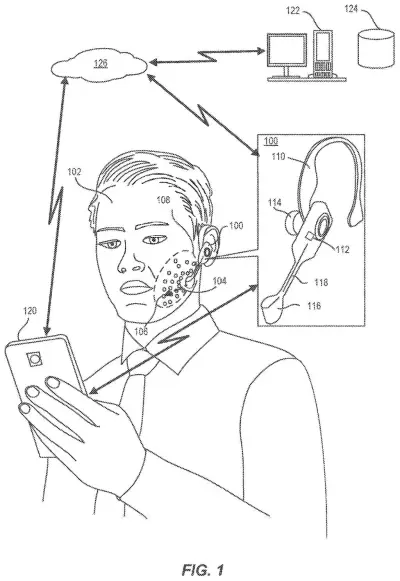
The idea is that a small device on your ear or face senses the tiny muscle movements your face makes when you form words. Software turns those movements into what you meant to say, then answers you privately, perhaps through a speaker in your ear. The filing also covers some friendly extras: a reminder of an earlier topic after you have moved on to another, and replies that copy your own speaking style.
It also tries to judge whether you stopped mid-question because you were thinking or because you were done, so an assistant does not jump in too early.
… at least one sensor incorporated with the housing and configured to output signals indicative of communication-related neuromuscular activity of the individual …
Translation: Sensors built into the headset track the tiny muscle movements you make when trying to speak.
How the sensor reads tiny movements in your face
The claimed system has three parts: a housing worn on the head, a sensor, and a processor. The sensor produces signals tied to neuromuscular activity (the nerve and muscle activity that happens when you form words). The processor works out the substance of a conversation event, meaning what you actually said or meant, and then generates an output such as audio, text or a command.
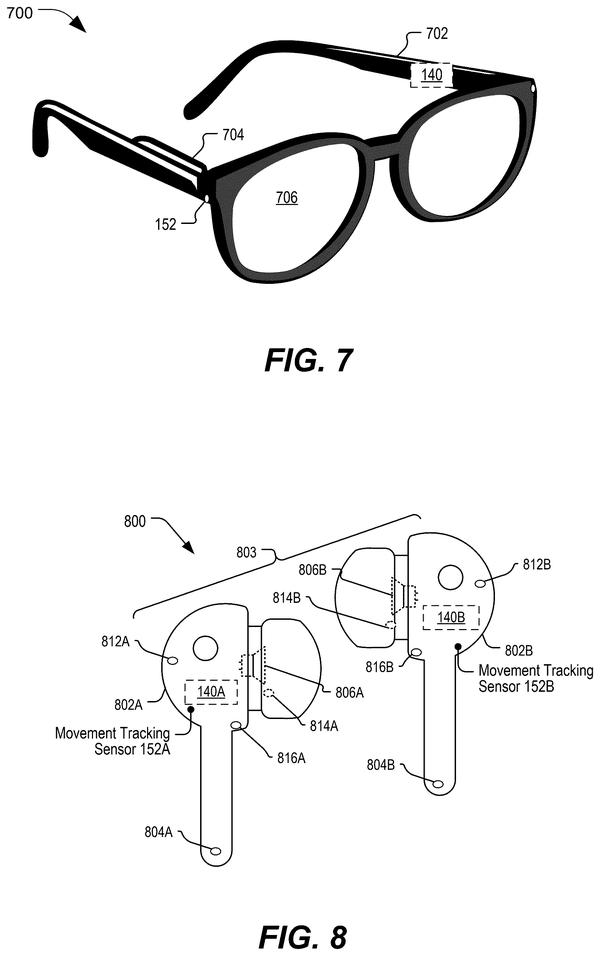
The description fills in the how. The housing can be an earbud, glasses or a headset. In the main example, a light source shines laser light on your cheek and a detector watches how it scatters off the skin. The light forms a grainy pattern (called speckle) that shifts when facial muscles move, even by tiny fractions of a millimeter. A trained neural network (software that learns patterns from many examples) turns those shifts into words, and the filing says it can be fine-tuned to a new wearer within minutes. One claim also covers sensing activity tied to a cranial nerve (the nerves that run from the brain to the face).
The dependent claims add specific behaviors:
- Topic reminders: after you move to a second topic, you get a private reminder of the first.
- Speaking style: it picks up your cadence, tone and volume and answers in a matching manner.
- Pause checks: it decides whether a pause means you are still forming a question or are done, then holds the query or sends it to the assistant.
- Turn-taking: it tracks the back-and-forth with another person or a large language model (the AI behind chatbots).
… analyze the received signals to determine substance of at least one conversation event associated with the individual …
Translation: A computer processor decodes those muscle signals to figure out what you are silently trying to say.
What silent speech could change for Apple's assistant
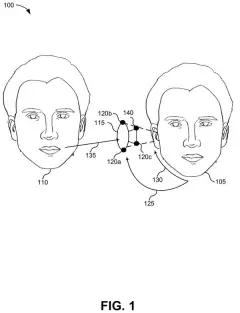
If you have ever hesitated to talk to your phone on a train, in an office or in a waiting room, this is the problem being attacked. A device that reads your mouthed words lets you ask an assistant a question or send a command privately, with no sound for anyone nearby to hear. The filing also shows two people each wearing a device and talking silently to one another.
For Apple, the pieces line up with hardware people already wear: earbuds and headsets are among the head-worn housings the filing names, and it lists glasses and extended reality headsets too. The assistant-focused claims (reminders of earlier topics, waiting out your pauses, matching your speaking style) aim to make a voice helper feel more like a conversation than a string of commands.
This is the 14th Apple filing we've tracked since May on our wearables reading your body watch, following one on head-tilt voice cutoff and another on gesture voice shortcuts.
Source: US 2026/0369274 A1 at the USPTO (PDF). Full patent text and figures are in the official publication.
Get our take in your Top Stories
Liked this breakdown? Add Patentlyze as a preferred source on Google, and our plain-English take shows up more often in your Top Stories the next time Apple patent news breaks.
Add Patentlyze on Google
One click.
There are more where this came from
We read every patent application Big Tech publishes and send you the ones worth knowing. Plain English, free, every week.
The drawings · 14 sheets
14 drawing sheets from US 2026/0369274 A1 · click any drawing to enlarge


Show the other 6 sheets


More from Apple
All 748 Apple patents →
More in Hardware
All 2,355 Hardware patents →
Sony
Sony Files Patent for a Wearable That Flags Its Own Bad Heart Rate Readings
Samsung
Samsung Patents a Wearable That Uses Skin Temperature to Know How You're Wearing It
Google
Google Files Patent to Fix Smartwatch Health Sensor Lights That Dim With Age
Qualcomm
No comments yet