

OpenAI
OpenAI · Wearable · Filed May 14, 2026 · USPTO published Nov 19, 2026 · This week's release
A New OpenAI Patent Describes Earbuds That Pick Up Words You Only Mouth
OpenAI has filed a patent for an earbud that can work out which words you are silently mouthing, just by feeling your ear canal move. No microphone needed to hear you, because you never make a sound.
- Publication number
- US 2026/0369273 A1(US20260369273A1)
- Applicant
- OpenAI OpCo, LLC
- Filed · Published
- May 14, 2026 · Nov 19, 2026
- Inventors
- Douglas Stuart Brodie, Daniel Boothe
- Status when we published
- Waiting for an examiner
- Document
- 20 claims
- US classification
- 704/271
- Parent application
- Claims priority from a provisional application 63805864 (filed May 14, 2025)
What OpenAI's silent-speech earbud actually does
A commuter sits on a packed train, lips moving slightly, saying nothing out loud. Nobody around her notices, but the earbud in her ear is paying close attention.
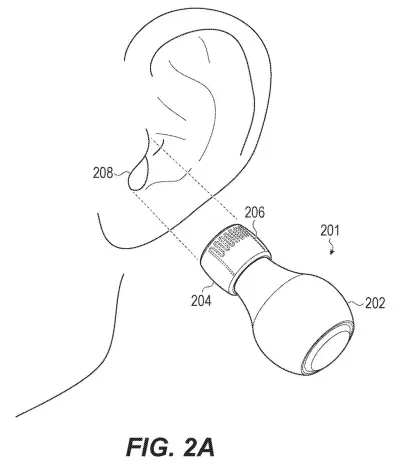
That is the idea in this OpenAI filing. When you form words with your mouth, your jaw joint (the hinge just in front of your ear) shifts, and the shape of your ear canal changes with it. A small sensor in the earbud feels those tiny movements, and software turns the pattern into words.
Those words could become a text message, a command to your phone, or speech played into someone else's earbud. The filing also describes training the system on your own mouthing of sample words, so it can learn how your jaw moves.
detect motion of the ear canal resulting from articulation of a mouth of the user corresponding to a nonvocalized expression of one or more words …
Translation: It senses how your ear canal moves when you mouth words without speaking out loud.
How an earbud reads your jaw from inside the ear
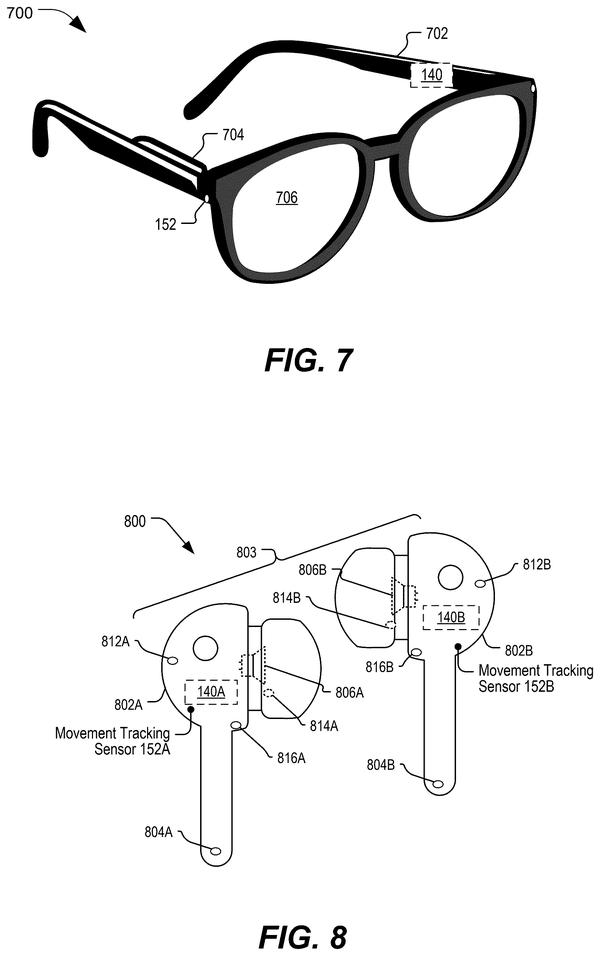
The core device is an earbud-style body that sits partly inside your ear canal. Inside it, a sensing system picks up movement of the ear canal caused by your mouth shaping words without sound. A processing system then turns that movement data into a representation of the words, which can be text or a string of speech sounds.
The filing describes two ways to sense this. One uses a motion sensor, such as an accelerometer (a chip that measures movement) or an inertial measurement unit (an accelerometer plus a gyroscope that tracks rotation). The other uses a flexible tip, made of something like silicone, pressed against the ear canal wall. A strain gauge (a sensor that detects stretching or bending) is built into that tip and notices when the canal changes shape.
A machine learning model (software that learns patterns from examples) does the translation. In the described version it guesses which of the roughly 44 English speech sounds you made, then groups those sounds into words. It can be trained on you saying a set of sample words silently.
The earbud can also send the result over a wireless link to a phone or another device, which might speak the words aloud. A separate claim adds a bone conduction microphone that picks up speech below about 30 decibels, quieter than a whisper.
… a processing system operatively coupled to the sensing system and configured to generate, based on the motion information, a representation of the one or more words …
Translation: A computer chip turns that ear movement data back into readable words.
Why silent talking could change how you use earbuds
The practical pitch is talking to your devices in places where talking is awkward: a quiet office, a crowded train, a library. Instead of speaking a command to a voice assistant or typing on a screen, you would just mouth it. The filing also describes two people messaging each other silently, with replies played privately in each other's ears.
For OpenAI, the patent shows interest in new ways to feed words into AI, beyond keyboards and microphones. The filing describes the words driving AI assistants, such as composing messages or updating schedules. It is a patent application, so nothing here says a product is coming.
That makes this OpenAI's 52nd filing in our OpenAI coverage since May, adding to work like shared project folders and chat-built apps.
Source: US 2026/0369273 A1 at the USPTO (PDF). Full patent text and figures are in the official publication.
Get our take in your Top Stories
Liked this breakdown? Add Patentlyze as a preferred source on Google, and our plain-English take shows up more often in your Top Stories the next time OpenAI patent news breaks.
Add Patentlyze on Google
One click.
There are more where this came from
We read every patent application Big Tech publishes and send you the ones worth knowing. Plain English, free, every week.
The drawings · 7 sheets
7 drawing sheets from US 2026/0369273 A1 · click any drawing to enlarge


More from OpenAI
All 58 OpenAI patents →
More in Hardware
All 2,355 Hardware patents →
Sony
Sony Patents Earbuds That Filter Out Noise from Your Health Readings
Samsung
Samsung Patents Earbuds That Work Out What You're Doing From Sound and Movement
Qualcomm
Qualcomm Files Patent for an Earbud Sensor That Hears Your Voice Through Bone
Samsung
No comments yet