
Salesforce Patents Chatbot Memory That Shrinks Old Topics and Keeps the Relevant Ones
Most chatbots either re-read your whole conversation or forget everything except the last few messages. Salesforce's filing describes a third option: rebuild the history for each new question, keeping only the relevant parts in full.
What Salesforce's chatbot memory trick does
Imagine you've spent an hour with a work chatbot. First you asked it to write a haiku, then to look up a customer, then to draft an email. Now you ask it to change one word in that haiku. To answer, the bot needs the haiku, but it doesn't need every word of the customer lookup.
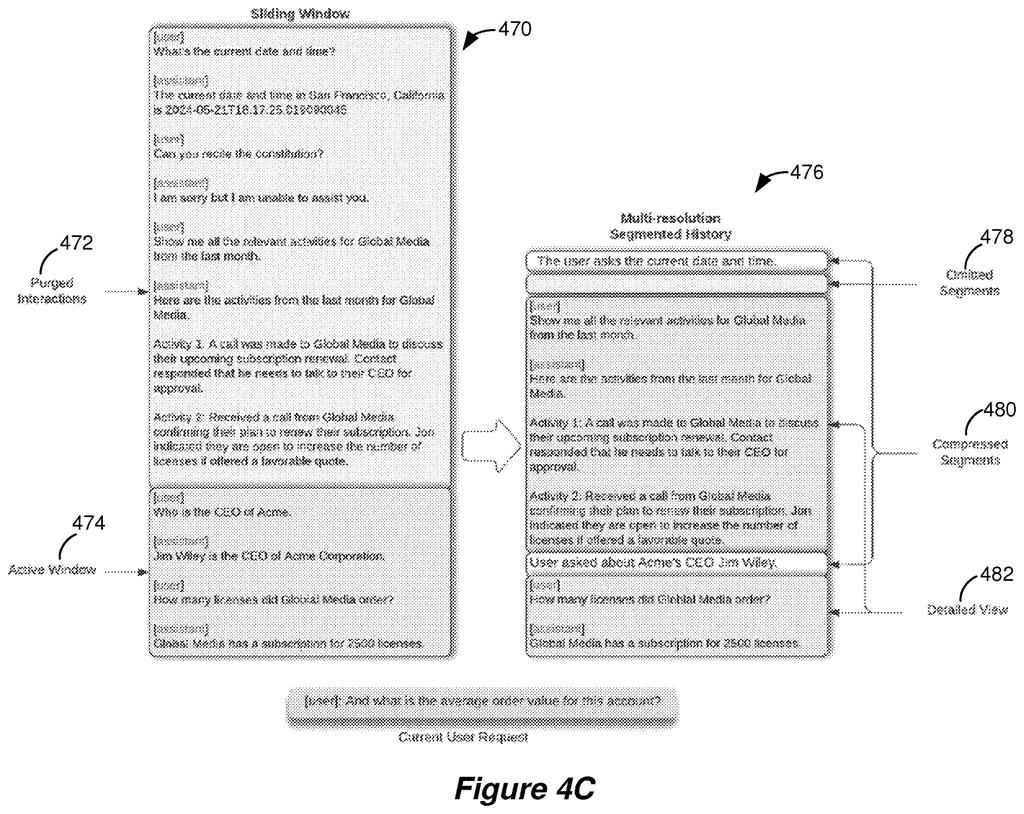
Most chatbots handle this crudely. They either re-read the entire conversation every time, which gets slow and costly, or keep only the last few messages and forget the rest. Salesforce's filing describes a middle path. It chops the conversation into topics, saves shorter summaries of each, and for every new question rebuilds a version of the history that keeps the relevant parts in full and squeezes the rest.
The result is a shorter prompt that still contains what the bot needs to answer you.
… estimating, for at least a first segment of the plurality of segments, a level of relevance to a query; selecting a compressed segment from the one or more compressed segments, based, at least in part, on the level of relevance to the query; …
Translation: The system figures out which past topics matter before shrinking the rest.
How old chat segments get shrunk and ranked
The filing starts with a conversation history, the running record of earlier requests and replies that gets bundled into a prompt (the text instructions sent to the language model). The system divides that history into segments, usually by topic or task. It can also use fixed chunks of a set number of turns, which is faster.
For each segment it generates one or more compressed versions, often by asking a language model to summarize it. One example instruction asks for a single sentence with names, dates and records stripped out. Another keeps record IDs, names and dates. Zero compression is also an option, so the full original can be one of the stored versions. This happens once per segment and the results are saved for reuse.
When a new question arrives, the system estimates how relevant each segment is. The filing lists four ways to do that:
- Word-overlap scoring (TF-IDF and BM25, which reward shared rare words)
- Embedding similarity (turning text into lists of numbers and measuring how close they are)
- Mutual information (a measure of how much one text reveals about another)
- Asking a language model how likely the question is to follow that segment
Highly relevant segments get the detailed version, weaker ones get a summary, and a segment scoring zero can be dropped. The pieces go back together in chronological order and are sent to the model with the question.
A compressed segment is selected from a set of segments including the compressed segments, based, at least in part, on the level of relevance to the query.
Translation: The chatbot picks the most useful condensed memories to answer your question.
Why cheaper, shorter prompts matter for CRM bots
If you use a business chatbot for a long working session, longer prompts mean slower answers and higher computing bills. The filing also says language models can perform worse as prompts grow. Trimming the history to what your current question needs could keep replies quick while the bot still remembers the thing you asked about an hour ago.
Salesforce's description is framed around CRM work, where a sales rep's questions tend to circle one deal or one customer. A bot that can restore an old record in full detail and shrink everything else fits that pattern. The filing doesn't name a product, so treat it as a look at how the company thinks about chatbot memory.
Salesforce's fifth filing we've tracked since July in our assistants that remember you watchlist builds on one that logs past conversations, and one that ranks saved messages.
Every shortcut here is a bet about what you will ask next. Summaries drop detail on purpose, and the filing's own example of a tight summary removes names, places and dates. If the relevance score ranks an old topic as unimportant and you circle back to it, the chatbot works from a thin note instead of the real exchange.
There are other costs. Something has to cut the chat into topics, write each summary and store several versions of every segment. The filing softens that bill by summarizing each segment once and reusing it, which avoids redoing the work for every question.
The trade looks worth it for long work sessions, where a fixed window of recent messages forgets older topics outright. The weak point is the relevance scoring, and the filing offers four ways to do it without saying which one holds up best.
Get our take in your Top Stories
Liked this breakdown? Add Patentlyze as a preferred source on Google, and our plain-English take shows up more often in your Top Stories the next time Salesforce patent news breaks.
There are more where this came from
We read every patent application Big Tech publishes and send you the ones worth knowing. Plain English, free, every week.
The drawings
15 drawing sheets from US 2026/0350073 A1 · click any drawing to enlarge


Show the other 7 sheets


Want this weekly breakdown for a company we don't cover? Patentlyze Pro →
Be the first to weigh in