
Salesforce Patents a Faster Way to Build Custom Versions of Its Apps
Every time a business wants a tweaked version of a Salesforce app, someone has to rebuild it from scratch. This patent describes a way to skip most of that work by packaging the original app into a reusable container image.
What Salesforce's container-based custom app builds actually do
Imagine a bakery that makes the same base cake every day, then customizes each one for individual orders. Right now, the baker starts from raw flour every single time, even if the base cake hasn't changed at all. That's roughly how many enterprise software builds work today.
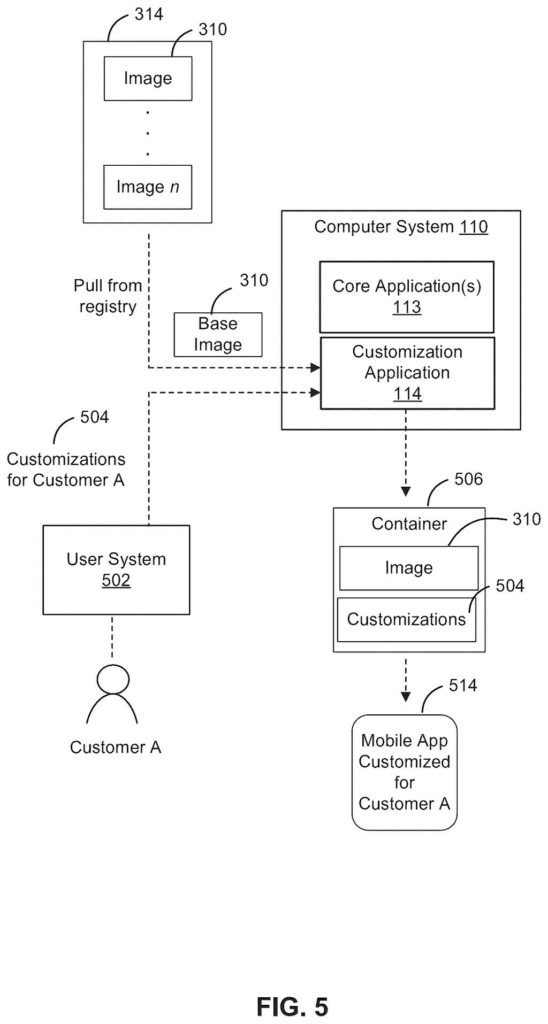
Salesforce's patent describes a system that bakes the base cake once, freezes it, and then only adds the custom frosting for each customer. It takes the original app's code, bundles it into a self-contained package called a container image, and saves the intermediate work (the "build cache") so it doesn't have to be redone.
When a business needs a customized version of that app, the system pulls out the pre-built package and applies just the specific changes requested. The result is a personalized app that took far less time and computing power to produce than rebuilding from zero each time.
How the build cache and container image speed up customization
The patent describes a three-stage pipeline for producing customized software applications without repeating expensive build work.
- Stage 1 - Base build: The system compiles the original ("base") application from its source code and any assets it needs, such as images or configuration files. A build cache (a saved record of every intermediate compilation step) is captured at this point, so future builds can skip steps that haven't changed.
- Stage 2 - Containerization: The compiled app, its assets, and the build cache are packaged together into a containerized software image file (think of a container like a self-contained shipping box that holds everything the app needs to run, isolated from the rest of the computer).
- Stage 3 - Customization: When a customer or tenant needs a personalized version, the system reads the pre-built container image and applies only the requested customizations on top of it, producing a finished custom app without re-running the full compilation from scratch.
The core efficiency gain is that the slow, compute-heavy work of building the base app happens only once. Every subsequent customized variant reuses that work rather than repeating it, which is especially valuable when hundreds or thousands of customers each need slightly different configurations.
What this means for businesses running custom Salesforce software
For businesses running Salesforce software, this is fundamentally a speed and cost question. Rebuilding an entire application every time a customer wants a different logo, a different data field, or a different workflow wastes server time and delays delivery. A container-image approach means your customized instance of a Salesforce product could be generated and updated far faster than it is today.
For Salesforce as a company, this matters at scale. The company serves hundreds of thousands of businesses, many of whom run custom-configured versions of the same core products. Any system that cuts the compute cost of generating those variants has a direct impact on infrastructure spending and the speed at which new product updates can be rolled out to every customer at once.
This is unglamorous but genuinely useful engineering. Caching build artifacts inside container images is a well-known technique in software infrastructure, so the novelty here is in how Salesforce applies it specifically to the multi-tenant, high-customization world of enterprise SaaS. It's the kind of patent that probably reflects real internal pain they're solving rather than a speculative land-grab.
There are more where this came from
We read every patent application Big Tech publishes and send you the ones worth knowing. Plain English, free, every week.
The drawings
8 drawing sheets from US 2026/0219861 A1 · click any drawing to enlarge


Want this weekly breakdown for a company we don't cover? Patentlyze Pro →
Be the first to weigh in