Samsung
Samsung · Networking · Filed Jan 7, 2025 · USPTO published Aug 27, 2026 · Aug 27 release
Samsung Patent Would Auto-Delete Stale AR Frames Before They Glitch Your Headset
When a wireless network falls behind delivering frames to an AR headset, the worst outcome is showing the user a frame that's already too old to be useful. Samsung's new patent describes a way to automatically throw those stale packets away before they can cause a visual glitch.
- Publication number
- US 2026/0255215 A1(US20260255215A1)
- Applicant
- Samsung Electronics Co., Ltd.
- Filed · Published
- Jan 7, 2025 · Aug 27, 2026
- Inventors
- Vinay Kumar SHRIVASTAVA, Sriganesh RAJENDRAN, Aby Kanneath ABRAHAM
- Status when we published
- Waiting for an examiner
- Document
- 15 claims
- US classification
- 370/329
- Parent application
- National Stage Entry of PCT/KR2023/009990 (filed Jul 13, 2023)(PCTKR2023009990)
How Samsung cuts AR freeze-frames in 5G streaming
Every time your AR headset or VR glasses render a moving scene over a 5G connection, the network is shipping dozens of tiny data chunks per second. If the connection hiccups, some of those chunks arrive late, and showing a late frame is often worse than skipping it entirely.
Samsung's patent sets up a countdown clock tied to each group of packets that make up a single video frame. When the clock runs out, any packets from that group still sitting in the queue get automatically deleted rather than sent. The device never has to try to display a frame that's already stale.
The system also handles a trickier edge case: what if the countdown on the first packet expires, but later packets from the same frame arrive afterward? The patent spells out rules for handling both situations, so the whole frame is either delivered on time or discarded cleanly, with no partial wreckage cluttering the stream.
… starting, based on reception of the PDCP SDU, an extended reality (XR) discard timer for a protocol data unit (PDU) set associated with the PDCP SDU, wherein the PDU set includes a PDCP PDU corresponding to the PDCP SDU; and in case that the XR discard timer expires, discarding PDCP PDUs of the PDU set.
Translation: The system starts a countdown timer for data packets as soon as they arrive and deletes them if they take too long to process.
How the XR discard timer tracks and drops stale packets
The patent covers a PDCP discard mechanism (Packet Data Convergence Protocol, the software layer inside a 5G radio that assembles and sequences data) designed specifically for extended reality (XR) applications like AR glasses or VR headsets.
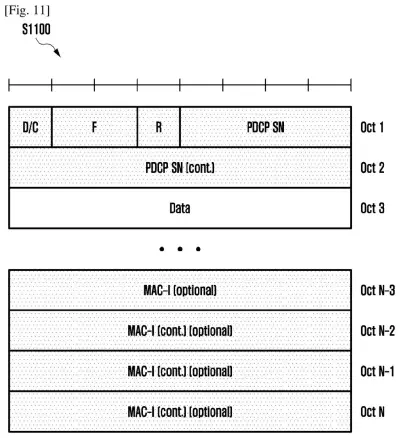
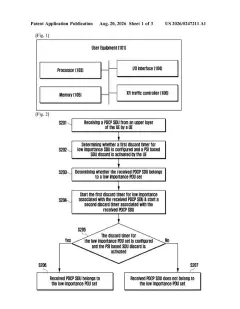
In a 5G stack, video frames are broken into groups called PDU Sets (Protocol Data Units). Each PDU Set corresponds to one rendered frame. The patent introduces an XR discard timer that starts the moment the transmitter receives the first packet of a PDU Set. If the timer expires before all packets in that set are sent, the system discards the remaining ones.
Two specific rules govern edge cases:
- If the first packet's timer has already expired and a later packet from the same frame arrives, that later packet is discarded immediately.
- If the first packet's timer has not yet expired when a later packet shows up, the later packet gets mapped to its own individual per-packet timer rather than inheriting the group timer.
This dual-mode logic prevents the network from wasting bandwidth sending partial frames that the receiving device cannot use, while still giving individually arriving packets a fair shot if the group deadline hasn't passed.
The method includes detecting whether a XR discard timer for a PDU Set is expired. In an embodiment, the method includes discarding the subsequent SDU/PDU of the PDU Set, when the XR discard timer for the first SDU/PDU of the PDU Set is expired wherein at least one subsequent SDU/PDU of the PDU Set is already received at the PDCP entity …
Translation: If the first part of a data set is too old, the system will automatically throw away the rest of the related data.
What this means for AR glasses on next-gen 5G networks
Latency and visual glitches are the single biggest obstacle to making AR and VR wearables feel natural. Even a fraction of a second of stale imagery, where what you see doesn't match where your head moved, triggers discomfort or disorientation. A mechanism that automatically discards outdated frame data instead of trying to push it through is a practical fix for a problem that current 5G stacks handle inconsistently.
Samsung makes both the network infrastructure equipment and the consumer devices that would use this protocol layer, so a filing like this sits at a useful intersection of both sides of the chain. The wireless-XR space is drawing a lot of attention from chipmakers and network vendors right now, and plain-English patent summaries covering 5G and AR filings show just how much protocol-level engineering is happening beneath the surface of any headset that claims to work wirelessly.
This is the 65th Samsung filing we've tracked since May in our 5G and network work, joining earlier applications like one on voice isolation and one on emergency video feeds.
Source: US 2026/0255215 A1 at the USPTO (PDF). Full patent text and figures are in the official publication.
Get our take in your Top Stories
Liked this breakdown? Add Patentlyze as a preferred source on Google, and our plain-English take shows up more often in your Top Stories the next time Samsung patent news breaks.
Add Patentlyze on Google
One click.
There are more where this came from
We read the new patents from Big Tech, carmakers and more and send you the ones worth knowing. Plain English, free, every week.
The drawings · 11 sheets
11 drawing sheets from US 2026/0255215 A1 · click any drawing to enlarge


Show the other 3 sheets


More from Samsung
All 1,662 Samsung patents →
More in Networking
All 516 Networking patents →
Meta
Meta Patents Technology That Helps Wireless Devices Find and Connect to Each Other Faster
Qualcomm
Qualcomm Patents Technology That Keeps Smart Glasses Video Smooth and Uninterrupted
Qualcomm
Qualcomm Patents Technology That Keeps AR Glasses Streaming Smoothly Without Draining the Battery
Qualcomm