
Samsung Patents Fix That Stops Emergency Video Feeds From Overwriting Each Other
When multiple officers or firefighters join the same emergency video call, their streams can accidentally get the same ID number, causing chaos for the network trying to sort them out. Samsung's new patent describes a server-side fix that stops that collision before it starts.
What Samsung's mission-critical video ID fix actually does
A police dispatcher opens a video call with six officers in the field. Each officer's phone generates a random number to label its video stream, and two of those phones happen to pick the same number.
That kind of accidental ID clash can scramble audio and video on real-time emergency networks, exactly the moment when clarity matters most. Samsung's patent describes a server that takes charge of handing out unique ID numbers to every participant before the call gets going, so no two streams ever share the same label.
The system also handles the case where someone joins and immediately asks to start transmitting at the same time, making sure they get a properly unique ID even in that rushed scenario. The goal is that you, as the person relying on that video feed, never see a dropped stream or garbled audio because of a behind-the-scenes numbering accident.
receiving at least one call setup request initiated by at least one MCVideo client, wherein the at least one call setup request comprises a session description protocol (SDP) offer, and wherein the SDP offer comprises at least one of an audio media data, or a video media data; …
Translation: The server gets a request to start an emergency video or audio call from a participant device.
How the MCVideo server assigns unique stream IDs
The patent targets a specific problem inside MCVideo (Mission Critical Video) networks, which are the specialized video-call systems used by police, fire, and emergency services on 5G infrastructure.
When two devices join the same call, each one creates a media source identifier (SSRC), a random 32-bit number baked into every data packet it sends. Because these numbers are generated randomly by the device rather than centrally assigned, two participants can accidentally pick the same number, a situation called an SSRC collision. When that happens, the receiving network cannot reliably tell which packets belong to which speaker.
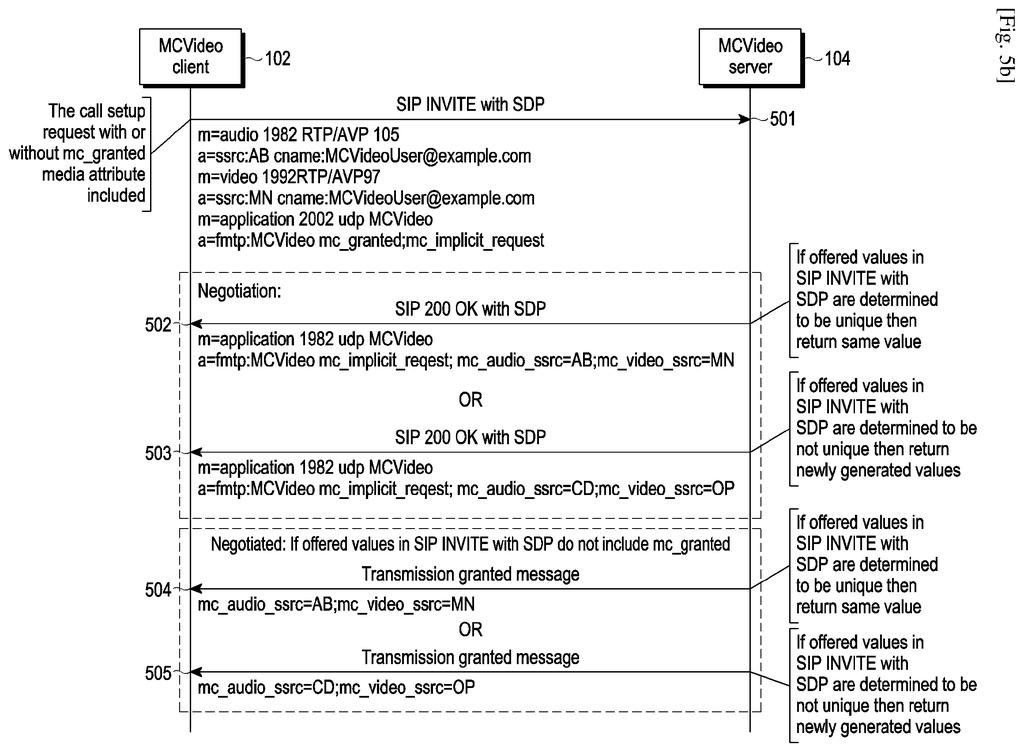
Samsung's proposed fix moves the ID assignment to the MCVideo server. Here is how the server handles it:
- It receives each participant's call-setup request, which includes an SDP offer (a standard handshake message listing what audio and video the device can send).
- It generates unique value information tied to that participant's audio and video streams.
- It sends those unique IDs back to the client before media starts flowing.
The patent also covers a timing edge case: if a participant requests permission to transmit at the exact moment they are joining the call, the server still guarantees they receive a collision-free ID. All of this runs over RTP (Real-Time Transport Protocol), the standard plumbing underneath nearly all live video and voice on the internet.
… provide uniqueness to the media source identifiers of the MCVideo communication participants to avoid collision of media source identifiers which are used in real-time transport protocol (RTP) packets.
Translation: Assigning unique labels to each emergency video feed prevents different streams from overwriting each other.
What this means for emergency video communication reliability
For everyday consumers this patent is invisible, but for anyone whose job depends on emergency video communications, an SSRC collision at the wrong moment could mean a corrupted video feed during a crisis. Fixing that at the server level, rather than relying on each device to detect and resolve its own collision after the fact, is a more reliable approach because the server has a full picture of every participant in the call.
The filing sits in the broader 5G and 6G standardization space, where carriers and device makers are still hammering out the plumbing for mission-critical services. Samsung's work on new Big Tech patents in the 5G networking layer reflects how much engineering effort still goes into making emergency communications dependable before those networks are handed to first responders.
Samsung's 63rd filing in 5G and network research we've tracked since May builds on earlier work like training AI across network nodes and keeping sensors alive during shutdowns.
For a firefighter watching an emergency video feed, the gain is simple: the right voice stays matched to the right face, streams stay sorted, and connections no longer drop without warning because two users accidentally got the same ID number.
The fix solves one specific problem, nothing more. In life-or-death networks, that focus is a strength, not a weakness.
A clean solution to a clear problem beats a broad solution that only works sometimes.
Get our take in your Top Stories
Liked this breakdown? Add Patentlyze as a preferred source on Google, and our plain-English take shows up more often in your Top Stories the next time Samsung patent news breaks.
There are more where this came from
We read every patent application Big Tech publishes and send you the ones worth knowing. Plain English, free, every week.
The drawings
6 drawing sheets from US 2026/0246820 A1 · click any drawing to enlarge


Want this weekly breakdown for a company we don't cover? Patentlyze Pro →
Be the first to weigh in