
Samsung Patents an AI Camera That Identifies Real-World Objects and Labels Them On-Screen
Samsung is patenting a system that watches your camera feed in real time, spots objects in the frame, and floats an AI-generated information label directly over each one. No tap required.
What Samsung's live AI camera overlay actually does
You're walking through a museum, phone up, camera open, and a small label appears floating over a painting on your screen, telling you the artist, the year, and a sentence of context. That's the experience Samsung is describing in this patent.
The phone spots objects in the live camera view, draws a box around each one, and immediately asks two things: a database of knowledge about that object, and an AI model that can look at the image and the database answer together to produce a plain-language description. That combined answer then shows up as an augmented reality overlay, a label or highlight sitting right on top of the object in your camera view.
The whole loop happens on your device, while the camera is still running, so there's no obvious pause or search step. You point, and information appears.
… querying a knowledge base with a knowledge base query including a bounding box image of the object detected from the camera feed …
Translation: The app crops an image of the item and searches a database to figure out what it is.
How the vision model and knowledge base work together
The system runs three steps in parallel or close sequence while your camera is live.
First, an object-detection layer scans the camera feed frame by frame. When it finds something worth labeling, it draws a bounding box (a tight rectangle around the object) and crops that region of the image.
Second, the device queries a knowledge base, a structured database of facts, using that cropped image. Think of it as a fast, local encyclopedia lookup: "Here's an image of this thing; what do you know about it?"
Third, a Vision Language Model (VLM) (an AI that reads both images and text together, similar in concept to what powers tools like Google Lens) takes the cropped image and the knowledge base result, and runs inference (generates an answer). The VLM's output is then formatted into an AR overlay, a visual element layered on top of the live camera feed that highlights the detected object and displays the AI-generated information beside or on top of it.
The claim is device-local: the detection, the query, and the inference all happen within the phone, which matters for speed and offline use.
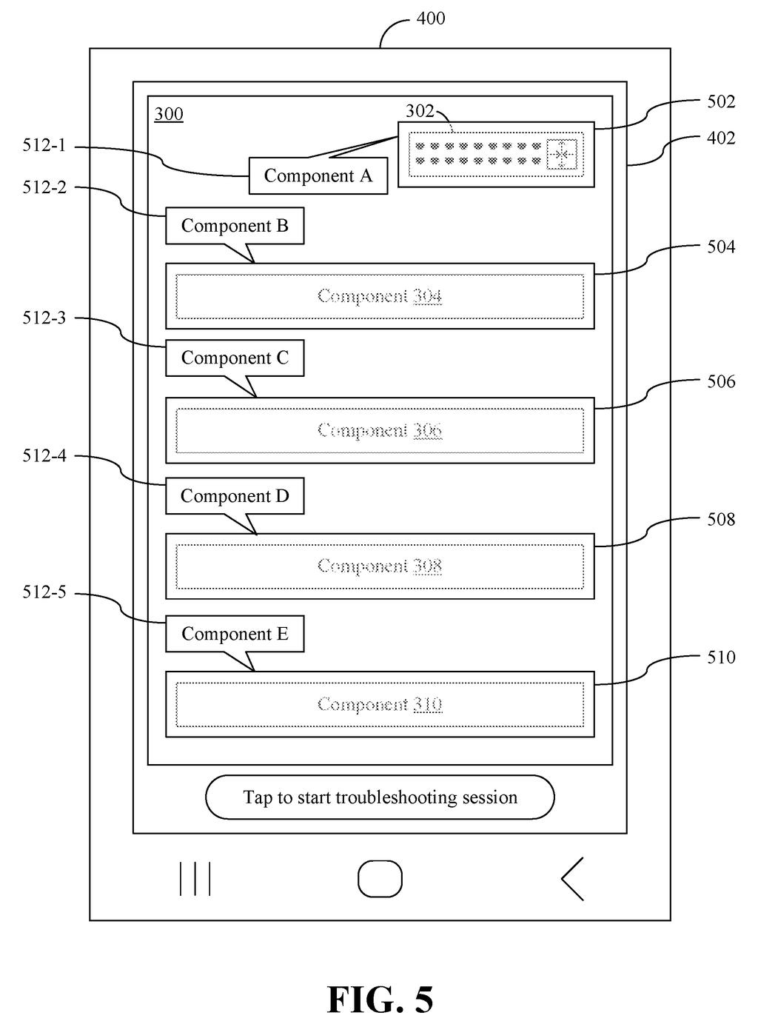
An AR overlay is displayed on the display screen of the device over the camera feed. The AR overlay visually distinguishes the object within the camera feed and displays VLM information for the object specified by the VLM result.
Translation: Labels and information pop up directly on top of the live video stream.
What this means for Samsung's camera and AR ambitions
For users, this collapses the gap between "I see something interesting" and "I know what it is." Right now, that loop usually requires you to pause, screenshot, and open a search app. A live AR overlay removes all three steps.
The design bet here is that doing everything on-device, rather than sending frames to a cloud server, keeps the experience fast enough to feel real-time. Samsung keeps filing on on-device AI inference suggests this is part of a broader push to bake AI tightly into its camera hardware and software stack, which is where Samsung keeps circling the camera-AI area in hardware competition with Apple and Google.
Samsung's 1272nd filing in our Samsung coverage since May follows work like the auto photo tagging application and the switchable privacy display.
Running two separate AI checks on every object the camera spots, while the camera itself is still rolling, puts a serious strain on the phone's battery and processing power. That's the central cost of this design, and the patent says nothing about how the device keeps up.
The choice to add a knowledge base lookup before the AI generates its answer is a meaningful concession: it admits the AI can't be trusted to answer from memory alone. That's an honest and reasonable tradeoff, because AI tools that sound confident while being wrong are the ones people stop using.
Whether this feels like a useful feature or a battery-draining novelty comes down entirely to optimization work the patent doesn't address. The underlying logic is sound, but the gap between a working demo and something people actually use every day is where this idea will succeed or fail.
There are more where this came from
We read every patent application Big Tech publishes and send you the ones worth knowing. Plain English, free, every week.
The drawings
14 drawing sheets from US 2026/0279081 A1 · click any drawing to enlarge


Want this weekly breakdown for a company we don't cover? Patentlyze Pro →
Be the first to weigh in