
Patent Reveals Real-Time AR Overlay System for Camera Views
Point your phone's camera at something, and Google's system could immediately paste related content, ads, or information directly on top of that object, in real time, before you even take a picture.
What Google's live-camera content overlay actually does
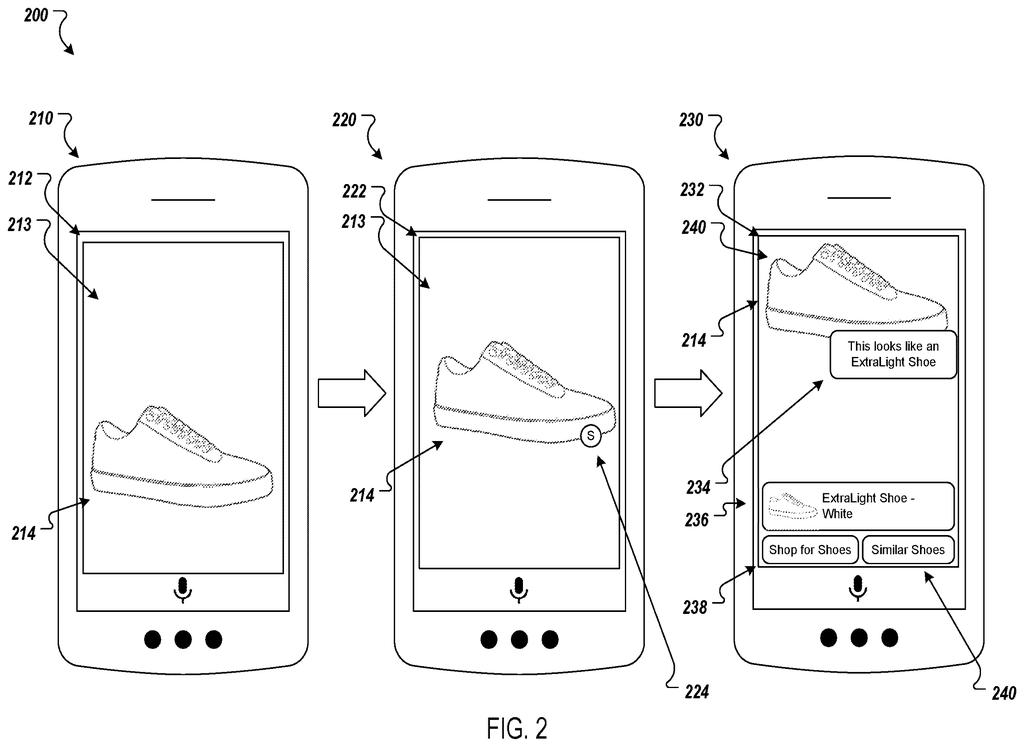
Imagine pointing your phone at a pair of sneakers on a store shelf. Before you tap anything, a little card pops up right on the sneakers showing the price, a review, or maybe a sponsored link from a competitor. That's the core idea in this Google patent.
The system watches your camera viewfinder continuously, figures out what objects are in frame, and sends that information to Google's servers. While it waits for a response, it keeps tracking where those objects move in your viewfinder so the overlay stays glued to the right spot. When the server responds with related content, the phone knows exactly where to put it.
What makes this distinct from a simple image search is the live tracking piece. You can pan the camera around, and the system keeps the content pinned to the object rather than losing it the moment things shift.
… requesting content related to the one or more objects from a content distribution system, wherein the request includes data based at least in part on the one or more confidence values; tracking each of the one or more objects in the viewfinder of the camera while waiting to receive the content as requested content from the content distribution system; …
Translation: The app asks a server for info while keeping track of moving objects on screen.
How the phone tracks objects while waiting for the server
The patent describes a mobile camera pipeline with three main stages running in parallel.
- Object detection: The phone's camera identifies objects in the viewfinder and assigns each a confidence value, a score indicating how certain the system is that the detected thing belongs to a particular category (shoe, bottle, car, etc.).
- Content request: The phone sends those confidence values to a content distribution system (essentially an ad or information server). The server uses the confidence data to decide which content is relevant enough to serve back.
- Live tracking: While the round trip to the server is happening, the phone continues tracking each detected object's position in the viewfinder. This is the critical piece. Network latency means there's always a gap between sending the request and receiving a response. Without tracking, the content would land in the wrong place.
Once the content arrives, the system combines the server's response with the tracker's current position data and renders the content directly on top of the object in the live viewfinder, not on a separate screen or in a pop-up aside.
A location of each of the one or more objects in the viewfinder of the camera is tracked while waiting to receive content from the content distribution system.
Translation: The system follows moving objects on the camera screen while it waits for the server to reply.
What this means for Google Lens and mobile advertising
This patent sits squarely inside Google's existing Google Lens product and points toward where visual search advertising could go next. Today, Lens requires you to tap or capture an image first. This system would let content follow objects in real time without any deliberate user action, which is a meaningfully different experience and a meaningfully different advertising surface.
For users, the upside is faster, more contextual information while browsing the physical world. The obvious downside is that your camera viewfinder becomes a potential ad canvas. The patent specifically routes requests through a content distribution system, which is Google's standard framing for its advertising infrastructure, so the commercial intent here is pretty transparent.
This is Google Lens with ads baked in at the camera level, and the engineering detail that makes it credible is the object-tracking-while-waiting step. That's a real and non-trivial problem to solve, because servers are slow and cameras are fast. Whether this ships as a feature or stays as a capability waiting for the right product moment, it signals that Google is thinking hard about turning your phone camera into a live ad unit.
There are more where this came from
We read every patent application Big Tech publishes and send you the ones worth knowing. Plain English, free, every week.
The drawings
4 drawing sheets from US 2026/0229031 A1 · click any drawing to enlarge


Want this weekly breakdown for a company we don't cover? Patentlyze Pro →
Be the first to weigh in