
Samsung Patents an AI Keyboard That Rewrites Your Text in Multiple Styles
Samsung is patenting a keyboard feature that takes what you type and instantly offers you rewritten versions of it, from formal to casual to emoji-heavy, without you having to ask twice.
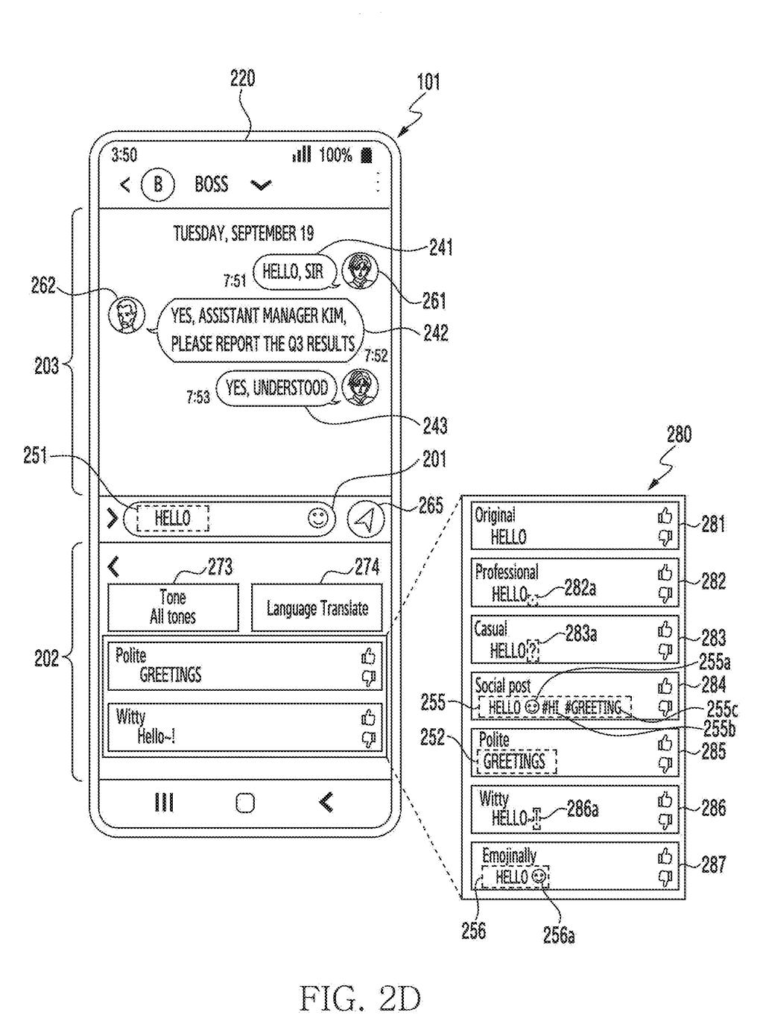
What Samsung's style-conversion keyboard feature actually does
You're texting someone and you've typed out a message, but it feels a little flat or too stiff for the moment. Samsung's patent describes a keyboard that reads what you typed and automatically offers you a list of alternative versions: the same basic message rewritten in different tones and styles, including at least one version where emoticons are woven in.
You'd see all the options in a list, pick the one that fits, and send it. No switching apps, no copy-pasting into a separate AI tool. The whole thing happens inside the keyboard, while you're already typing.
The system uses what the patent calls a style conversion model, which is an AI trained specifically to rewrite text rather than just generate it from scratch. Think of it as autocomplete, but instead of finishing your sentence, it offers you a wardrobe of different ways to say the same thing.
… obtain, by using a style conversion model for text generation, a plurality of texts, which are related to the first text and are corresponding to a plurality of styles …
Translation: The system uses an AI model to rewrite your typing into several different tones.
How the style conversion model generates and groups text variants
The patent describes an on-device or integrated AI system that monitors text entered through a software keyboard. Once the user has typed a message (the "first text"), the system receives a request to generate alternatives. That request could be triggered by a button tap or a gesture, though the patent doesn't fix the trigger to a specific UI element.
In response, a style conversion model (an AI component purpose-built for transforming existing text into different registers or tones) produces a set of multiple text variants, each corresponding to a different style. At least one of those variants must include emoticon objects grouped into the text, meaning the model doesn't just swap words but also inserts emoji or emoticon characters in a contextually appropriate way.
The full list of variants is then displayed on the device's screen, overlaid on or near the keyboard interface, so the user can scan and select. Key technical points from the claim:
- The model produces multiple outputs simultaneously, not one at a time
- Styles are treated as discrete categories, not a spectrum
- Emoticon grouping is a required output type, not optional
- Everything runs while an app is already open, meaning the keyboard stays in context
The patent does not specify whether the model runs on-device or in the cloud, which leaves both architectures open.
What this means for messaging on Galaxy devices
For everyday users, this would remove one of the more annoying workarounds in AI-assisted texting right now: copying your draft into a separate chatbot, asking it to make the message sound friendlier, copying the result back. If Samsung ships this as a keyboard-level feature, the whole loop collapses into a single tap.
Samsung's run of AI-keyboard filings The emoticon-grouping requirement is the detail worth watching. It suggests Samsung is aiming this at messaging contexts specifically, where tone and emotional register matter more than in, say, email. For Galaxy device users, this fits the broader direction of putting AI into the system keyboard rather than keeping it inside a single app.
Samsung's 19th filing in our Language AI coverage since May follows earlier applications like one predicting phone needs and one turning photos into words that we've tracked.
Everything described here runs on software alone. No new chip, no new sensor, just a keyboard that sends your draft to an AI model and returns several rewritten versions in different tones, ready to tap and send.
The main work before this ships is making the suggestion list feel natural rather than overwhelming, and training the model to place emoji where a human would actually put them, not just scatter them in. Both are solvable with good design and enough example messages to learn from.
The specificity of the patent suggests this is closer to a product update than a research sketch. A feature like this could plausibly arrive as a quiet addition to an existing keyboard app without much fanfare.
Get our take in your Top Stories
Liked this breakdown? Add Patentlyze as a preferred source on Google, and our plain-English take shows up more often in your Top Stories the next time Samsung patent news breaks.
There are more where this came from
We read every patent application Big Tech publishes and send you the ones worth knowing. Plain English, free, every week.
The drawings
41 drawing sheets from US 2026/0260056 A1 · click any drawing to enlarge


Show the other 33 sheets


Want this weekly breakdown for a company we don't cover? Patentlyze Pro →
Be the first to weigh in