
Samsung Files Patent for Event Photos That Double as Proof You Showed Up
Samsung's patent application describes a server that builds a digital attendance badge from the photos your group's phones took, then stamps on a cartoon avatar one of you owns as an NFT. It even changes the picture depending on whether your team won.
What Samsung's attendance-badge patent does
Today, a digital badge proving you attended an event is issued by the host through a special platform, and the photos everyone snapped during the evening play no part in it. Samsung's patent application would build the badge for you, out of what your phones already captured.
The phones at a gathering find each other over Bluetooth, and a server collects photos, captions and other activity from them. It picks the shot that best sums up the night, erases the people from it, and adds a cartoon avatar that one of the attendees owns as an NFT (a one-of-a-kind digital collectible). The avatar's pose and expression match the mood, and a logo or line of text can finish it off.
The result is a single image that works as a certificate that you were there.
identifying user terminals of attending members who attended a target event from among enrolled members based on a non-fungible token (NFT) issued for a specified gathering …
Translation: Checking who is at the event using their membership NFTs.
How the server picks the photo and the avatar
A server first works out who was at the event. Phones that hold an NFT (a digital token recorded on a blockchain) issued for the gathering scan for each other over Bluetooth and report who is nearby. The phones then send in event-related data: videos, details like time and place, ambient sound recorded around each capture, calendar entries and app activity.
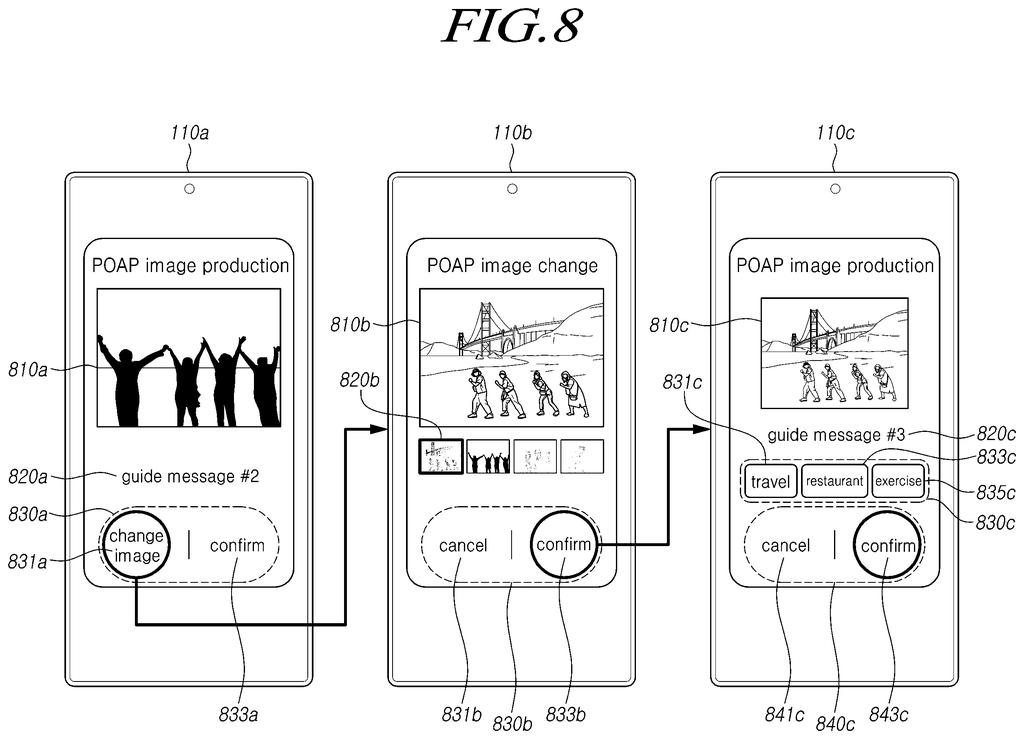
To choose the background, the server scores photos by how often the same subject was captured, how many times a photo was sent through a messaging app, and how many likes it drew. The top scorer becomes the representative image, and the host can swap it for another candidate. If an attendee appears in it, AI editing removes them.
Then comes the avatar, which the claims call a character image. It is based on a character owned as an NFT by an attendee, either someone pictured in the photo or someone who fits the scene, and its attire, pose and facial expression follow the mood. The server layers it over the background as a watermark (a stamp-like overlay), optionally with a logo, emblem or text.
The filing also describes variations:
- Movie posters or book covers as the background
- A marathon badge built from start and finish photos, with the distance (such as 10 km) as text
- A soccer game where the background changes depending on whether your team won
… superimpose the character image onto the background image to generate the POAP image proving attendance at the event …
Translation: Combining the character and background to make the final attendance badge.
What this means for event keepsakes on your phone
For you, this would be a souvenir that assembles itself. The inputs come from apps already on a phone: camera, gallery, messages and calendar. The filing lists smartphones, tablets and wearables as devices that could take part, so it targets everyday gadgets.
The stated goal is to build trust between group members by generating the badge automatically from evidence of who was actually there. Like any patent application, it may never become a product, and the filing gives no sign of one.
Samsung's 1459th filing in our Samsung coverage since May follows work like sharper motion photo covers and self-updating avatars.
The price of this design is data. To build one keepsake, a server needs your photos, the sound recorded around them, your calendar entries, and how your messaging and gallery apps get used. That is a lot to hand over for a cartoon badge, and the filing says nothing about what happens to that data afterward.
The design also depends on a narrow starting point. Everyone needs an NFT for the gathering, and some attendees need NFT avatars to put on the image. The filing itself says these badges can have value as investments but also carry risks. A group with no NFTs gives the system nothing to work with.
The trade looks lopsided for most people: heavy phone monitoring in return for a souvenir image. The photo-picking and mood-matching are fun touches, and a version that asked for less data would be easier to like.
Get our take in your Top Stories
Liked this breakdown? Add Patentlyze as a preferred source on Google, and our plain-English take shows up more often in your Top Stories the next time Samsung patent news breaks.
There are more where this came from
We read every patent application Big Tech publishes and send you the ones worth knowing. Plain English, free, every week.
The drawings
36 drawing sheets from US 2026/0320876 A1 · click any drawing to enlarge


Show the other 28 sheets


Want this weekly breakdown for a company we don't cover? Patentlyze Pro →
Be the first to weigh in