
Samsung Patents a Way to Translate One Voice Into Multiple Languages at Once
Most voice translators handle one language pair at a time, making multi-language rooms a logistical headache. Samsung's new patent describes a device that takes one person's voice and delivers different translations to different listeners simultaneously.
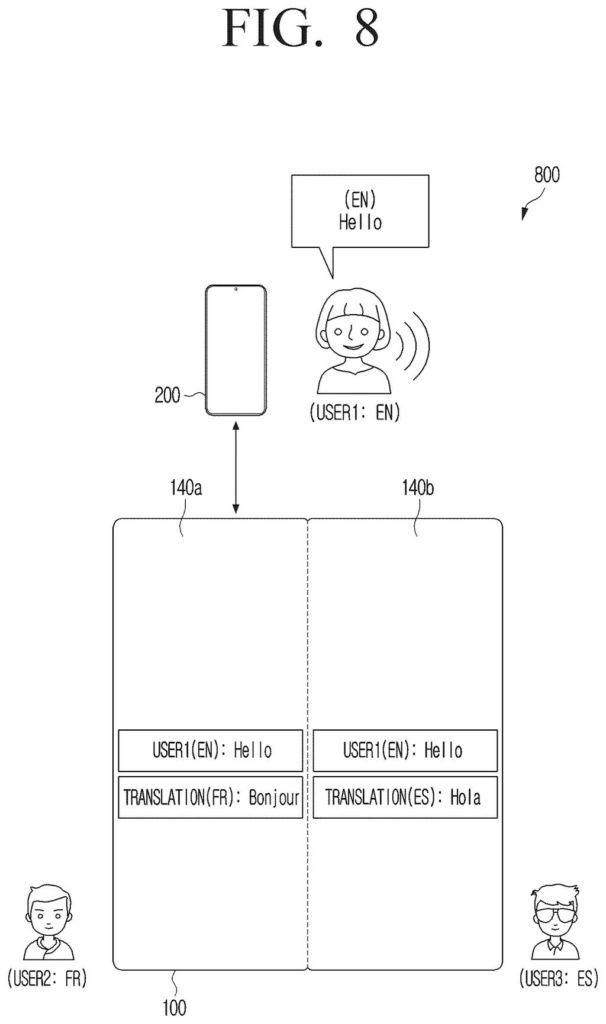
How Samsung's multi-language translation would work in a room
Today, real-time voice translators work like a one-on-one phone call: one speaker, one listener, one language pair. If three people in a room each speak a different language, you'd need separate translation sessions or a lot of awkward waiting.
Samsung's patent describes an electronic device that takes a single voice recording and translates it into two different languages at the same time, routing each translation to a different person. So if you speak English, your French colleague hears a French version and your Japanese colleague hears a Japanese version, all from the same utterance.
Samsung doesn't spell out exactly what physical product would do this, but the filing covers a standalone device connected wirelessly to external equipment, meaning it could sit in a conference room, a translation earpiece hub, or a mobile phone.
receive a first voice of a first language uttered by a first user from the external device through the communication circuit, translate the first voice in a second language to obtain a first translation result, translate the first voice in a third language to obtain a second translation result …
Translation: The device captures a person's speech and simultaneously converts it into two different languages for other listeners.
How the apparatus splits one voice into parallel translation outputs
The patent describes an electronic apparatus that contains a processor, memory, and a communication circuit. That circuit connects to an external device (a phone, earpiece, or microphone) and receives a voice input in a first language.
Once the voice arrives, the processor runs two separate translation pipelines in parallel:
- Pipeline one converts the input into a second language, producing what the patent calls the "first translation result."
- Pipeline two converts the same input into a third language, producing the "second translation result."
- Each result is then delivered to a different named user, meaning the system tracks which listener needs which language.
The claim is intentionally broad. It doesn't specify whether the translation is neural machine translation (AI-based text-to-speech) or a cloud lookup, nor does it describe how the output reaches each person (earphones, a screen, speakers). The core idea is simply that one voice in triggers multiple translated voices out, simultaneously, to separate recipients.
The apparatus is connected to an external device through the communication circuit, so the microphone picking up the first user's voice could be a paired phone or wearable, not necessarily built into the translating unit itself.
… provide the first translation result to a second user, and provide the second translation result to a third user.
Translation: The system delivers the translated audio to different people at the same time.
What this means for translation devices and group calls
For anyone who has sat in a multilingual meeting and watched a human interpreter bounce between language pairs, this is the obvious next step for translation hardware. A device that fans one voice out to multiple translated streams would cut the back-and-forth significantly and make group conversations more natural. The practical applications range from international business calls to travel devices to real-time captioning in multilingual classrooms.
The filing is broad enough to cover a lot of ground, which means Samsung is likely staking out territory before a specific product is finalized rather than patenting a finished implementation. Translation hardware is a crowded space with earpiece makers and phone vendors all competing, and Big Tech patent news has tracked growing activity in AI-driven real-time translation filings as the underlying models get fast enough to be practical in conversation.
The core claim covers a useful idea, but the patent is light on implementation detail, which puts it closer to a territorial stake than a shipping spec. Samsung would need to solve real latency problems before multi-stream simultaneous translation feels smooth in a live conversation, and the filing says nothing about how the system knows which listener speaks which language. The shortest path to a product is probably a software update to an existing Galaxy AI translation feature, with no new hardware required, which makes this plausible within a product cycle if the underlying models are ready.
There are more where this came from
We read every patent application Big Tech publishes and send you the ones worth knowing. Plain English, free, every week.
The drawings
41 drawing sheets from US 2026/0236720 A1 · click any drawing to enlarge


Want this weekly breakdown for a company we don't cover? Patentlyze Pro →
Be the first to weigh in