
Samsung Patents a Robot That Figures Out Whose Turn It Is to Be Looked At
Most robots stare awkwardly at whoever is loudest or closest. Samsung is filing for a system that tracks a group of people and works out, from voices and body language, a sensible order in which to make eye contact with each one.
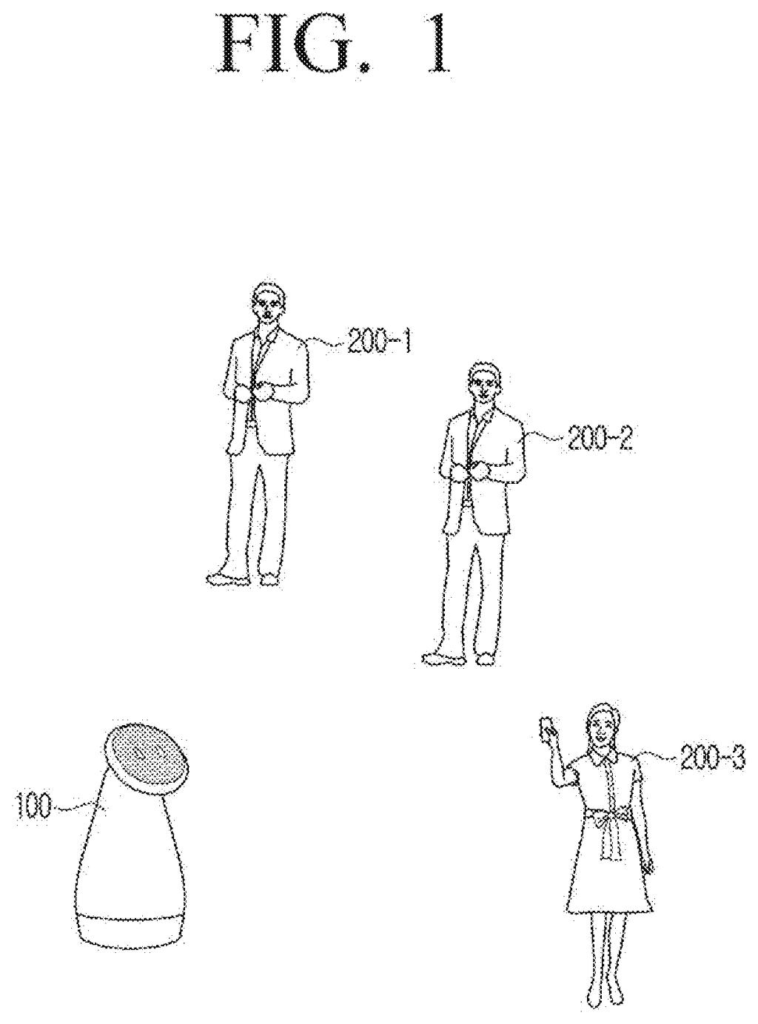
How Samsung's robot decides where to look in a crowd
You're in a room with a home robot and three other people, all talking at once. The robot doesn't know where to look, so it just picks the loudest person and stays there, which feels rude to everyone else.
Samsung's patent describes a fix for that. The robot uses its camera to spot all the people in view and divides the camera's frame into zones. It then listens through a microphone and watches body language to figure out who is talking, who is being talked to, and who is just waiting their turn. From that, it builds a priority order, then rotates smoothly to "look at" each person in a sequence that mirrors how a human host would work a room.
The goal is to make group interactions with a robot feel less like shouting at a kiosk and more like talking to an attentive presence that acknowledges everyone. Whether it's a household assistant, a reception bot, or a customer-service unit, the underlying idea is the same: social awareness through gaze.
recognize a plurality of people based on an image acquired through the camera, identify interaction information of the plurality of people based on the voice acquired through the microphone and the image, and determine a first gaze order of the plurality of people based on the identified interaction information of the plurality of people.
Translation: The robot figures out who is talking and decides whose turn it should be to get looked at.
How the robot maps faces, voices, and conversation flow
The patent describes a robot with a camera and a microphone that work together to handle multi-person conversations.
On the vision side, the robot's field of view is divided into a grid of regions. When it spots one or more people, it notes which region each person occupies. That positional data feeds directly into calculating how far and in which direction the robot needs to rotate to face each person, keeping the physical movement efficient rather than spinning randomly.
On the audio side, the microphone captures what people are saying. The system analyzes the voice input alongside the image to extract interaction information (essentially: who is speaking, who they appear to be addressing, and what the conversational dynamic looks like at that moment). From that combined reading, it produces a gaze order, a ranked sequence of people the robot should turn to face.
The rotation logic then uses the gaze order together with each person's position in the camera frame to calculate a precise angle and direction. The robot turns to the first person, engages, then moves on to the next in the sequence. If the interaction state changes mid-conversation, the order can be updated. The patent also references handling voice commands as a trigger for re-evaluating who to face next.
What this means for robots operating in social spaces
For robots to feel socially comfortable in homes, offices, or public spaces, they need to handle the basic human courtesy of acknowledging everyone present. A robot that locks onto one person and ignores others will feel off-putting fast, the way a customer-service agent who never makes eye contact with you feels dismissive even if they're technically helping.
This patent is part of Samsung has been filing around social and domestic robotics for a while now, as the company positions itself in the home-robot market. The gaze-ordering system described here is a relatively small behavioral detail, but small behavioral details are often what separates a product people trust from one that feels like an appliance with a face painted on it.
Samsung's 48th filing we've tracked in our home robot watchlist since May builds on earlier applications like the automatic mop pad swap and sound-based floor reading.
The core engineering trade-off here is real: the system combines two noisy data streams, voice and video, and asks them to produce a clean, confident social decision in real time. Microphones in a busy room pick up overlapping voices; cameras struggle with occlusion and lighting. Asking a robot to infer "who is talking to whom" from those inputs is genuinely hard, and the patent doesn't spell out how robust the inference is when conditions get messy. That uncertainty is a meaningful cost.
The rotation approach trades precision for approachability. Physically turning to face someone is far more legible to humans than a subtle camera pan, but every rotation takes time and motor energy, and in a fast conversation with four people, a robot physically pivoting every few seconds could quickly become distracting rather than polite.
Still, the design logic is sound. Social robots that ignore most of the room are a known frustration, and the patent targets that problem directly. Whether the voice-plus-vision inference holds up outside a lab is the real open question, and that answer lives in hardware testing, not in the filing.
There are more where this came from
We read every patent application Big Tech publishes and send you the ones worth knowing. Plain English, free, every week.
The drawings
18 drawing sheets from US 2026/0295854 A1 · click any drawing to enlarge


Want this weekly breakdown for a company we don't cover? Patentlyze Pro →
Be the first to weigh in