
Samsung Patents a Pivoting Wheel-Link System for Stable Robots
Keeping a robot upright on a bumpy floor is harder than it sounds. Samsung's new patent describes a mechanical linkage system that lets each wheel respond to the terrain independently while the robot's body stays level.
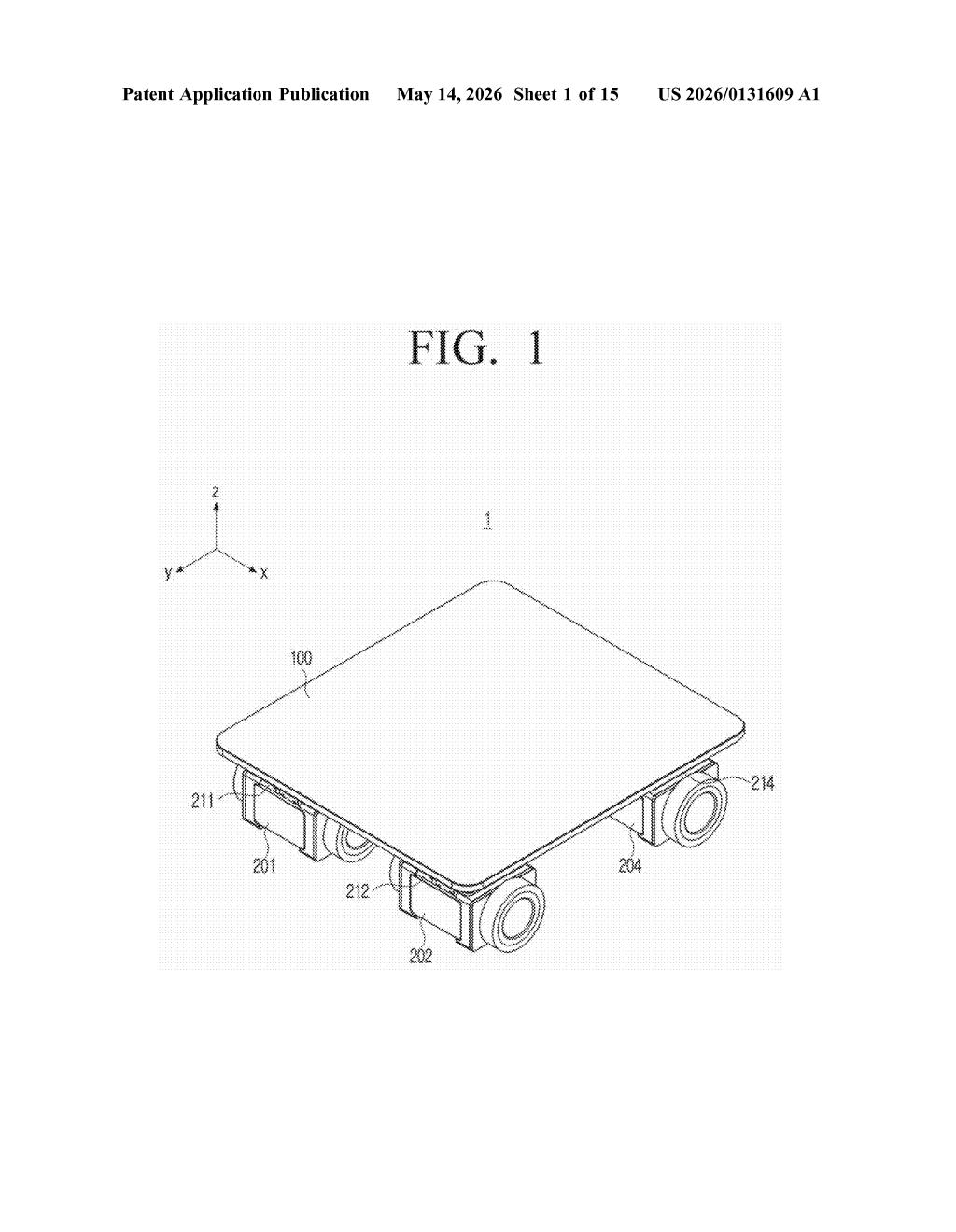
What Samsung's robot suspension linkage actually does
Imagine a small home robot rolling from a hardwood floor onto a thick rug, or over a door threshold. Without some kind of suspension, the whole body tilts awkwardly — or a wheel loses contact with the ground entirely. That's the problem this patent is trying to solve.
Samsung's design adds a clever set of pivoting arms between the wheels and the robot's body. There's a central pivot bar (the "main link") attached to the underside of the robot, and it can rock side-to-side like a see-saw. Branching off from that are smaller arms ("sub-links"), each connected to a wheel. When one wheel hits a bump, the arms pivot to absorb the height difference without tilting the whole robot.
The result is a bit like how a mountain bike's suspension lets the wheels follow rough ground while the rider stays relatively smooth. Your robot stays upright and in control, even when your floors aren't perfectly flat.
How the main link and sub-links distribute wheel movement
The patent describes a wheeled robot chassis built around a hierarchical pivoting linkage — essentially a mechanical suspension system with two levels of articulation.
At the top level, a main link member is attached at its center to a main hinge on the underside of the robot body. This lets the bar rotate freely around its midpoint (like a see-saw), so forces from the left and right sides of the chassis can balance each other out.
At the second level, sub-link members branch off from each end of the main link. Each sub-link is anchored to the robot body at two additional pivot points — a first hinge member and a second hinge member — positioned at a distance from the main link. Each sub-link also connects to a pair of wheels (a first and a second wheel). When those wheels encounter terrain changes, the sub-link pivots around its two hinge points to accommodate the height difference.
The geometry means:
- Vertical wheel motion is absorbed locally by the sub-links
- Larger cross-body imbalances are absorbed by the rocking main link
- The main body remains comparatively level throughout
This is a purely mechanical passive suspension — no motors or sensors required to make it work, which keeps complexity and cost down.
What this means for Samsung's home robot ambitions
Samsung has been investing heavily in home robotics, and one of the most persistent challenges for wheeled home robots is navigating the real-world chaos of domestic floors — rugs, cables, thresholds, and uneven tiles. A passive mechanical suspension like this improves reliability without adding the cost or failure points of an active, sensor-driven system. That's a meaningful engineering trade-off for a consumer product.
For you as a potential buyer, it means a robot that's less likely to get stuck or topple when it leaves your smooth kitchen floor for the living room rug. It also suggests Samsung is thinking seriously about the physical robustness of its robot platforms, not just the software and AI layers that tend to get all the headlines.
This is a fairly focused mechanical engineering patent — not flashy, but exactly the kind of unglamorous chassis work that separates a robot that actually works in your home from one that struggles past the demo stage. Samsung filing this alongside its broader robotics push signals that it's thinking about the full stack, ground-contact mechanics included.
There are more where this came from
We read every patent application Big Tech publishes and send you the ones worth knowing. Plain English, free, every week.
Want this weekly breakdown for a company we don't cover? Patentlyze Pro →