
Samsung
Samsung · Display · Filed Mar 12, 2026 · USPTO published Aug 13, 2026 · Aug 13 release
Samsung Patents a TV That Auto-Crops Short Videos to Fit a Split Screen
Samsung is working on a TV interface that plays multiple short-form video playlists side by side and silently fixes the moment a vertical TikTok clip lands in a widescreen box.
- Publication number
- US 2026/0238856 A1(US20260238856A1)
- Applicant
- SAMSUNG ELECTRONICS CO., LTD.
- Filed · Published
- Mar 12, 2026 · Aug 13, 2026
- Inventors
- Yeeun SHIN, Boyoon HUR, Junpyo HONG, Ahyeon SHIM, Jangwon SEO, Eunhee PARK
- Status when we published
- Waiting for an examiner
- Document
- 20 claims
- US classification
- 725/116
- Parent application
- Continuation of PCT/KR2026/001995 (filed Feb 3, 2026)(PCTKR2026001995)
How Samsung's TV handles vertical videos on a big screen
A TV screen sits idle in a living room while its owner scrolls through a pile of short clips saved from social media. Nothing fits quite right: some videos are tall and narrow, some are wide, and the TV just slaps black bars around whichever ones don't match.
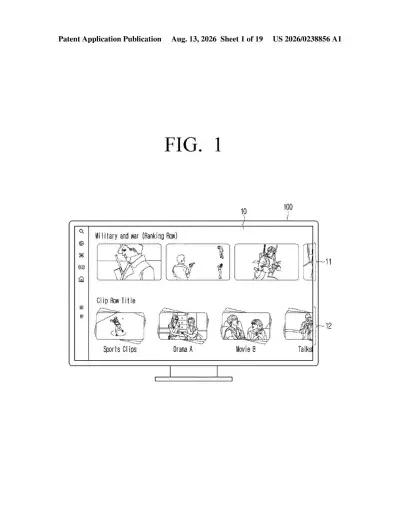
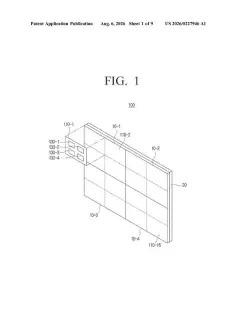
Samsung's patent describes a system that organizes short videos into themed playlists, then splits the TV screen into zones, one per playlist. Each zone plays its playlist in sequence. When a video's shape doesn't match the zone it's playing in, the TV either crops the clip to fill the space cleanly or shrinks it to fit without distortion. You don't touch anything.
The interface monitors which zone you're looking at (via an on-screen graphic indicator) and uses that attention signal to decide how to handle the mismatch. The goal is a continuous, tidy stream of short content across a large display, without the awkward letter-boxing or pillar-boxing that makes phone-shot videos look wrong on a 65-inch screen.
… identify, based on a graphic interface being displayed in an area of the plurality of areas, whether an aspect ratio of a short-form content displayed in the area corresponds to a ratio of the area …
Translation: The TV automatically compares the video shape to the screen area shape to decide if adjustments are needed.
How the aspect-ratio check and crop logic actually work
The patent covers a display system with three interlocking pieces: a playlist generator, a multi-zone interface, and an aspect-ratio correction engine.
Playlist grouping: The processor divides a library of short-form clips into groups (by topic, source, or another criteria the filing leaves open) and generates one playlist per group. Each playlist maps to a dedicated region of the screen.
Multi-zone playback: The interface screen is divided into multiple areas, each showing one playlist's clips in order. Think of it like a split-screen view where each panel has its own continuous feed.
Aspect-ratio detection and correction: When a clip is queued for a zone, the system checks whether the clip's shape (its ratio of width to height) matches the zone's shape. If they match, the clip plays normally. If they don't match, the system picks one of two fixes:
- Crop mode: The clip is trimmed so it fills the zone fully, cutting off the edges that don't fit.
- Letterbox/pillarbox mode: The clip plays at its original shape inside the zone, leaving blank space at the borders.
The decision to apply correction is triggered by a graphic interface element being visible in that zone, which acts as the signal that the zone is active and being monitored. The patent doesn't specify an AI model; the logic reads as rule-based geometry checking.
… based on the aspect ratio not corresponding to the ratio of the area, crop the short-form content and playback the cropped short-form content in a portion of the area, or playback the short-form content in a portion of the area.
Translation: If the video does not fit the split screen ratio, the TV will crop it down or resize it to fit inside that section.
What this means for TikTok-style content on Samsung TVs
For anyone who has tried to watch vertical TikTok clips or YouTube Shorts on a large TV, the problem is familiar: the content either drowns in black bars or gets stretched into something unwatchable. Samsung's filing is an attempt to solve that at the system level rather than leaving it to individual apps.
The practical payoff is a TV that handles the shape mismatch for you, automatically, during playback. Whether Samsung ships this as a feature in its Tizen-based smart TV software, a dedicated short-form content mode, or something tied to its existing Samsung TV Plus service is unknown, but the filing signals that the company sees short-form video as a format worth building native display logic around. Samsung's display patents sit alongside a growing body of new Big Tech patents targeting the collision between phone-native video formats and living-room screens.
Source: US 2026/0238856 A1 at the USPTO (PDF). Full patent text and figures are in the official publication.
Get our take in your Top Stories
Liked this breakdown? Add Patentlyze as a preferred source on Google, and our plain-English take shows up more often in your Top Stories the next time Samsung patent news breaks.
Add Patentlyze on Google
One click.
There are more where this came from
We read the new patents from Big Tech, carmakers and more and send you the ones worth knowing. Plain English, free, every week.
The drawings · 19 sheets
19 drawing sheets from US 2026/0238856 A1 · click any drawing to enlarge


Show the other 11 sheets


More from Samsung
All 1,662 Samsung patents →
More in Display
All 746 Display patents →
Microsoft
Microsoft Patent Targets Dynamic Screen Dimming Precisely Where Your Eyes Look
Qualcomm
Qualcomm Patents a Display Trick That Keeps Partial Screen Updates Sharp
Sony
Sony Patents a Camera Chip That Activates Only When Lighting Conditions Change
Microsoft