
Samsung Patents a Metal-Air Battery That Stays Efficient as Its Power Strip Wears Down
Most batteries degrade partly because their electrodes shrink unevenly over time, creating gaps that kill efficiency. Samsung's new patent tackles that problem with a geometric fix: a wedge-shaped aluminum anode that keeps the right distance from its partner electrode even as it dissolves.
What Samsung's tapered battery electrode actually does
A small metal rod slowly burns down inside a battery while you use your phone or laptop. That image is closer to reality than most people realize, and it is one of the central problems with a promising class of batteries called metal-air cells.
Metal-air batteries use a piece of metal (in this case, aluminum) as one electrode and pull oxygen from the surrounding air as the other. They can pack a lot of energy into a small space, but there is a catch: the aluminum gradually dissolves as the battery does its job. As it shrinks, the distance between it and the oxygen-side electrode changes, and the battery becomes less and less efficient.
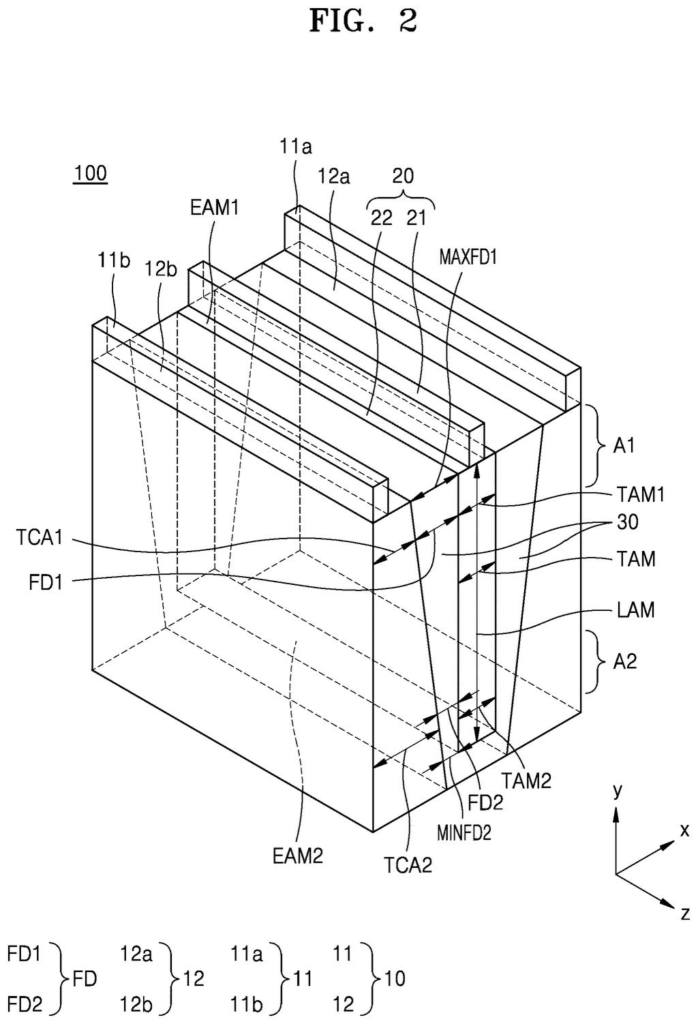
Samsung's patent describes an anode (the aluminum electrode) that is shaped like a wedge rather than a flat slab. Because it tapers, the gap between the aluminum and the oxygen electrode stays consistent even as the metal wears away from one end. It is a simple geometric trick that could extend how long the battery performs at its best.
… an anode comprising an anode current collector and an aluminum metal extending in a first direction from a first end adjacent to the anode current collector to a second end opposite the first end …
Translation: The battery uses an aluminum strip that reaches outward from its power connection point.
How the angled anode compensates for aluminum loss
A standard metal-air battery sandwich looks like this: an oxygen-consuming cathode on one side, a metal anode on the other, and a liquid or gel electrolyte in between carrying ions back and forth. The distance between cathode and anode matters a great deal; too far apart and the chemistry slows down, too close and you risk short circuits.
The problem is that the aluminum anode dissolves from its far end (the end farthest from the current collector, the metal tab that connects to your circuit) inward. As that end shrinks, the gap between the aluminum surface and the cathode widens, and performance drops.
Samsung's patent describes shaping the aluminum anode so it is thicker near the current collector and thinner at the far end (a taper, or wedge). Because the battery consumes the thinner end first and the cathode is typically angled to match, the working distance between the two electrodes changes much less over the battery's life. The claim specifies that the distance between cathode and aluminum decreases in the direction away from the current collector, which is the geometric relationship that makes the compensation work.
- Cathode: uses atmospheric oxygen as its active ingredient, so it doesn't need to store oxidant internally
- Anode: aluminum metal, shaped with a taper along its length
- Electrolyte: sits between the two, conducting ions as aluminum oxidizes
- Key geometry: cathode-to-anode distance decreases toward the anode's free end, maintaining efficiency as the metal wears
… wherein a distance between the cathode and the aluminum metal decreases in the first direction.
Translation: The gap between the internal components narrows as you move along the strip.
What this means for long-life portable power supplies
Metal-air batteries have long been considered a potential successor to lithium-ion for applications where energy density matters most, including wearables, hearing aids, drones, and portable medical devices. The main practical barrier has never been theoretical energy capacity; it has been durability. Electrode geometry that degrades over time is one of the leading causes of early failure.
If Samsung can manufacture aluminum anodes with this tapered profile reliably and cheaply, it addresses one specific but meaningful link in that failure chain. For you as a consumer, the downstream promise is a battery that holds closer to its original performance for more of its rated lifespan, rather than the familiar cliff-drop in capacity that tends to hit older portable devices.
Samsung's 1265th filing we've tracked since May in our Samsung coverage adds to a radio-focused run that includes dual-signal antenna work and room-detection via Wi-Fi.
The problem this patent attacks is real and genuinely expensive. Metal-air batteries are attractive because they use oxygen from the air as one electrode, which means they can store far more energy by weight than conventional lithium-ion cells. The catch is that the metal electrode (here, aluminum) dissolves during use, and as it shrinks, the internal geometry falls out of spec, degrading performance and shortening life.
Samsung's approach is elegant in its simplicity: cut the anode at an angle so that as the metal retreats, the gap between the two electrodes stays roughly constant. It is a mechanical answer to a chemical problem, which is exactly the kind of solution that tends to survive into real products because it adds almost no manufacturing complexity.
Whether this is enough to make aluminum-air batteries practical at scale is a separate, harder question. The chemistry still has challenges beyond electrode geometry. But solving the wear-induced gap problem is a necessary step, not a sufficient one, and this filing shows Samsung is working the problem from multiple directions.
There are more where this came from
We read every patent application Big Tech publishes and send you the ones worth knowing. Plain English, free, every week.
The drawings
18 drawing sheets from US 2026/0279973 A1 · click any drawing to enlarge


Want this weekly breakdown for a company we don't cover? Patentlyze Pro →