
Samsung Patents a Smartwatch That Uses Its Own Metal Frame as an Antenna
Samsung is designing smartwatches where the metal rim around the screen doesn't just look good — it literally is the antenna. No separate radio component needed.
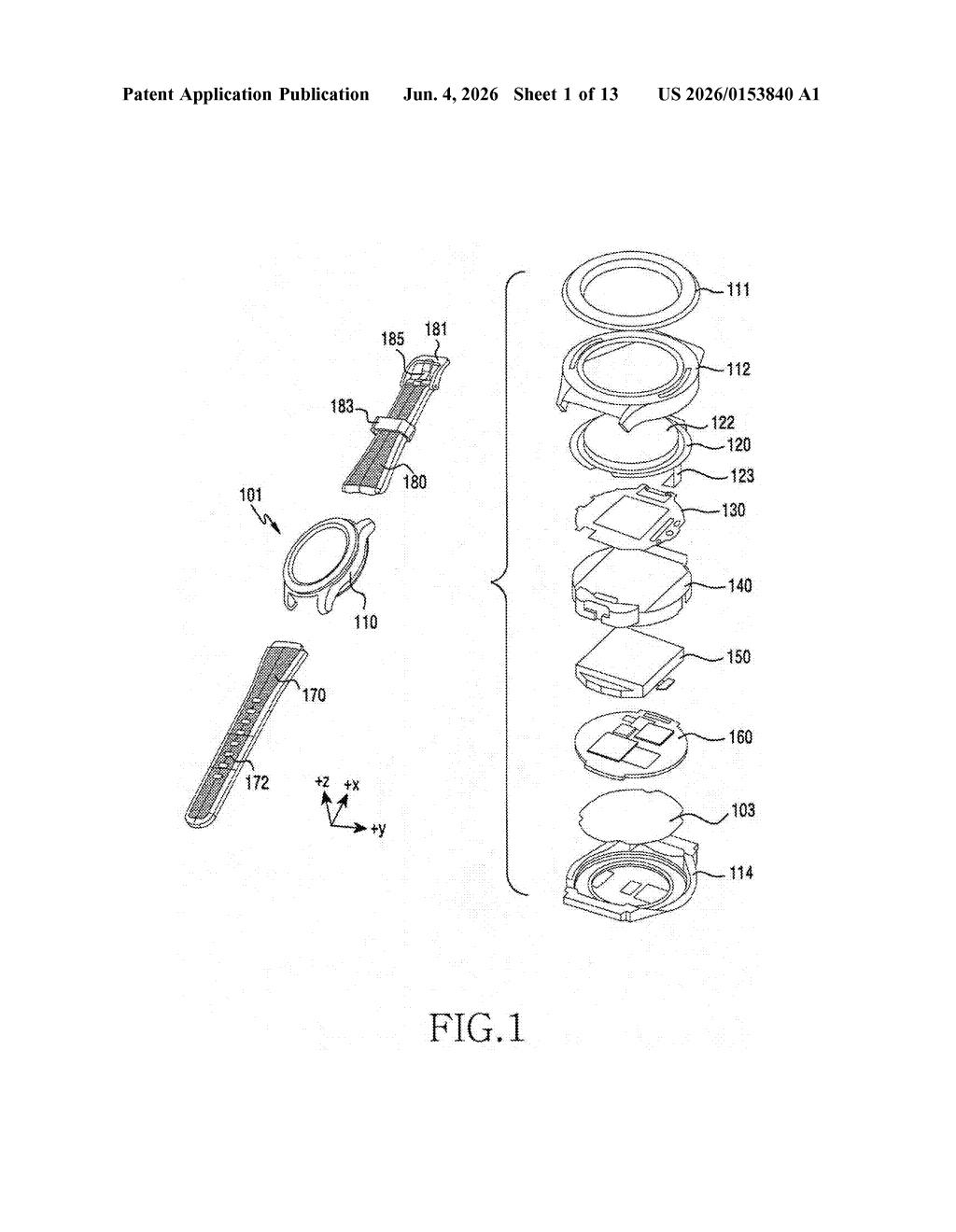
How Samsung hides a radio antenna inside a watch frame
Imagine you're wearing a sleek metal-rimmed smartwatch. Somewhere inside that slim case, the watch needs an antenna to pick up Bluetooth, Wi-Fi, or cellular signals. Usually, that means a dedicated plastic or ceramic antenna piece taking up precious space. Samsung's patent skips that entirely.
The idea is to use the metal frame — the band of metal forming the watch's side edges — as the antenna itself. The watch's internal circuitry connects to different points on that frame at different heights from the back cover. Feeding power to a lower point on the frame handles lower-frequency signals; feeding a higher point handles higher frequencies.
To make the ground connection reliable, Samsung layers two circuit boards inside the watch. A second board sits between the display and the first board, and a pair of small connector pieces bridge that second board to the metal frame. It's a tightly engineered handshake that lets the frame double as a real, tunable antenna without adding bulk.
How the dual-PCB stack feeds the metal frame at different heights
The patent describes a wearable device — almost certainly a smartwatch — built around a metal frame antenna architecture. Rather than embedding a separate antenna component, the metal rim that forms the device's side surface acts as the radiating element (the part that actually sends and receives radio waves).
Inside the watch, two printed circuit boards (PCBs) are stacked between the display and the rear cover. The second PCB (closer to the display) carries the ground plane — essentially the electrical reference point the antenna needs to work. Two small connectors bridge that ground to the metal frame:
- A first connection member sits on the surface of the second PCB and ties into its ground.
- A second connection member physically contacts the first and connects to the metal frame, completing the circuit.
For multi-band radio support, the wireless circuit feeds power to different vertical points on the frame — a lower point (closer to the rear cover) for lower frequency bands, a higher point for higher frequency bands. Changing the feed height changes the electrical length of the antenna segment, which shifts its resonant frequency (the sweet spot where it transmits and receives most efficiently).
The net result is a compact antenna system that's mechanically integrated into the watch's structural frame, freeing up internal volume that would otherwise go to a discrete antenna.
What this means for slimmer, better-connected Galaxy Watches
Smartwatch design is an ongoing war for interior real estate. Every cubic millimeter saved on an antenna is a millimeter that can go to a bigger battery, a thinner profile, or additional sensors. By turning a structural component — the metal frame — into a functional antenna, Samsung could meaningfully reduce the internal footprint of radio hardware in future Galaxy Watch models.
The dual-feed-point approach also hints at multi-band capability within a single metal element, which matters as wearables increasingly need to handle LTE, Wi-Fi 6, Bluetooth, and UWB simultaneously. For you as a user, that could translate to more reliable connectivity without the watch getting thicker or heavier.
This is unglamorous but genuinely clever engineering. Using the structural frame as an antenna is a well-established trick in smartphones, but adapting it to the constrained geometry of a smartwatch — with stacked PCBs and precision connector bridges — is a real design challenge. If Samsung ships this, it's the kind of invisible improvement that shows up as 'slightly better battery life and signal' in reviews, which is exactly what wearable buyers actually want.
There are more where this came from
We read every patent application Big Tech publishes and send you the ones worth knowing. Plain English, free, every week.
Want this weekly breakdown for a company we don't cover? Patentlyze Pro →