
Samsung Files Patent to Separate Dialogue From Background Sound on TVs Without Lag
Pulling a voice out of a movie soundtrack takes a few milliseconds, and on a TV even that can push the sound out of sync with the picture. Samsung's patent application gets around it by guessing how the next slice of sound will split before that slice plays.
What Samsung's sound-splitting patent does
Ever watched a video where the voices land a beat after the lips move? On a TV, that tiny mismatch is maddening, and it is a real risk for any feature that tries to separate voices from music in real time.
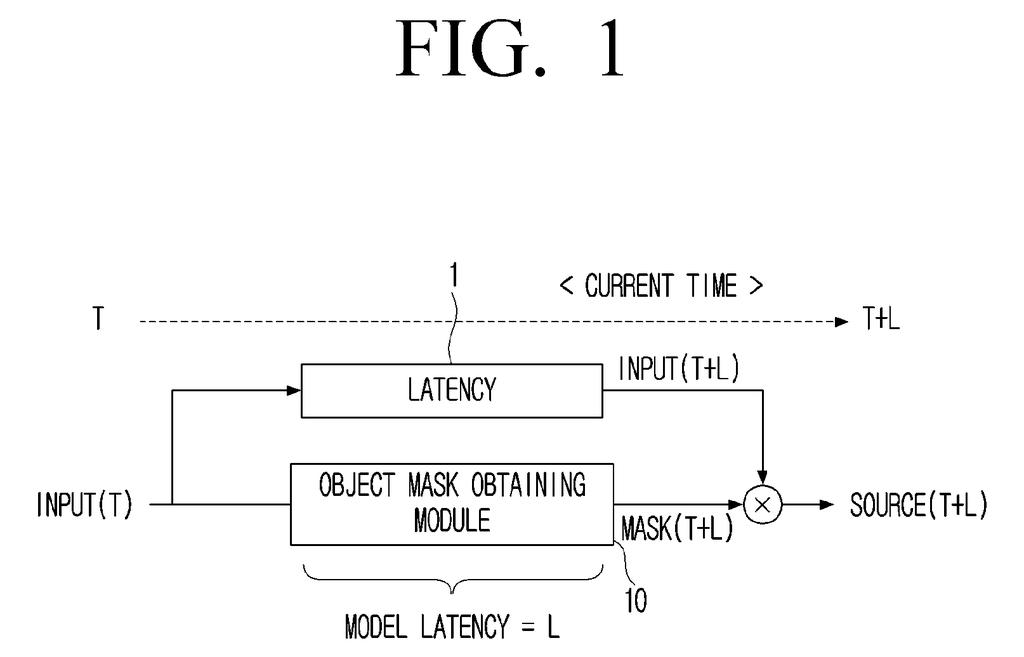
Samsung's patent application targets exactly that. Splitting a sound into its parts (say, dialogue versus background score) takes the processor a few milliseconds of work. Normally the TV would have to wait for that work to finish, so the sound would trail the picture. Samsung's idea is to do the work early: while one tiny slice of audio is playing, the system predicts what the separation recipe for the next slice will look like.
By the time that next slice is ready to play, the recipe is already waiting. You could then turn one sound, such as the voices, all the way down while everything else keeps playing, with no added delay.
… identify at least one second audio object mask corresponding to a second audio frame that is after the first audio frame by inputting the obtained at least one first audio object mask into a first neural network model …
Translation: The system predicts future sound patterns by running current audio data through an AI model.
How the model guesses the next 10.6 ms of sound
The filing describes two neural networks (software models trained on examples) working in a chain. The first one, built in a U-Net shape (a network that squeezes the audio down to its key features and then expands it back out), looks at one audio frame, a slice of sound that lasts 10.6 milliseconds in the example. It produces an object mask: a set of values saying which parts of that slice belong to which source, such as speech or background sound.
The second network is the one the claims center on. It takes the mask for the current frame and predicts the mask for the next frame, using a state space model (a math tool that estimates what comes next from the current state). The filing mentions a "mamba block," a type of state space building block. It is trained on pairs of back-to-back masks and corrected whenever its guess differs from the real mask for the next frame.
The rest of the pipeline looks like this:
- Each frame is converted to frequency data with a fast Fourier transform (a way to break sound into its pitches) and evened out with per-channel energy normalization (a loudness-balancing step).
- The predicted mask is multiplied by the next frame's frequency data, then converted back into sound, giving one clean track per source.
- This repeats frame after frame while the audio streams.
The filing says the mask prediction takes 6 to 10 ms, shorter than one 10.6 ms frame, so it finishes before the current frame stops playing. A screen can also list each separated sound, and the user can set any one of them to zero volume.
… obtain at least one first audio object mask corresponding to a first audio frame among a plurality of audio frames …
Translation: The television extracts specific sound elements from the initial pieces of an incoming audio track.
Why this matters for TV dialogue and music
If you stream movies or music on a TV, the payoff would be a soundtrack you can pull apart on the fly. You could silence the voices, or a single instrument, with no gap between what you see and what you hear. The filing describes a screen where each separated sound can be set to zero while the rest keeps playing.
For Samsung, the point is keeping audio features usable on devices where picture and sound have to line up, which the filing says is the case for a TV. It describes older approaches that either apply an out-of-date mask, which hurts separation quality, or wait for the separation to finish, which delays the sound. Predicting ahead removes that choice.
Samsung's 38th filing in the voice and speech AI patents we've tracked since May follows earlier applications like custom wake words for appliances and shared voice memory across devices.
The filing describes a software fix, and it says so itself: the methods could reach existing devices through a software upgrade. That puts the shortest route to a product at a sound-settings update on a TV or phone with a chip built for AI work, and the filing names such a chip as one possible processor.
What has to exist first is two trained models and a processor fast enough to run both inside one 10.6 millisecond slice of sound. The filing puts the work at 6 to 10 ms, which leaves little room to spare, so older or cheaper hardware may struggle.
The open question is how well the guesses hold up when the sound changes suddenly, like a door slamming mid-conversation. The document reports no test results, so there is no way to judge that yet. It is a sensible fix for a real annoyance, small and practical, and easy to picture in a living room.
Get our take in your Top Stories
Liked this breakdown? Add Patentlyze as a preferred source on Google, and our plain-English take shows up more often in your Top Stories the next time Samsung patent news breaks.
There are more where this came from
We read every patent application Big Tech publishes and send you the ones worth knowing. Plain English, free, every week.
The drawings
12 drawing sheets from US 2026/0331128 A1 · click any drawing to enlarge


Show the other 4 sheets


Want this weekly breakdown for a company we don't cover? Patentlyze Pro →
Be the first to weigh in