
Samsung Patents a Phone That Tells You When It's Misaligned on a Wireless Charger
Samsung's patent has your phone work out how well it's lined up with a wireless charger, then buzz and flash "MISALIGN" when it isn't. The charger can even slide its own coil to fix the fit.
What Samsung's charger-alignment check does
Every time you drop your phone onto a wireless charger, you're trusting that the coil inside it landed on top of the coil in the pad. If the two are off by a bit, charging gets less efficient and things heat up, and you usually have no idea it's happening.
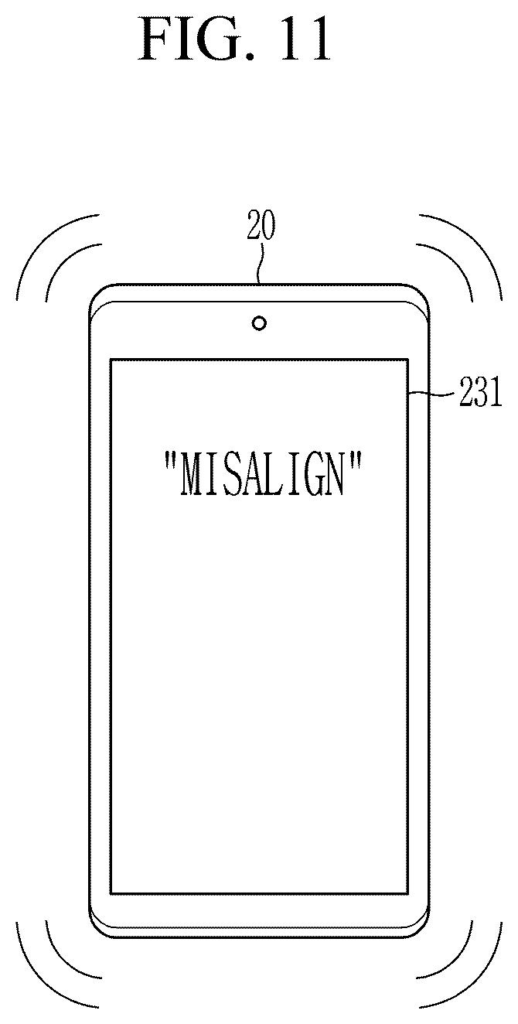
Samsung's new patent has the phone check for itself. It briefly changes how much current it draws, a few times in a row, and uses the readings to work out how well the two coils line up, on a scale where 1 is perfect. If the score falls below a set line (the filing's example is 0.9), the phone shows a MISALIGN message and vibrates.
The filing also describes a second trick. The phone sends its score to the charger, and the charger slides its own coil around inside the pad until the score improves. No magnet is needed to pull everything into place.
… an impedance control circuit disposed between the rectifier circuit and the regulator circuit, and configured to perform an operation of changing the DC current …
Translation: It alters the electrical current internally to test how well the phone aligns with the charging pad.
How the phone scores its own coil alignment
The claimed device is the receiving side, meaning the phone. A coil and a capacitor (together called an LC circuit) pick up power from the charger's magnetic field. A rectifier turns that back-and-forth signal into steady direct current (DC), and a regulator turns the DC into the voltage the battery charger needs.
Between those two sits an impedance control circuit, a part that can change how much current the phone draws, a bit like adjusting a tap. The phone sets the current to two or three different levels and, at each one, measures the load impedance (how much the phone's internal circuitry resists the incoming power) from the voltage and current. A coupling coefficient estimator then uses those readings to calculate a number up to 1 that describes how much of the charger's magnetic field reaches the phone's coil.
Before measuring, the phone sends a control error packet (a standard Qi charging message) asking the charger to hold its voltage steady, so the readings are comparable. One version also switches an extra capacitor in and out and watches the voltage to learn a sign the math needs.
If the score is under the threshold, the phone shows a warning and vibrates. The filing also describes the charger moving its coil: if the latest score is better than the last, it keeps going in the same direction, and if it's worse, it reverses.
… a coupling coefficient estimator configured to calculate an estimated coupling coefficient value between the coil and an external coil, based on the DC current and a load impedance …
Translation: This math component figures out how closely the phone and charger coils line up by analyzing current and resistance.
Why a crooked phone charges slower and hotter
If you charge your phone overnight on a wireless pad, a crooked fit can cost you speed and add heat, and the filing names exactly that as the problem. Samsung's patent would have your phone tell you when it's off, so you can nudge it back instead of finding out later.
It also gives the charger a way to help. Some chargers use magnets to snap a phone into place; this filing describes a phone that reports its alignment score and a pad that slides its coil toward a better spot. The filing also lists tablets, smartwatches and headsets as devices that could use the same measurement, so the check could apply well beyond phones.
Samsung's 289th filing in our cell phone patent coverage since May follows a triple-fold rubber edge guard and a faster shadow-and-highlight camera fix among the 288 we've tracked.
The shortest route to a product here is the phone-side alert. A charging phone already has a coil, a power chip, a screen and a vibration motor, so the new work is mostly a small circuit that varies the current, plus some math to turn the readings into a score.
The filing says the scoring can run as software on the power chip's controller, while the current-changing circuit is hardware. The cleanest version is a phone built with that circuit from the start.
The sliding-coil charger is a longer trip. The filing says the coil moves inside the pad but never describes a motor or mechanism, so a charger with moving parts would need designing from scratch, and it only helps people who buy it. The alert looks like the realistic first step, and the moving pad is a bonus.
Get our take in your Top Stories
Liked this breakdown? Add Patentlyze as a preferred source on Google, and our plain-English take shows up more often in your Top Stories the next time Samsung patent news breaks.
There are more where this came from
We read every patent application Big Tech publishes and send you the ones worth knowing. Plain English, free, every week.
The drawings
16 drawing sheets from US 2026/0352038 A1 · click any drawing to enlarge


Show the other 8 sheets


Want this weekly breakdown for a company we don't cover? Patentlyze Pro →
Be the first to weigh in