
Samsung Patents a Rubber Edge Guard for Phones That Fold Three Times
A phone that folds twice has to leave a gap in its frame wherever the screen bends, and dust loves a gap. Samsung's patent application describes a rubber edge guard, stiffened with firmer inserts, to plug it.
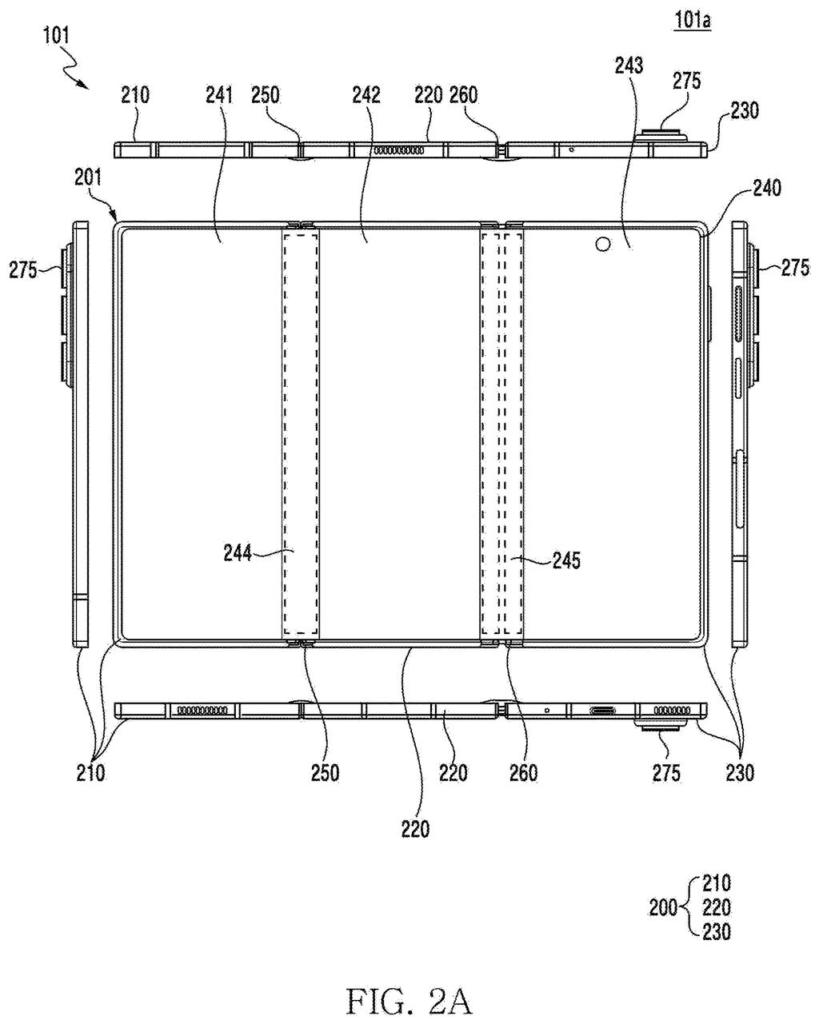
What Samsung's triple-fold edge guard does
Imagine a phone that opens into a tablet-sized screen with two bends, like a brochure folded in thirds. Each time you fold it, the screen curls around a hinge, and the trim that normally guards the screen's edge has to step aside at those spots. That leaves a gap where crumbs, lint and grit can slip in.
Samsung's patent application describes a strip of rubber that runs along the exposed edge and bends with the screen, plus thin, firmer inserts that help guide how it bends and protect the flat areas next to the bend. The middle hinge is wider than the outer one so a whole panel can tuck inside the fold, so that stretch gets the longer strip.
A soft bumper on the hinge cover also stops the folded panel from scuffing as it closes. In short, Samsung is building a small shock absorber and dust plug around the screen's most exposed spots.
a housing including a first housing, a second housing, and a third housing; a first hinge assembly rotatably connecting the first housing and the second housing; a second hinge assembly, rotatably connecting the second housing and the third housing, having a width wider than the first hinge assembly; …
Translation: The phone uses three connected sections and two hinges of different widths to fold up multiple times.
How the rubber and hard inserts share the job
The filing describes a phone with three housing sections joined by two hinges. The second hinge is wider than the first, which makes room for one section to sit between the other two when the phone is folded shut. Where the screen bends, the frame trim (the border pieces that normally cover the display's edge) has to be left out, and that opens a gap for dirt.
To close it, the patent adds a cover made of an elastic member (a rubbery strip that stretches and springs back) with a rigid member (a firmer insert) attached. The inserts can be metal, plastic sheet or tougher silicone, and they are glued on or molded together with the rubber. The strip wraps the front and the side of the screen edge.
The description adds several details:
- The strip is thickest over the flat middle of the bend and has slits that widen as it curves.
- Slots in the inserts let the frame trim slide along as the rubber moves.
- A lip on the hinge cover presses the strip down into a U shape as the phone folds, and it is wider on the wide hinge.
- A rubber or sponge patch on that cover touches the side of the first section when folded, so the two do not rub.
… a cover disposed in a partial area of the flexible display so as to prevent the introduction of foreign substances from the outside. The cover can include an elastic member, and a rigid member coupled to a partial area of the elastic member.
Translation: A protective guard made of flexible and rigid parts blocks dust and debris from getting inside the screen.
Why the wide hinge is the weak spot
A phone with two bends has twice as many places where the screen's edge is exposed, and Samsung's own description says the trim has to be left out at each bend. For you, the payoff would be a folding screen that is less likely to pick up grit or take damage from a knock or from the phone's own panels.
For Samsung, a filing like this shows the engineering effort that goes into making multi-fold hardware survive daily use. It is a patent application, so it does not mean a product with this exact design is coming, but it shows the problems the company is working through: dust, impact and wear around a wide hinge.
Samsung's 94th filing we've tracked on our foldable phone watchlist since May follows patents for a phone that folds twice and shrinking the screen gap.
Every layer here costs something. A rubber strip that sits on the screen's edge adds a visible lip around the bend, and rubber can pick up lint or wear down after many folds. The filing also stacks on slits, inserts, a pressing lip and a bumper, so there are more small parts that could loosen or crack.
The trade still reads as worth it. The alternative is an open gap right at the spot where the screen bends hardest, and grit in that gap is a familiar complaint about folding phones. A little extra bulk and a few more parts is a fair price to keep the screen's edge safe.
Get our take in your Top Stories
Liked this breakdown? Add Patentlyze as a preferred source on Google, and our plain-English take shows up more often in your Top Stories the next time Samsung patent news breaks.
There are more where this came from
We read every patent application Big Tech publishes and send you the ones worth knowing. Plain English, free, every week.
The drawings
33 drawing sheets from US 2026/0352751 A1 · click any drawing to enlarge


Show the other 25 sheets


Want this weekly breakdown for a company we don't cover? Patentlyze Pro →
Be the first to weigh in