
Qualcomm Patents a System That Lets Video Callers Block Filters on Their Own Face
Imagine joining a video call and discovering the other person's app has quietly swapped your face with a cartoon — without your knowledge. Qualcomm is filing a patent that would let the person being filmed decide whether that's allowed.
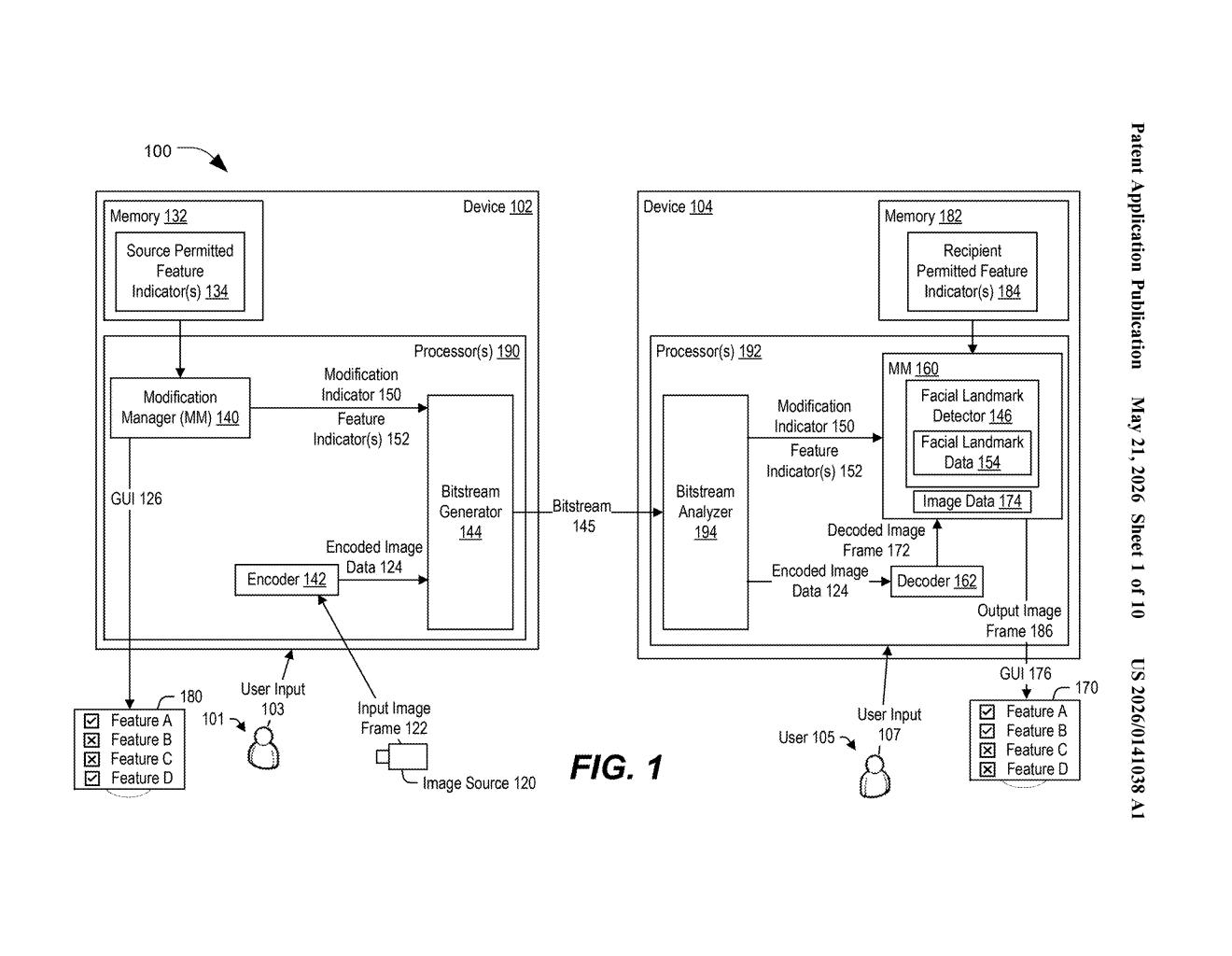
What Qualcomm's sender-controlled video filter system does
When you're on a video call, the app on the other person's phone can sometimes apply filters, background swaps, or facial modifications to your image as it displays on their screen. You might not even know it's happening. Qualcomm's patent proposes giving the sender — the person whose face is being streamed — a way to say "yes" or "no" to that.
The idea is straightforward: your device embeds a small flag inside the video data you're transmitting. That flag tells the recipient's device whether it's allowed to run image-modification effects on your video or not. If you've said no, the receiving app is supposed to respect that and show your unmodified image.
This is less about technical novelty and more about putting consent controls into the video codec pipeline itself, rather than relying on app-level policies that vary platform to platform.
How the modification indicator travels inside the bitstream
The patent describes a sender device — your phone or laptop — that encodes video frames and bundles a modification indicator alongside the compressed image data inside the outgoing bitstream (the stream of data sent over the network during a video call).
That modification indicator is essentially a binary flag: permitted or prohibited. On the recipient's side, a bitstream analyzer reads the flag before the decoded frame ever reaches the display pipeline. If the flag says prohibited, the recipient device is instructed not to apply facial landmark detection, filters, or other image modification features to that frame.
The patent also references facial landmark detection — a technique where software maps the geometry of a face (eyes, nose, jawline) to enable effects like AR masks, beauty filters, or expression tracking. The system is specifically designed to gate whether that detection pipeline even runs on received frames.
- Sender encodes frame + embeds modification indicator in bitstream
- Recipient's bitstream analyzer reads the indicator
- Downstream modification pipeline is allowed or blocked accordingly
- Output image frame is either filtered or left untouched based on sender's preference
What this means for video call privacy and consent
As video calling becomes infrastructure for everything from job interviews to medical consultations, the question of who controls how your face is rendered on someone else's screen is genuinely underexplored. Right now, that control sits entirely with app developers and the recipient's device settings — not you.
Qualcomm makes the chips and modem silicon that power a huge slice of Android devices, so a codec-level consent mechanism like this could realistically become a platform feature rather than an app-by-app choice. If this lands in a future Snapdragon video processing stack, developers building on top of it would inherit the sender-permission model automatically — which is a more durable solution than hoping every app implements its own consent UI.
This patent tackles a real and underappreciated problem: the person being filmed has almost no say in how their image is processed on someone else's device. Embedding consent at the bitstream level is the right architectural instinct — it's harder to bypass than app-layer policies. Whether Qualcomm can push adoption across a fragmented Android ecosystem is the harder challenge, but the underlying idea is worth paying attention to.
There are more where this came from
We read every patent application Big Tech publishes and send you the ones worth knowing. Plain English, free, every week.
Want this weekly breakdown for a company we don't cover? Patentlyze Pro →