Samsung
Samsung · Chip · Filed Nov 12, 2025 · USPTO published May 14, 2026 · May 14 release
Samsung Patents a Voltage-Sensing Protection System for Gas Cooking Appliances
A gas burner's ignition system is surprisingly vulnerable to electrical spikes — Samsung's latest patent describes a smart circuit that steps in automatically when voltage gets too high, potentially extending the life of ignition components and reducing failure risk.
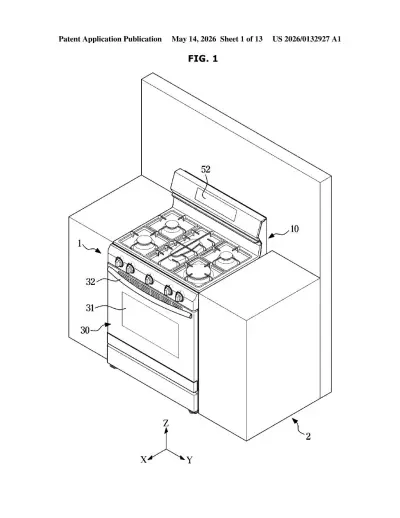
- Publication number
- US 2026/0132927 A1(US20260132927A1)
- Applicant
- SAMSUNG ELECTRONICS CO., LTD.
- Filed · Published
- Nov 12, 2025 · May 14, 2026
- Inventors
- Shinkyum KIM, Taewoo KIM
- Status when we published
- Waiting for an examiner
- Document
- 15 claims
- US classification
- 126/39R
- Parent application
- Continuation of PCT/KR2025/015278 (filed Sep 29, 2025)(PCTKR2025015278)
What Samsung's automatic burner protection actually does
Imagine your gas stove's ignition clicking away every time you turn a burner on. That little spark is generated by an electrical circuit, and like any electrical component, it can be damaged if too much voltage runs through it — especially in homes where power supply can be inconsistent.
Samsung's patent covers a cooking appliance that watches the voltage going to the ignition system in real time. If it climbs above a set threshold, a switching element automatically connects a current-limiting component into the circuit, acting like a pressure-relief valve to keep the current at a safe level.
The result: your burner's ignition hardware is less likely to be fried by an unexpected voltage surge. It's the kind of quiet, protective engineering that you'd never notice — until it saves you from a repair call.
How the voltage sensor triggers the current-limiting circuit
The patent describes a gas cooking appliance built around a feedback loop between a voltage sensor, a controller, and a pair of circuit elements.
Here's how the pieces fit together:
- Voltage sensor — continuously monitors the electrical voltage being applied to the burner's ignition device.
- Current limiting element — a component (likely a resistor or similar passive device) that reduces how much current flows through the circuit when inserted.
- Switching element — acts like an electronically controlled gate that can connect or disconnect the current limiter from the burner circuit on command.
- Controller — the decision-maker: when the detected voltage exceeds a defined first voltage threshold, it tells the switching element to bring the current limiter online.
The logic is straightforward: under normal voltage conditions, the current limiter stays out of the circuit so ignition performance isn't degraded. But when voltage climbs dangerously high — due to grid fluctuations or other causes — the controller intervenes within milliseconds to protect the ignition hardware.
The patent also references memory and communication circuitry, suggesting the controller could log events or potentially report faults remotely, though those aspects aren't central to the core claim.
What this means for gas range reliability and safety
Gas ranges are sold globally into homes with wildly varying power supply quality — voltage instability is a real-world problem in many markets where Samsung competes. A built-in voltage protection system could meaningfully reduce ignition component failures, which are one of the more common (and annoying) gas appliance repair issues. For Samsung, it's a differentiator that's easy to manufacture into existing designs at low cost.
For you as a consumer, this kind of protection is invisible when it works — but it's the difference between a stove that keeps sparking reliably for a decade and one that needs a service visit after a bad storm. It's not glamorous engineering, but it's exactly the sort of thing that drives long-term brand loyalty in home appliances.
Source: US 2026/0132927 A1 at the USPTO (PDF). Full patent text and figures are in the official publication.
Get our take in your Top Stories
Liked this breakdown? Add Patentlyze as a preferred source on Google, and our plain-English take shows up more often in your Top Stories the next time Samsung patent news breaks.
Add Patentlyze on Google
One click.
There are more where this came from
We read the new patents from Big Tech, carmakers and more and send you the ones worth knowing. Plain English, free, every week.
More from Samsung
All 1,662 Samsung patents →
More in Chip
All 651 Chip patents →
Qualcomm
Qualcomm Patents Technology to Wake Up Phone Processors Faster at Boot
Intel
Intel Patents Memory That Erases Itself After Being Read Once
Qualcomm
Qualcomm Patents a Backup Channel That Keeps Chiplets Running After a Link Failure
Qualcomm