Intel
Intel · Chip · Filed Dec 23, 2025 · USPTO published Jul 9, 2026 · Jul 9 release
Intel Patents a Way to Keep Ray-Traced Graphics Running Without Full Scene Rebuilds
Every time an object moves in a ray-traced scene, the invisible map that guides light rays can silently fall apart. Intel's new patent is a way to catch that decay before it tanks performance, without throwing out the whole map and starting over.
- Publication number
- US 2026/0195970 A1(US20260195970A1)
- Applicant
- Intel Corporation
- Filed · Published
- Dec 23, 2025 · Jul 9, 2026
- Inventors
- Matthaeus Georg Chajdas, Sebastian Bjorn Herholz, Pierre Serge Boudier, Graham John Sellers, Marcus Rogowsky
- Status when we published
- Waiting for an examiner
- Document
- 18 claims
- US classification
- 345/419
What Intel's ray-tracing quality monitor actually does
Imagine your GPS has a road map that slowly becomes inaccurate as construction changes the roads. You could reprint the entire map every few minutes, or you could track which roads have changed and only update those. Ray-traced games face a similar problem.
Ray tracing, the rendering technique that makes light in games look realistic, relies on a hidden structure called a bounding volume hierarchy (BVH for short) to figure out which surfaces a light ray hits. When characters and objects move around, that structure warps and becomes inefficient, like a filing cabinet where the folders have drifted out of alphabetical order.
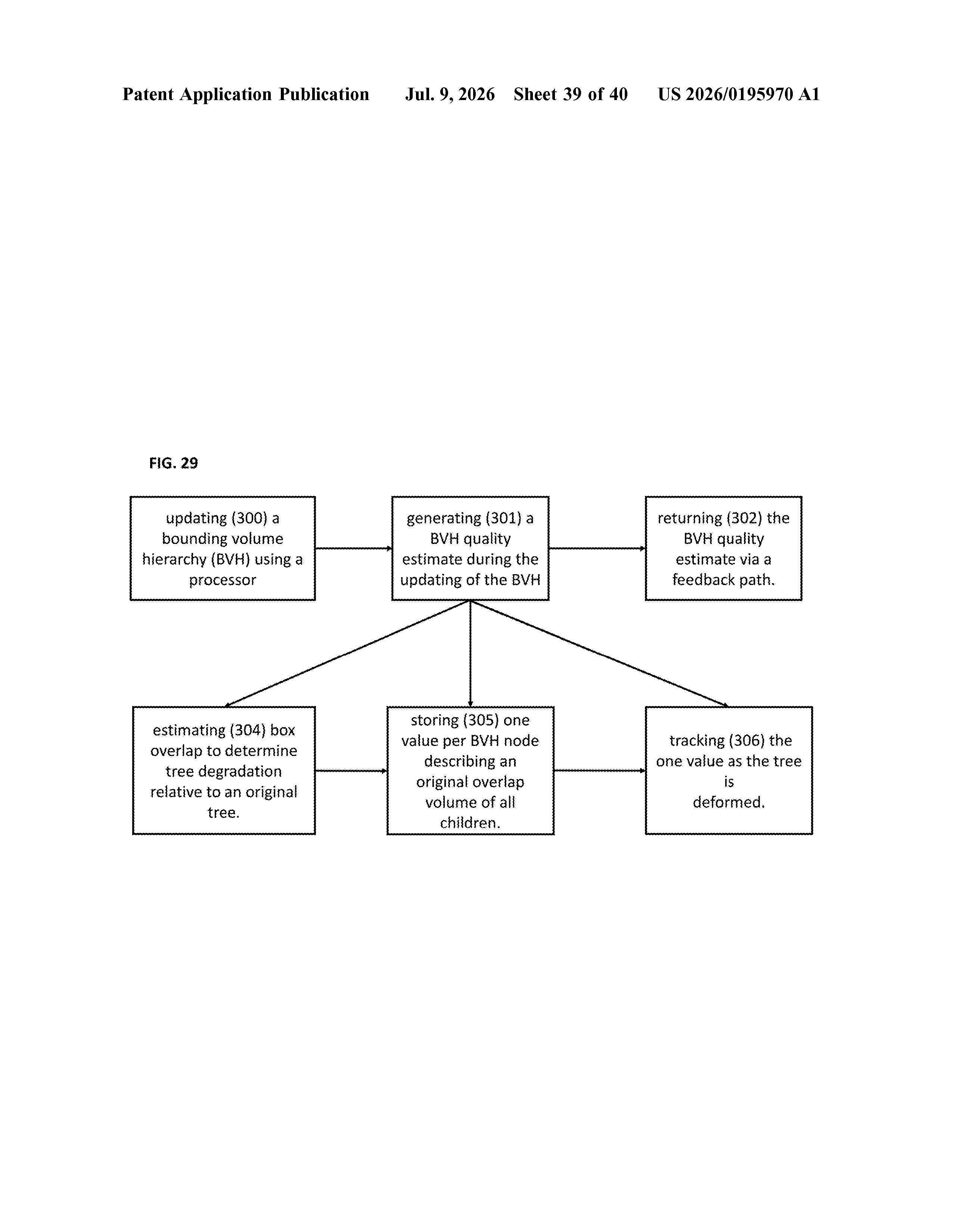
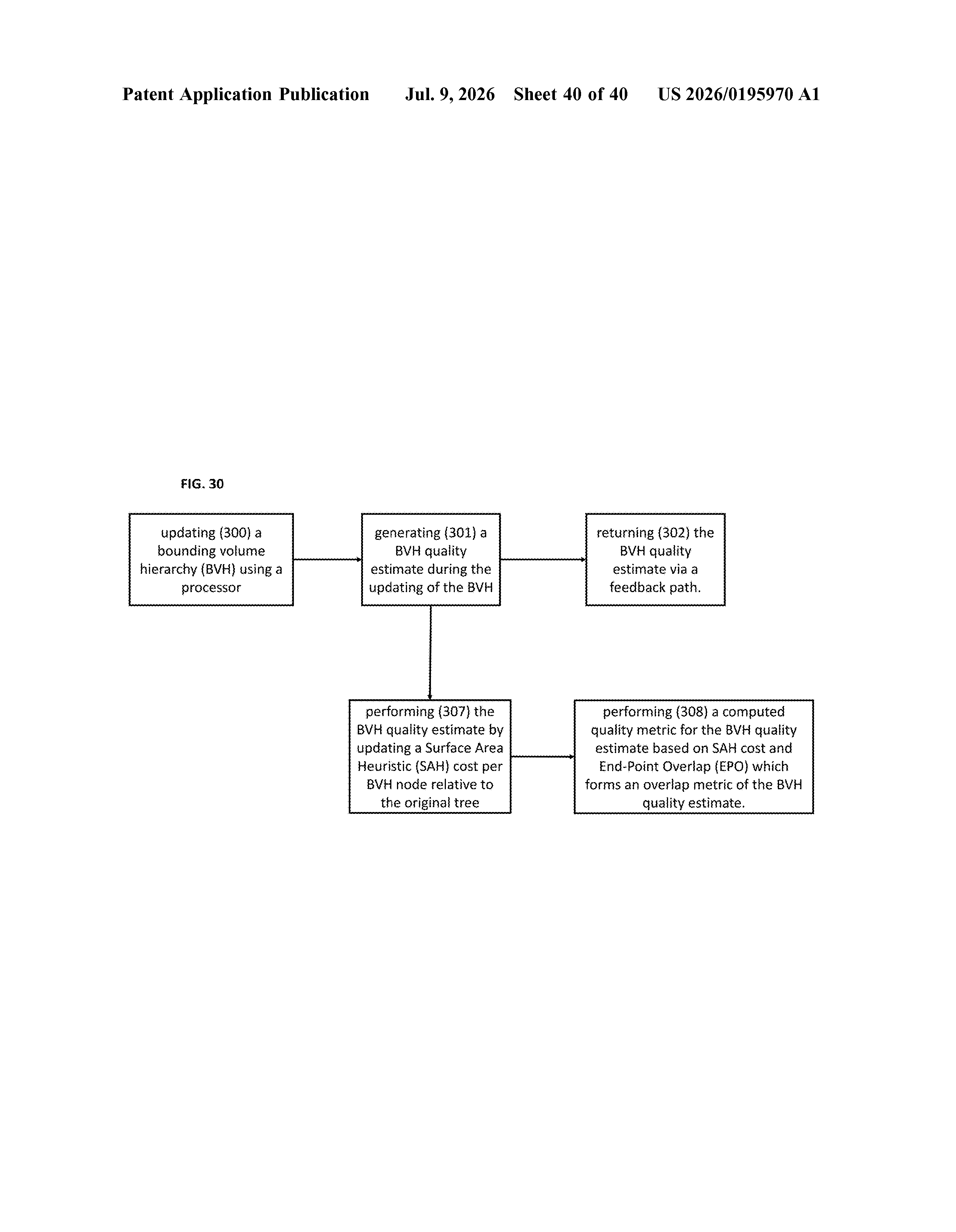
Intel's patent describes a system that watches the BVH as it updates and scores how degraded it has become, node by node. Instead of rebuilding everything from scratch whenever anything moves, the system flags only the parts that have truly fallen apart. For you as a player, that could mean smoother frame rates in complex scenes without sacrificing image quality.
How the feedback path scores each node's overlap
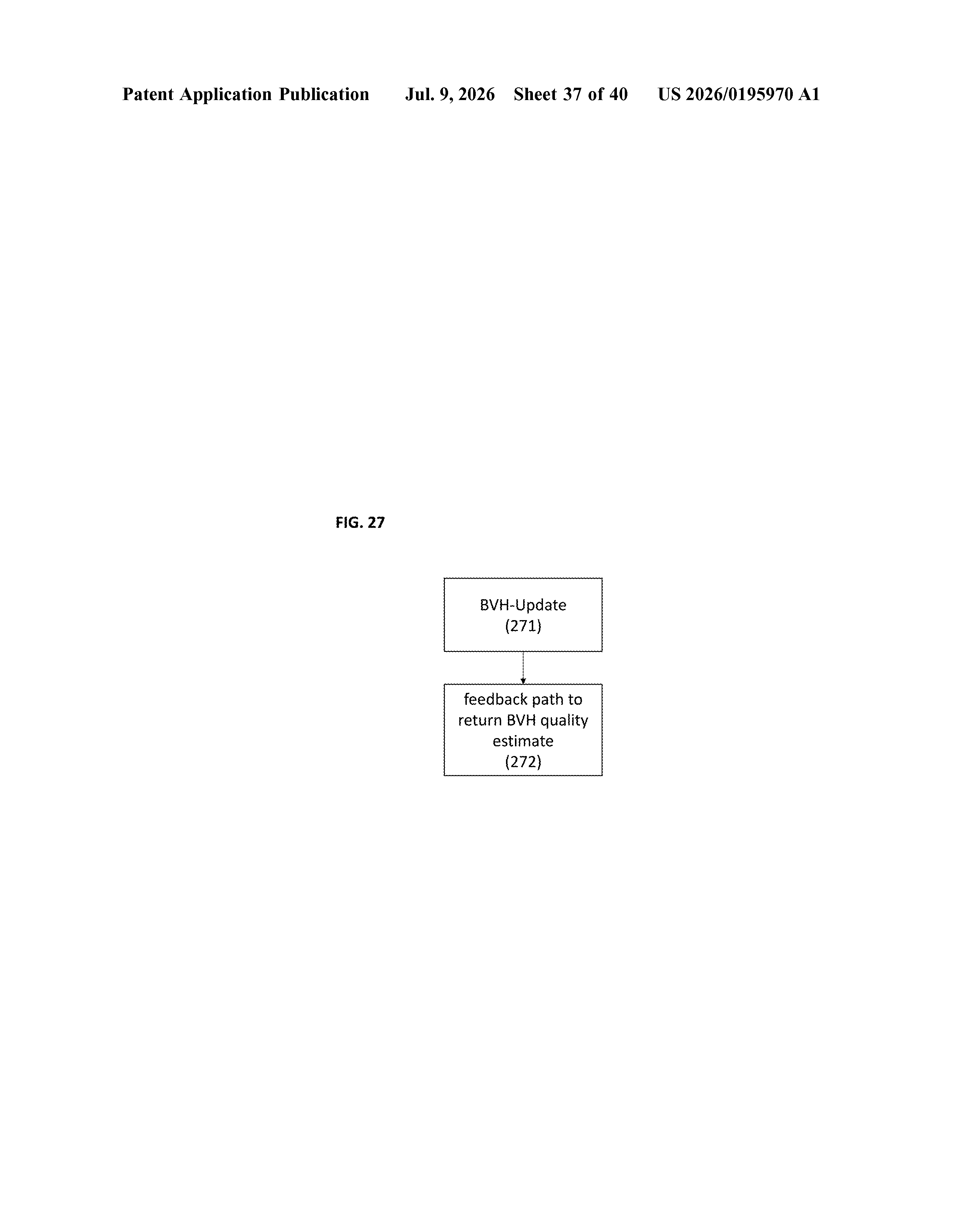
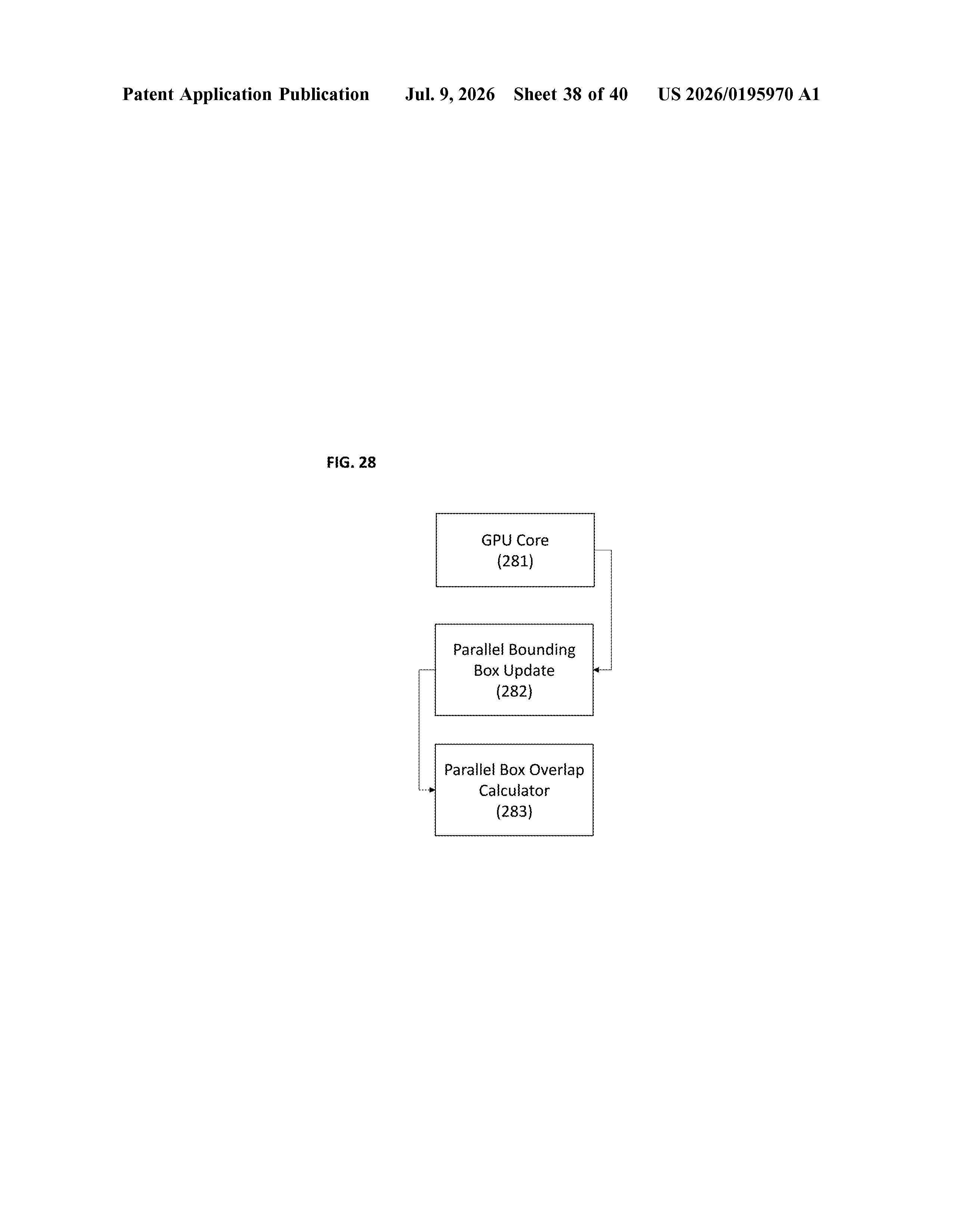
The patent centers on a feedback path added to the BVH update pipeline. A BVH is a tree-shaped data structure where each node is a box that contains geometry. When moving objects distort the scene, the boxes start overlapping each other badly, forcing the GPU to check far more surfaces than it should. That extra work slows down rendering.
Intel's system tracks a quality estimate per node by storing one value that describes how much the children of each node originally overlapped. As the tree deforms over time, the system compares current overlap against that baseline. When the degradation crosses a threshold, it sends a rebuild indication for just that subtree.
The patent also mentions several additional signals the system can monitor:
- A child-child overlap matrix that measures pairwise overlap between sibling nodes
- Preferred axis swap data (whether the dominant spatial axis of a bounding box has rotated, meaning the box is now pointing the wrong way)
- Aspect ratio changes (whether a box has stretched into an inefficient sliver shape)
- Active triangle counts (whether geometry inside a node has been culled or removed)
The combined signal lets the system choose between two cheaper alternatives to a full rebuild: a refit, which just tightens existing boxes around moved geometry, versus a targeted rebuild of the degraded subtree only. Parts of the tree that are still healthy get left alone entirely.
What this means for real-time ray tracing in games and GPUs
BVH management is one of the less glamorous but genuinely important bottlenecks in real-time ray tracing. Right now, engines typically pick one strategy for a whole scene and stick with it, even if only a corner of the scene is causing problems. Intel's approach would give the GPU (or driver) finer-grained control, potentially reducing wasted work in dynamic scenes with lots of moving parts, like a crowd, a particle system, or a destructible environment.
Intel has ray-tracing hardware in its Arc GPU line and its Xe-based integrated graphics, so a more efficient BVH maintenance system would be directly useful in its own products. It would also apply to any driver-level or hardware-accelerated BVH pipeline, making this relevant to the broader graphics ecosystem rather than just Intel customers.
Source: US 2026/0195970 A1 at the USPTO (PDF). Full patent text and figures are in the official publication.
Get our take in your Top Stories
Liked this breakdown? Add Patentlyze as a preferred source on Google, and our plain-English take shows up more often in your Top Stories the next time Intel patent news breaks.
Add Patentlyze on Google
One click.
There are more where this came from
We read the new patents from Big Tech, carmakers and more and send you the ones worth knowing. Plain English, free, every week.
The drawings · 40 sheets
40 drawing sheets from US 2026/0195970 A1 · click any drawing to enlarge
Show the other 32 sheets
More from Intel
All 199 Intel patents →
More in Chip
All 651 Chip patents →
Nvidia
Nvidia Patents a More Accurate Way to Light Hair and Fur in 3D Scenes
Samsung
Samsung Patents a Two-Model AI System for Producing Realistic 3D Lighting in Images
Nvidia
Nvidia Patents a Fix for How Games Track Motion Through Glass and Water
Nvidia