
Sony Files Patent for a System That Offers a Live Concert Stream When Your Car Parks Nearby
Park outside a sold-out concert and your car screen could offer the live stream, the fan club and the merch table. Sony's new patent describes software that picks what to show based on your tastes, your location and what you skip.
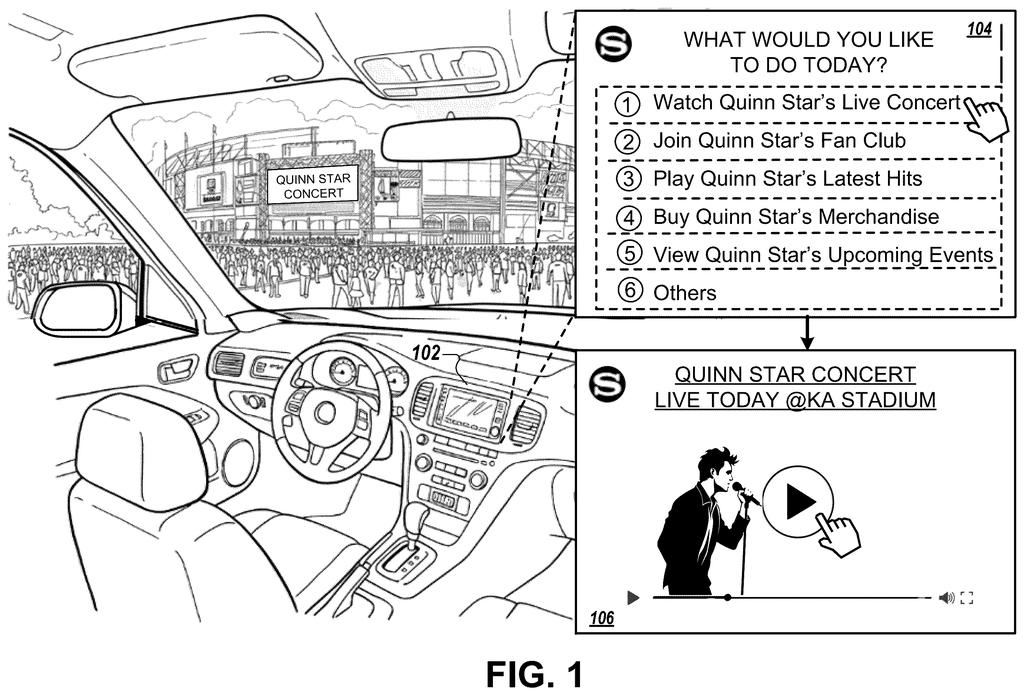
What Sony's context-aware content patent does
A driver pulls into a parking spot outside a stadium where a sold-out concert is underway. The car's screen lights up with a short menu: watch the show live, play the artist's latest hits, join the fan club, or buy merchandise.
Sony's patent application describes software that could do this for you. It builds a profile of your tastes from what you watch, play, listen to and buy, then checks where you are and what is happening nearby, and picks content to match. If you ignore or dismiss what it offers, it takes the hint and tries something different next time.
It is not only for cars. The filing also describes a runner at a 5K race whose smartwatch shows a racing heart rate, which triggers motivational messages and music on their phone. The goal is simple: show the right thing at the right moment, and stop showing what you keep skipping.
… updating a knowledge graph based on the feedback data, wherein the knowledge graph is a dynamic representation of relationships between one or more of users, rich engagement resources, locations, or contextual factors; …
Translation: It updates a digital map connecting users, media, places, and current situations.
How Sony's system learns from what you skip
The system, which the filing calls a rich engagement resource activation system, starts by turning each user into a feature vector (a long list of numbers that sums up your tastes, built from viewing history, purchases and outside data such as weather). A knowledge graph (a web of links between users, content, places and events) adds context, such as connecting a basketball fan to basketball video games.
To decide who gets an offer, a target tag such as 'Quinn Star fan' or 'runner' is also converted into numbers. Any user whose vector is similar enough, past a set threshold, counts as a match. The system then checks the real-world situation, like a nearby event, and keeps only the matched users whose location or device activity fits it.
The claimed feedback loop works like this:
- Collect feedback: clicks, shares, likes, skips, dismissals, purchases and time spent.
- Update the graph: links between a user and a type of content get stronger or weaker depending on whether the reaction was positive or negative.
- Refine the vectors: each user's number profile is adjusted using the new feedback and the updated graph.
- Pick and send: each content option gets a probability of success, the highest scorers are chosen, and they go to the user's device.
The filing lists phones, car infotainment screens, wearables, game consoles, smart TVs and computers as possible receiving devices.
… identifying one or more new target users whose user feature vectors, based on the refinement, match a target tag; determining an external real-time context relevant to the target tag; …
Translation: It spots drivers whose profiles match a specific event based on their current surroundings.
What this means for Sony's connected devices
If this ever shipped, the change you would notice most is timing. Instead of generic suggestions, your car, phone, watch or console could offer something because of where you are and what is happening around you, like a live stream outside a venue or a pump-up playlist at a race. It could also learn quickly to stop pitching things you keep dismissing.
The catch is data. The system draws on viewing and purchase history, third-party data, location and even heart rate. The filing says profiles can be anonymized and users could be given a choice over what is collected, and that choice would decide whether this feels helpful or intrusive. The filing also frames the system for companies that run many businesses at once, such as games, music, movies and electronics, which gives it plenty of data to combine.
Sony's fourth filing we've tracked since July in assistants that remember you builds on game trailers from play history and one for nursing care robots.
Anyone who has been pitched a movie they would never watch knows the problem here. Bad recommendations are everywhere, and the filing says they also waste computing power on people who were never going to care.
The fix it describes is a loop: offer something, watch what you do, adjust. Most modern recommendation systems already work that way, so the core claims are a broad bundle of familiar steps, and the solution is only as big as that loop.
The part with real texture is the physical-world trigger: your location and what is happening around you. That targets a problem people actually feel, which is offers that arrive at the wrong moment. Whether it lands will depend less on the math than on how people feel about a car that knows they are parked outside a stadium.
Get our take in your Top Stories
Liked this breakdown? Add Patentlyze as a preferred source on Google, and our plain-English take shows up more often in your Top Stories the next time Sony patent news breaks.
There are more where this came from
We read every patent application Big Tech publishes and send you the ones worth knowing. Plain English, free, every week.
The drawings
7 drawing sheets from US 2026/0320419 A1 · click any drawing to enlarge


Want this weekly breakdown for a company we don't cover? Patentlyze Pro →
Be the first to weigh in