
Sony Patent Uses Your Biometrics To Verify Virtual World Logins
Logging into a virtual world sounds simple, but proving you're really you in a persistent online space is a harder problem than most platforms admit. Sony's new patent describes a system where your device's biometric data does the confirming, not just a password.
What Sony's virtual space biometric login actually does
Ever tried to prove online that you're actually the account owner and not someone who stole your phone? That gap between "someone logged in" and "the real person is here" is exactly what this patent targets.
When you try to enter a virtual space, Sony's system doesn't just check a password. Instead, your device tells the server that your biometric information, such as a fingerprint or face scan, has already been verified and stored on your terminal. The server reads that confirmation and then decides whether to let you in. The biometric check happens on your device, not in the cloud.
The idea is that you've already proven who you are to your own hardware. The virtual space server trusts that local check rather than running its own separate identity test. It's a pattern that should feel familiar if you've ever used your face or fingerprint to authorize a banking app.
a communication section that receives, when logging in to a virtual space is requested by a terminal used by a user, registered information that is requested in the virtual space and that includes that biometric information of the user corresponding to the virtual space is registered in the terminal …
Translation: The system receives the user's saved biometric details from their device when they try to enter a virtual world.
How the server checks your device's biometric record
The patent describes an information processing apparatus (essentially a server or platform host) that manages login decisions for a virtual space.
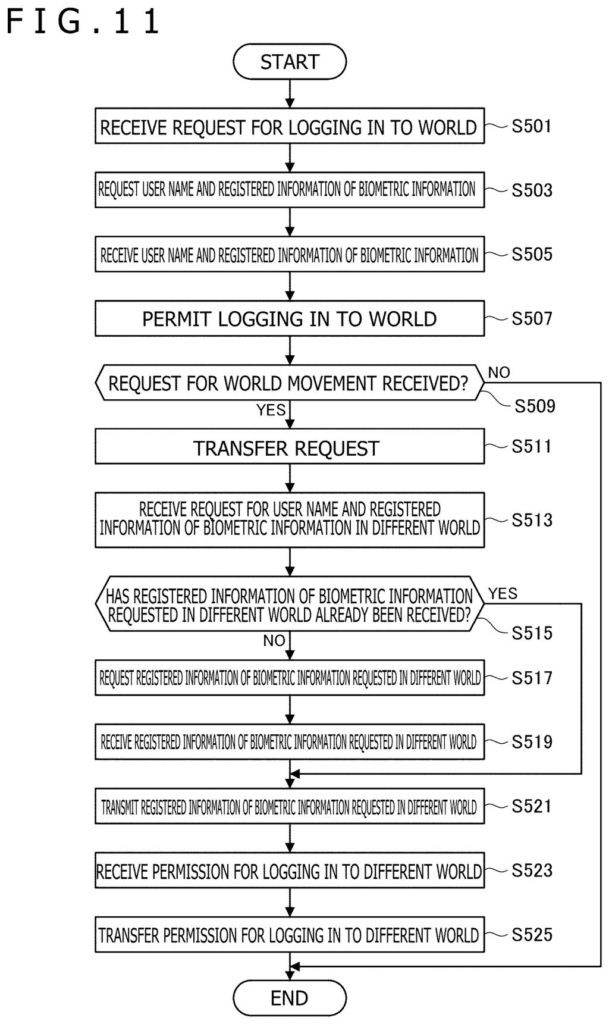
Here's how the flow works:
- A user's terminal (phone, headset, or computer) requests access to the virtual space.
- The terminal sends registered information to the server. This registered information confirms that the user's biometric data corresponding to that specific virtual space has already been enrolled and stored on the terminal itself.
- The server's permitting section reads that registered information and, if satisfied, grants the terminal entry to the virtual space.
The key design choice is where the biometric data lives. Rather than transmitting a fingerprint or face scan across the network, the system relies on the terminal having already completed enrollment. The server asks "has this device registered biometrics for this space?" rather than "send me your fingerprint now."
This approach leans on a model sometimes called FIDO-style local authentication (the idea that your device does the hard biometric matching and the server only sees a cryptographic confirmation). The claim doesn't explicitly call out FIDO, but the architecture follows that general philosophy.
… A user of a terminal that logs in to a virtual space is determined to be the user him/herself at higher accuracy.
Translation: The technology checks biometric data to make sure the person logging in is actually who they claim to be.
What this means for identity in virtual worlds
Virtual spaces, whether social platforms, gaming environments, or enterprise metaverse tools, have real identity problems. Account sharing, unauthorized access, and impersonation erode trust in ways that matter when money, reputation, or personal data are involved. A system that ties login to a device-verified biometric check adds a layer that passwords alone cannot provide.
For Sony specifically, this connects naturally to PlayStation Network and any persistent online or mixed-reality environments the company may build. The new Big Tech patents covering virtual-space identity are becoming more frequent as companies race to define how presence and authentication work in always-on digital environments, and Sony's filing stakes out a specific architectural approach: trust the device, confirm the biometric registration server-side, and grant access without moving the raw biometric data off the hardware.
That makes this Sony application the 368th we've tracked in our Sony coverage since May, a company that has filed on syncing avatars to fast limbs and faster subject detection in cameras.
Claim 1 covers any apparatus that receives confirmation of biometric enrollment on a device and uses that confirmation to grant access to a virtual space. The claim names no specific biometric, no specific platform, and no specific communication method, which makes it unusually wide. That width has real consequences if the patent is granted.
Any service that checks "did this user register a fingerprint or face scan on their device for this space?" before allowing entry could fall within the claim's reach, which describes a large and growing category of online experiences. The one phrase that might contain the claim's reach is "corresponding to the virtual space," which implies the biometric enrollment is tied to a specific space rather than the device generally.
Whether that distinction is enough to separate this patent from existing authentication systems is the question an examiner will have to answer, and it is not an easy one.
Get our take in your Top Stories
Liked this breakdown? Add Patentlyze as a preferred source on Google, and our plain-English take shows up more often in your Top Stories the next time Sony patent news breaks.
There are more where this came from
We read every patent application Big Tech publishes and send you the ones worth knowing. Plain English, free, every week.
The drawings
10 drawing sheets from US 2026/0252674 A1 · click any drawing to enlarge


Want this weekly breakdown for a company we don't cover? Patentlyze Pro →
Be the first to weigh in