
Microsoft Patents a Login System That Picks the Right Security Test for Each User
Not every security challenge fits every person or device, and Microsoft thinks the mismatch is costing users and security teams alike. This patent proposes a system that studies your device before deciding which verification test to throw at you.
How Microsoft's adaptive login challenge actually works
A locked door sits at the end of a hallway, and the guard has only one key for everyone. That single-size approach to login security is exactly what Microsoft is trying to fix.
When you try to log into a protected account or system, you usually get whatever verification test the platform happens to default to, whether that's typing distorted letters, clicking traffic lights, or answering a knowledge question. The system described in this patent instead looks at information about your specific device and the full menu of available challenges, then scores each challenge for how well it fits you. Only the challenges that clear a suitability threshold make the shortlist, and you get one of those.
The goal is a verification step that is neither too easy for an attacker to fake nor too hard for a legitimate user to pass on their particular device. Think of it as security that tries to meet you where you are, rather than forcing you to meet it on its own terms.
… generating, based on the challenge features and the user features, suitability scores for the challenges; building, based on the suitability scores, a subset of the challenges, wherein the subset of the challenges is selected to meet a suitability threshold; …
Translation: The system calculates how appropriate each security test is for the user to create a customized list of options.
How the system scores and filters challenges per device
The patent describes a two-track feature-generation process. On one track, the system produces challenge features, essentially a profile of every available verification test: its difficulty, format, accessibility requirements, and so on. On the other track, it produces user features drawn from the device making the login attempt, things like device type, browser capabilities, network context, and behavioral signals.
Those two sets of features feed into a scoring model that outputs a suitability score for each possible challenge. The scores represent how appropriate each test is for this user, on this device, at this moment. Challenges that fall below a configurable suitability threshold are dropped from consideration entirely.
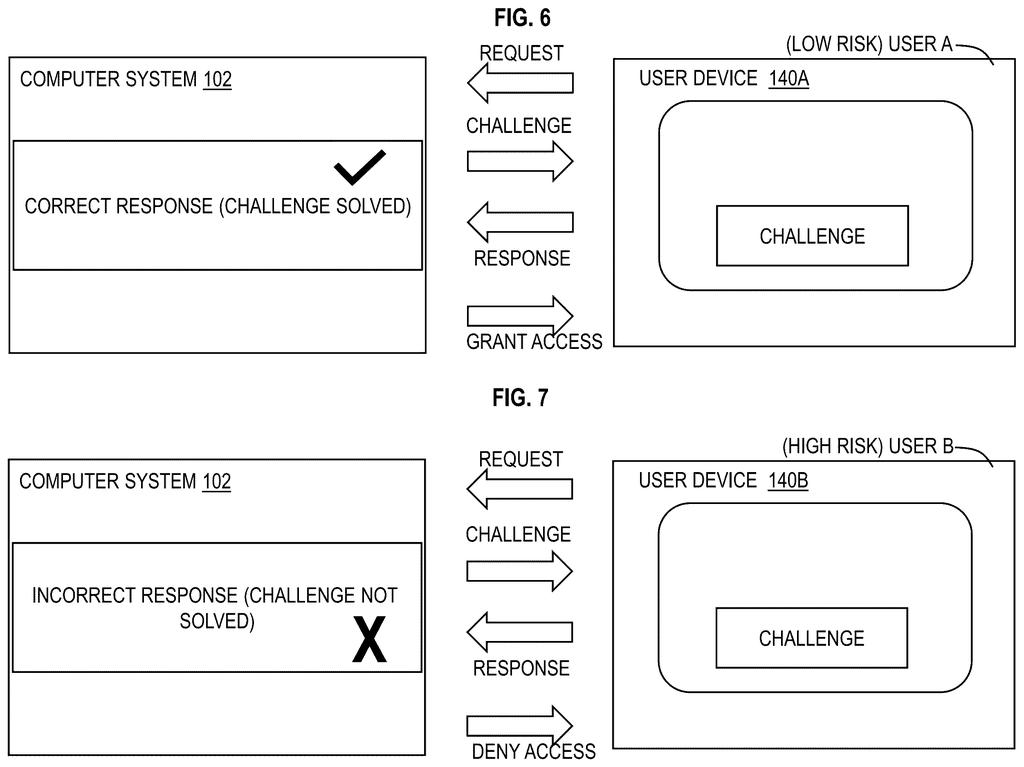
What remains is a filtered shortlist. The system picks one challenge from that shortlist and presents it to the user. The user's response then determines whether they gain access to the protected system.
The title references conformal uncertainty calibration, a statistical technique (borrowed from machine learning) that attaches reliable confidence intervals to predictions rather than just outputting a raw score. In plain terms, it means the system knows not just which challenge looks best, but how confident it is in that ranking, which matters when the cost of a wrong call is unauthorized access.
Aspects of the disclosure include methods and systems for an adaptive risk-based challenge system. A method includes generating challenge features for challenges and generating user features for a user device.
Translation: The invention covers a security setup that adapts its verification steps based on device data and risk levels.
What this means for everyday account security
Account takeover and bot-driven credential stuffing are genuinely expensive problems. When the verification layer is one-size-fits-all, attackers can train specifically to defeat the most common challenge type, because they know in advance what they are going to face. A system that varies the challenge based on device context raises that cost: an attacker has to be ready for multiple test types simultaneously.
For real users, the flip side is also meaningful. Accessibility-unfriendly challenges (distorted text, color-dependent image grids) can lock out people with visual impairments or older hardware, creating friction for legitimate users while determined attackers find workarounds anyway. Microsoft's approach, at least on paper, tries to route users toward challenges they can actually complete. Security-focused interesting tech patents in the identity and access-management space have been multiplying as bot attacks grow more targeted, and this filing sits squarely in that stream.
Microsoft's 326th filing among the patents we've tracked since May includes work like the atom-by-atom drug builder and one-tap device pairing, all part of our Microsoft coverage.
Account verification fails hundreds of millions of people every day. Mismatched security puzzles cause lockouts, costly support calls, and real breaches. Choosing the right puzzle based on what device a person is actually using is a fair, measured fix, not overkill.
The extra layer here is that the system also knows when it is not sure of itself. A system that admits uncertainty is more trustworthy than one that guesses boldly every time. In security, a wrong call has direct consequences, so that difference matters.
Get our take in your Top Stories
Liked this breakdown? Add Patentlyze as a preferred source on Google, and our plain-English take shows up more often in your Top Stories the next time Microsoft patent news breaks.
There are more where this came from
We read every patent application Big Tech publishes and send you the ones worth knowing. Plain English, free, every week.
The drawings
11 drawing sheets from US 2026/0244721 A1 · click any drawing to enlarge


Want this weekly breakdown for a company we don't cover? Patentlyze Pro →
Be the first to weigh in