
Sony Patents a Finger-Gripping Device That Pushes Back Against Your Touch
Sony has filed a patent for a device that wraps around a single finger and pushes back against it from multiple directions, simulating the physical resistance you'd feel when touching or gripping something in the real world.
What Sony's finger-gripping force feedback device actually does
A gamer reaches out in a VR game to grab a virtual rock. Right now, their hand closes on nothing. Sony wants to fix that.
The patent describes a small device that holds your finger snugly, clamping it from at least two sides. Inside that casing, a tiny moving part can press against the pad of your finger, the tip, the sides, or even the area near your nail. Each push is a signal your brain reads as physical resistance, the same signal it gets when you press your thumb against a table.
The result is that a virtual object could feel like it's actually pushing back. Pick up a virtual ball and feel it pressing into your fingertip. Drag a heavy crate and feel friction on the sides of your finger. It's the kind of physical feedback that today's controllers, with their simple rumble motors, can't come close to replicating.
a holding unit configured to hold a user's finger from at least two directions; and a haptic presentation unit comprising a movable member being movable in three axial directions perpendicular to one another and being disposed inside the holding unit at a position where the movable member is configured to come in contact with the user's finger held by the holding unit …
Translation: It holds your finger and moves a small piece in three directions to push against your skin.
How the movable pin pushes on each side of your finger
The patent describes a two-part system. The first part is a holding unit, a housing that wraps around and grips a user's finger from at least two directions, keeping it securely positioned inside the device.
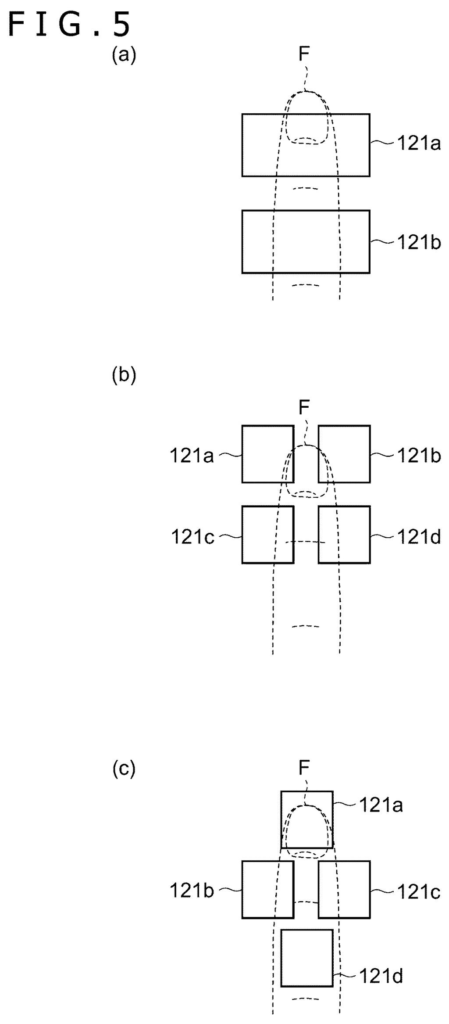
The second part is the haptic presentation unit, which sits inside that housing. Its core component is a movable member, essentially a small pin or pad that can travel along three independent axes simultaneously (think left-right, forward-back, and up-down). Because it moves in three dimensions at once, it can press against any surface of the enclosed finger: the soft pad on the bottom, the harder nail surface on top, or either of the two sides.
The claim is intentionally broad. The system does not specify a single motor type or a fixed contact point. Instead, it establishes the principle that a contained, multi-axis actuator touching multiple finger surfaces can deliver directional force feedback (the sensation of being pushed in a specific direction, not just vibrated).
- Holding unit grips the finger from multiple sides for stable positioning
- Movable member travels in three perpendicular axes independently
- Contact is possible at pad, left side, right side, and nail surface
- The output is directional force, not simple vibration
… at least one of areas including at least the pad side, left side, right side, and nail side of the user's finger held by the holding unit …
Translation: The device can target the bottom, sides, or top of your finger.
What this means for VR gloves and haptic controllers
Current haptic technology in gaming controllers is mostly vibration: motors that shake the whole device to hint at an explosion or a road bump. That works for broad context but tells your fingers almost nothing about what they're touching. A device that can press against specific points on a single finger is a meaningful step toward touch that actually informs you.
For VR and robotics, the difference matters a lot. Surgeons training on simulated tissue, designers sculpting virtual objects, or players who want physical weight in their game worlds all hit a wall with shake-only feedback. a growing pile of Sony haptics filings suggests the company sees finger-level force feedback as a real part of its PlayStation ecosystem roadmap, not a side experiment. Whether this particular design ever ships is a separate question, but the problem it addresses is concrete and the approach is more targeted than anything in modern consumer controllers.
Sony's 23rd filing we've tracked in input and haptics since May follows ideas like jolting hands between actions and paying through a controller.
VR has convincing visuals and spatial audio, but your hands feel nothing, and that absence breaks the illusion faster than any graphical flaw. Fingertips are among the most sensitive parts of the human body, finely tuned to detect direction, pressure, and texture, so fooling them demands a serious mechanical effort.
Sony's approach wraps the finger and pushes from multiple sides simultaneously, which is physically the right way to simulate directional force rather than just buzzing at you. That ambition matches the scale of the problem.
Whether a device gripping your finger firmly enough to actually work will feel comfortable across a long session is a question this patent cannot answer. Sony has produced compelling input research before that never became a product, and that gap between a strong idea and something people willingly wear remains the real test.
There are more where this came from
We read every patent application Big Tech publishes and send you the ones worth knowing. Plain English, free, every week.
The drawings
4 drawing sheets from US 2026/0301551 A1 · click any drawing to enlarge


Want this weekly breakdown for a company we don't cover? Patentlyze Pro →
Be the first to weigh in