
Sony Patents Technology That Keeps Avatars In Sync With Fast-Moving Limbs
When your avatar's arm lags a half-second behind your real arm, the illusion collapses. Sony is filing patents on a system that prioritizes the body parts moving fastest to close that gap.
How Sony's avatar lag fix actually works
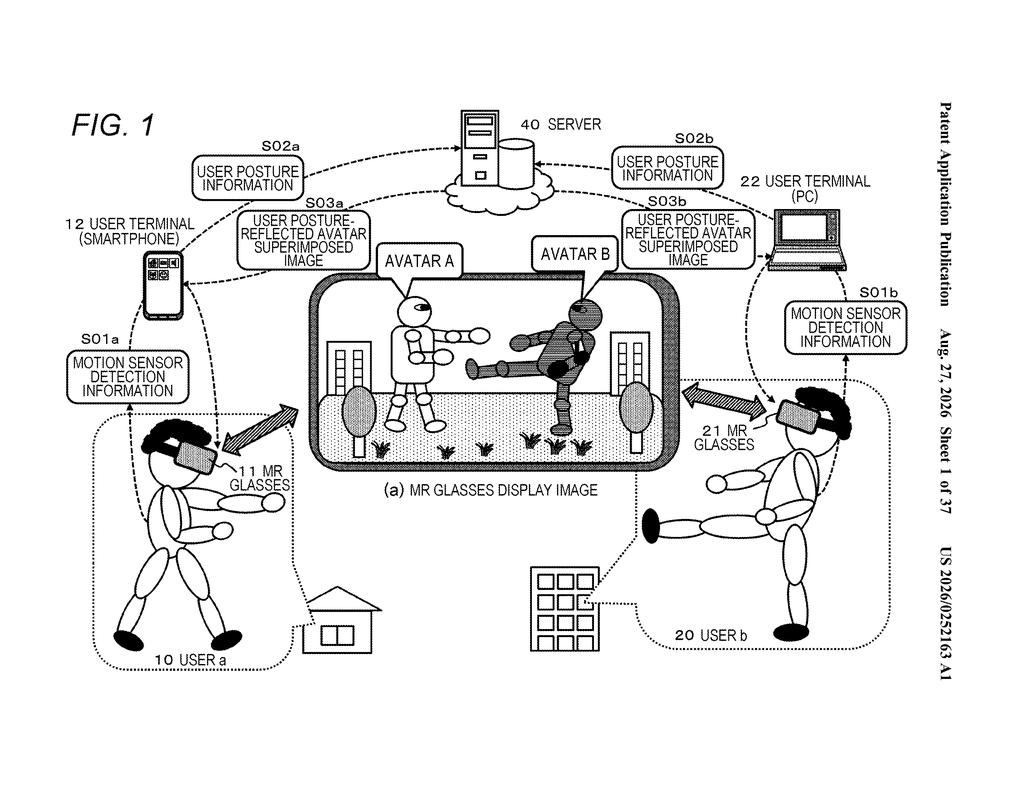
You're in a virtual meeting or online game, moving your hands and head, and your 3D avatar is supposed to mirror you in real time. But sending every sensor reading from every part of your body to a remote server takes time, and by the time the server builds and sends back your avatar image, your body has already moved on.
Sony's patent describes a smarter traffic system for that data. Your device wears motion sensors on multiple body parts, estimates your overall posture locally, and then picks out only the parts of your body moving faster than a set speed threshold. Those high-priority sensor readings get sent to a server ahead of everything else. The server uses both pieces of information, your general posture plus those fast-motion details, to correct the avatar image before sending it back.
The result is an avatar that keeps up with your quickest gestures, like a wave or a head turn, without waiting for a full-body data dump every frame.
… a sensor detection value selection unit configured to selectively acquire a sensor detection value of a part having a motion faster than a prescribed threshold …
Translation: The system singles out body parts that are moving faster than a specific speed limit.
How the system picks which sensors to prioritize
The system has two main stages running in parallel. On the user's device, a posture estimation unit reads all the body-worn motion sensors at once and builds a rough model of your current pose. At the same time, a sensor detection value selection unit scans which body parts are moving faster than a defined speed threshold and flags those sensor readings as high priority.
Only the fast-motion sensor values are transmitted to the server alongside the overall posture estimate. This reduces the data the server has to wait for before it can start rendering.
- The server receives the posture estimate and the fast-motion sensor values.
- It generates a 3D avatar image that reflects both inputs.
- Before sending the image back, it applies an image correction step that repositions the fast-moving body parts using the most recent sensor data, compensating for any time that passed during rendering.
- The corrected avatar image is transmitted back to the display.
The correction step is the key detail. Because rendering takes time, the server essentially looks ahead, using the newer sensor values to shift the avatar's limb positions to where they should be now, not where they were when rendering started. It is a form of predictive adjustment baked into the image pipeline.
… image correction of reflecting a user part position estimated based on a newer sensor detection value to generate a user posture-reflected three-dimensional avatar image …
Translation: The server tweaks the image using the freshest motion data to keep the avatar in sync.
What this means for real-time virtual presence
Avatar lag is not a fringe annoyance. In any application where your virtual self is supposed to represent you in real time, whether that is a corporate virtual meeting, a live-streamed performance, or a multiplayer game, a noticeable delay between your motion and your avatar's response breaks the sense of presence that makes those experiences worth having. The problem compounds on slower network connections, where round-trip times to a server can stretch well past 100 milliseconds.
Sony has an obvious stake in solving this across PlayStation, its VR hardware line, and broader entertainment platforms. This patent targets the lag at the data-selection level rather than simply demanding faster servers or fatter network pipes, which is a more practical approach for real-world consumer devices. For anyone tracking where spatial computing and virtual presence technology are heading, the plain-English patent summaries covering Sony's avatar and sensor filings show a company steadily building the plumbing for persistent virtual identity across its product ecosystem.
That makes this Sony's 367th filing in our Sony coverage since May, adding to work like faster subject tracking and self-powered image capture.
Avatar lag is a real problem, and it is one that scales with ambition. The more lifelike and responsive a virtual presence system tries to be, the more the latency gap punishes it. Sony is attacking a genuine friction point, not a hypothetical one.
The approach here, prioritizing fast-motion sensor data rather than transmitting everything equally, is practical engineering. It acknowledges a real constraint: bandwidth and rendering time are finite, so the system should spend its budget on the moments that matter most perceptually, which are the quick gestures your eye catches first.
The honest caveat is that this kind of optimization is incremental. It will not make avatar lag disappear; it will make it less noticeable for the motions users care about most. That is a meaningful improvement, but it is an engineering refinement rather than a fundamental rethink of how avatar systems work.
Get our take in your Top Stories
Liked this breakdown? Add Patentlyze as a preferred source on Google, and our plain-English take shows up more often in your Top Stories the next time Sony patent news breaks.
There are more where this came from
We read every patent application Big Tech publishes and send you the ones worth knowing. Plain English, free, every week.
The drawings
37 drawing sheets from US 2026/0252163 A1 · click any drawing to enlarge


Want this weekly breakdown for a company we don't cover? Patentlyze Pro →
Be the first to weigh in