
Sony Files Patent for Game Streams That Tell Your Screen When Lag Matters Most
Your screen usually has no idea whether you're in a quiet cutscene or a boss fight. Sony's patent has the game server tell it.
What Sony's game-stream hints actually do
Ever had a streamed game feel laggy right when a boss fight heats up? Part of the problem is that your device is mostly guessing what it's looking at. Cleaning up a fuzzy picture takes time, and that time shows up as delay between your button press and the action on screen.
Sony's patent has the game server stop leaving your device in the dark. Along with the video, the server sends small notes: how busy the scene is, how good the picture quality is, or whether this is a moment where fast reactions matter.
With those notes, your screen can decide on the spot. During a slow cutscene, it can spend extra effort sharpening the picture. During a frantic fight, it can skip the polish so the game answers your controls faster.
… determine display metadata indicating at least one property relating to a rendered image frame of the encoded video for making a display decision regarding the rendered image frame …
Translation: Figure out special instructions for each video frame to help the screen handle lag.
How the server packs hints into the video
On the server side, the system runs the game, draws the image frames, and compresses them into a video stream (encoding). It also works out display metadata, meaning extra information about a frame that helps the player's device decide how to show it. That information is packed in with the video and sent over.
The filing lists several kinds of hints:
- Game state: the current level, how much motion is on screen, the game's complexity mode, and how latency-sensitive the moment is (a boss fight versus a cutscene).
- Complexity: spatial (how much detail is in a frame) and temporal (how much changes between frames).
- Quality scores: standard measures of how much the picture has degraded, such as MSE, PSNR and SSIM.
- Pre-processing: what the server already did to the video.
The server can estimate complexity from game data like music, sound effects, haptic feedback and subtitles, instead of analyzing the finished video, which would add delay. Quality numbers can be reused from the encoder's own balancing act between file size and picture quality (rate-distortion optimisation).
The hints can ride in packet headers, such as one small number per packet. On the other end, a modified decoder reads them, and the device picks post-processing like denoising or upscaling. It can also report its choice back to the server.
… a game execution unit configured to execute the game, wherein executing the game comprises rendering a plurality of image frames for display to the player …
Translation: The hardware runs the game and generates the picture frames for the user.
Why this matters for cloud gaming on weak devices
If you stream games to a phone, handheld or TV, you've probably felt the tradeoff: a sharper picture can mean slower response. A fixed setting gets one of those wrong at some point. Hints from the server let your device lean toward quality in calm scenes and toward speed when timing counts.
The filing also says sending these hints can reduce analysis work on the player's device, which could help lower-powered hardware handle game streaming. The ideas are plain enough to apply to any game streamed from a server, whether a cloud service or a console in another room. Nothing here says it's headed for a particular product.
Sony's 599th filing in our Sony coverage since May joins earlier applications like the AI game settings one and the road-projecting car one.
Claim 1 is wide. It asks for a server that runs a game, encodes the video, works out some property of a frame that helps decide how to show it, packs that property in with the video, and sends both to a player's device. It never says which property. Quality scores, scene busyness and lag sensitivity only show up in the later claims.
If granted, that breadth would reach any game server that ships frame-level hints with its stream for the screen to act on, however those hints are chosen. Claim 16 adds the receiving side: a device that gets the hints and makes a display decision from them. So the player's device is covered along with the server.
The most interesting detail sits in a dependent claim, the hint about how latency-sensitive the current stage of the game is. The idea itself is simple, and the claim is drafted wide enough to make it matter.
Get our take in your Top Stories
Liked this breakdown? Add Patentlyze as a preferred source on Google, and our plain-English take shows up more often in your Top Stories the next time Sony patent news breaks.
There are more where this came from
We read every patent application Big Tech publishes and send you the ones worth knowing. Plain English, free, every week.
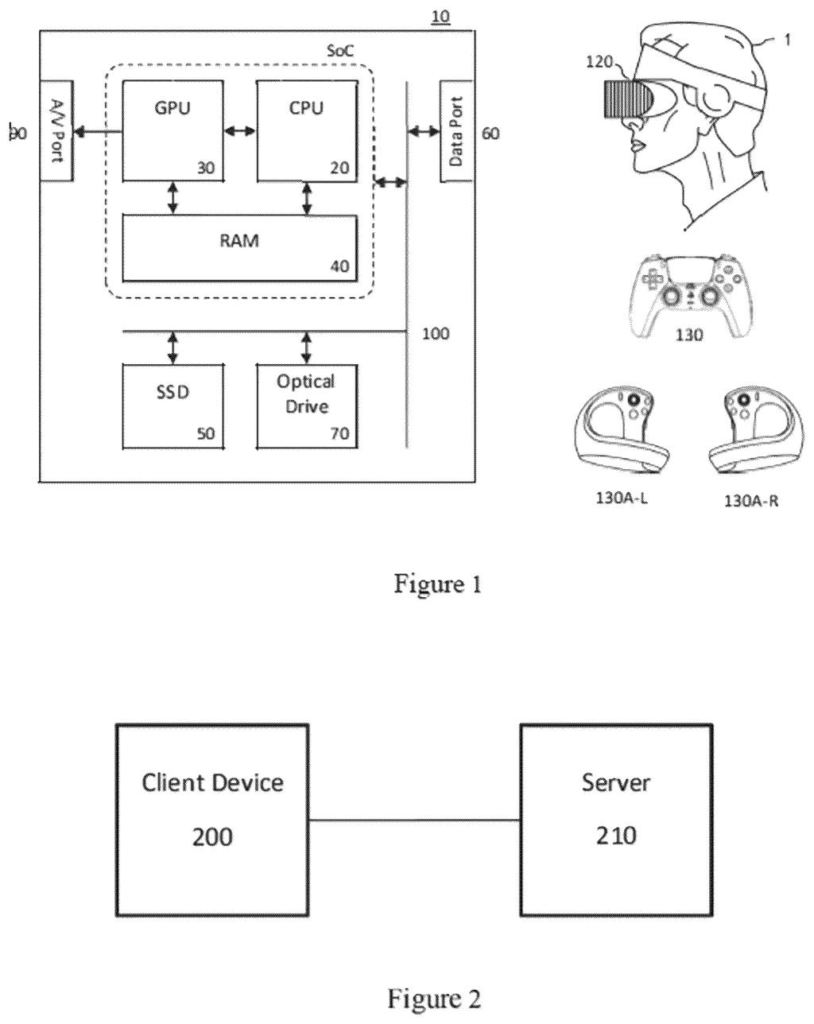
The drawings
3 drawing sheets from US 2026/0306942 A1 · click any drawing to enlarge


Want this weekly breakdown for a company we don't cover? Patentlyze Pro →
Be the first to weigh in