
Sony Files Patent for Car Screens That Offer a Live Concert Stream When You Park Nearby
Park near a stadium and your car could offer you a live stream of the sold-out show inside. That's the lead example in a new Sony patent application about content that appears when your interests and your surroundings line up.
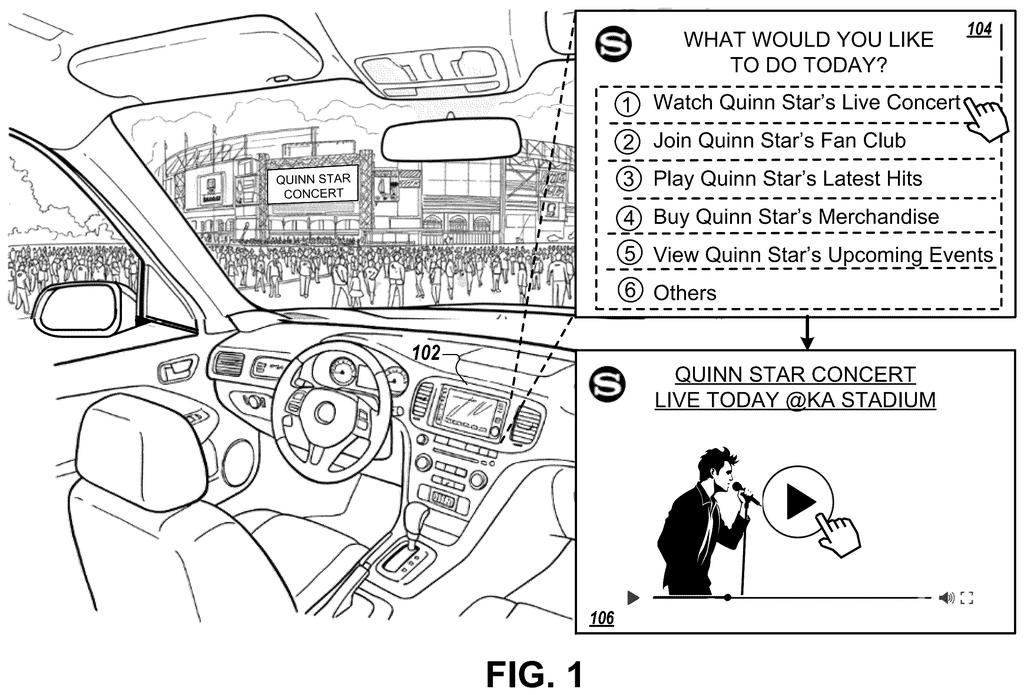
What Sony's concert-parking car screen does
Imagine you're a big fan of a pop star, and you park your car outside a stadium where that star is playing a sold-out show. Your car's screen lights up with choices: watch the concert live, play their latest hits, or buy merchandise.
That's the lead example in a new Sony patent application. The system builds a picture of you as a fan from what you watch, play, listen to and buy. It then checks where you are and what's happening nearby. When your tastes and the moment match, and there's something to offer, it switches on content just for you.
The filing says this goes beyond cars. A smartwatch that shows a racing heart at a 5K race could trigger motivational music on your phone. The system also learns from what you tap, skip or ignore, so its guesses improve over time.
determining a plurality of users whose user feature vectors match a target tag; determining an external real-time context related to the target tag; determining, among the plurality of users, one or more users whose real-time contextual data matches the external real-time context; …
Translation: It finds people nearby whose profiles and current situation match what is happening outside.
How Sony matches your tastes to the moment
The system starts by turning each user into a list of numbers, called a feature vector (a compact numerical snapshot of your tastes and habits). The numbers come from several sources: the company's own media data (games, music, movies), other first-party data such as purchases and device use, and third-party data such as partner information and weather.
An input label, called a target tag (for example, a particular artist's fan or a runner), gets converted into its own vector. The system then scores how similar each user's numbers are to the tag's numbers. Users whose score passes a set threshold count as a match.
The system then runs through four checks before it acts:
- Which users match the tag?
- Is there an outside event or situation tied to that tag, such as a concert?
- Do any of those users' real-time signals, like GPS location or smartwatch data, match that situation?
- Is there something available to offer, from the company's own catalog or from third parties?
If all four are true, it activates the content for those users. The filing also describes a feedback loop. Clicks, skips and dismissals update a knowledge graph (a map of how users, content and places relate) and feed a method that favors the options most likely to succeed.
… activating an engagement resource for the one or more users in the external real-time context.
Translation: It turns on the live entertainment stream on their car screens.
What this means for Sony's content and devices
The filing lists the devices that could receive these offers: phones, wearables, smart TVs, laptops, gaming consoles and a car's infotainment screen. It describes content Sony already sells, from streaming and gaming to merchandise and coupons. In practice, your devices would do more of the suggesting, and they'd do it based on where you are and what's going on around you.
There's a trade-off for you. The idea depends on tracking your location, activity and even heart rate to decide when to pitch you something. The filing says users could be given options to manage data collection, and that data can be anonymized. How much control you'd really have isn't spelled out.
Sony's 611th filing in our Sony coverage since May adds to a run that includes a concert stream tied to parking and an AI that predicts game frames.
Claim 1 is written very broadly. It covers finding users who match an interest tag, finding an outside real-time situation tied to that tag, checking that those users' live data matches it, confirming something is available, and then switching that content on. It doesn't mention cars, concerts or even location. Location and activity data show up only in later, narrower claims.
The claim also lists no specific machine learning method. The feedback loop, the knowledge graph and the method that favors winning options all sit in the description, outside claim 1. As written, the claim covers a recipe that many apps and services already follow in some form: know the fan, know the moment, send the offer.
The vivid details make the filing fun to read, but the claim's breadth is the real story. If it were ever granted in this form, it would be a wide net around context-triggered content. Whether it holds up is a separate question this text can't answer.
Get our take in your Top Stories
Liked this breakdown? Add Patentlyze as a preferred source on Google, and our plain-English take shows up more often in your Top Stories the next time Sony patent news breaks.
There are more where this came from
We read every patent application Big Tech publishes and send you the ones worth knowing. Plain English, free, every week.
The drawings
7 drawing sheets from US 2026/0319849 A1 · click any drawing to enlarge


Want this weekly breakdown for a company we don't cover? Patentlyze Pro →
Be the first to weigh in