
Sony Patents a Touchscreen That Treats a Hovering Finger as Part of the Gesture
On most touchscreens, the instant your finger leaves the glass, the device stops paying attention. Sony's filing says the second right after you lift off should still count as part of what you were doing.
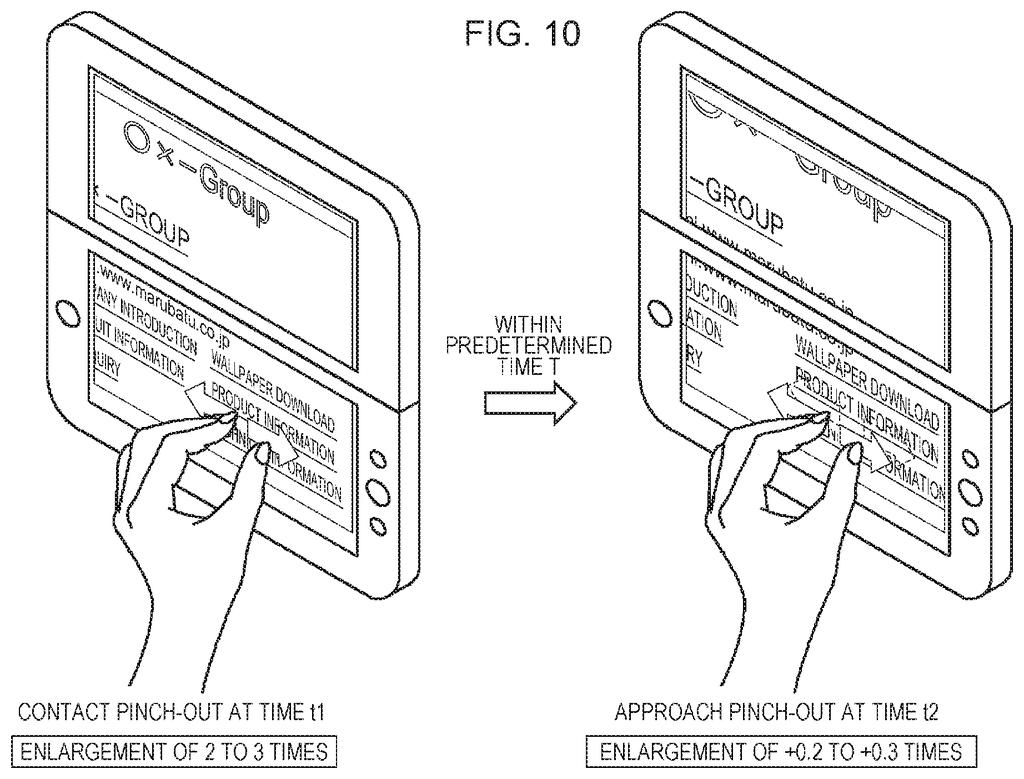
What Sony's touch-then-hover gesture does
On most touchscreens, the phone stops listening the moment your finger lifts off the glass. Zoom in too far on a web page and you have to pinch again or hunt for a button to get back to where you were.
Sony's patent application describes a screen that also senses a finger hovering just above it. If you touch the screen and then hover within about one second, the device treats the two as one gesture. Pinch to zoom, then zigzag your finger in the air, and the page returns to its old size.
The filing has other examples too. A second pinch in the air can nudge a zoom from 2x to 2.3x, and holding a finger above a list can keep it scrolling after a single swipe.
a contact detection unit configured to detect a contact operation for an operation surface; an approach detection unit configured to detect an approach operation for the operation surface …
Translation: Sensors track both when your finger touches the screen and when it hovers right above it.
How the screen tells a touch from a hover
The filing covers a device with three parts: a sensor that detects contact (a finger touching the screen), a sensor that detects approach (a finger hovering close without touching), and a control unit that treats the two as one series of inputs when they are detected back to back.
In the example hardware, a grid of capacitance sensors (electrodes whose readings change as a fingertip gets near) feeds a processor. The reading is 10 at 30 mm, 20 at 15 mm, 40 at 5 mm and 80 at contact. A reading of 50 or more counts as a touch, 20 to 49 counts as a hover, and anything lower is ignored.
A timer of about one second decides whether a touch and a hover belong together. Examples from the filing:
- Pinch to zoom, then zigzag a finger above the screen: the zoom returns to its earlier level. After the window closes, the same zigzag means "go back a page."
- Pinch out, then pinch out again in the air: a finer adjustment, such as 2x to 2.3x.
- Drag a list, then hold a finger still above it: scrolling continues at the same speed and direction.
- Flick a finger above a key, then tap it: types an alternate character, such as "?" from the M key.
The time limit could also be set per gesture (5 seconds after a pinch-out, 1 second after a drag), and users could register their own combinations.
… recognize the contact operation and the approach operation as a series of operation inputs when the contact operation and the approach operation are continuously detected …
Translation: The device treats the hovering motion and the touch as one single continuous gesture.
What this means for typing and scrolling
If this reached a real device, the payoff would be fewer taps. You could undo a zoom without finding a button, fine-tune a zoom after a rough pinch, or keep a long list scrolling while your finger hovers above it instead of swiping again and again. A keyboard could also fit several characters on one key, which frees up screen space.
The filing describes a two-screen handheld, but says the idea could apply to phones, cameras, PCs, game machines and music players, or any screen that senses a nearby finger. It also traces back through a long chain of related filings to a 2010 Japanese application, so this is an old idea resurfacing on new paper. A patent application is no promise of a product.
Sony's 91st filing in the Display patents we've tracked since May adds to a run that includes a push-back touchscreen and angle-based color correction.
The price of this idea is a stopwatch. Everything hinges on a window of about one second: hover inside it and your gesture counts as a follow-up, wait longer and the same hover means something else, like going back a page. A gesture whose meaning shifts with your timing is easy to trigger by accident and hard to learn.
Hidden gestures also cost you discoverability. Nothing on screen tells you that zigzagging above the glass undoes a zoom, so most people would never find it without being taught. The filing softens this by leaving ordinary touch gestures as they are and by letting users register their own combinations.
The trade looks worth it for undoing a zoom or keeping a list scrolling, where it saves real effort. Flicking above a key to type a question mark sounds fussier than a shift key to me, and the added risk of stray hovers outweighs the saved screen space.
Get our take in your Top Stories
Liked this breakdown? Add Patentlyze as a preferred source on Google, and our plain-English take shows up more often in your Top Stories the next time Sony patent news breaks.
There are more where this came from
We read every patent application Big Tech publishes and send you the ones worth knowing. Plain English, free, every week.
The drawings
15 drawing sheets from US 2026/0310347 A1 · click any drawing to enlarge


Want this weekly breakdown for a company we don't cover? Patentlyze Pro →
Be the first to weigh in