
Sony Patents a Depth Camera That Sharpens Its Focus on Nearby Objects Automatically
When a sensor fires a laser pulse and gets reflections back from two objects at once, most chips have to pick one distance and guess. Sony's new patent describes a chip that sidesteps that problem by running two different measurement modes in the same scan.
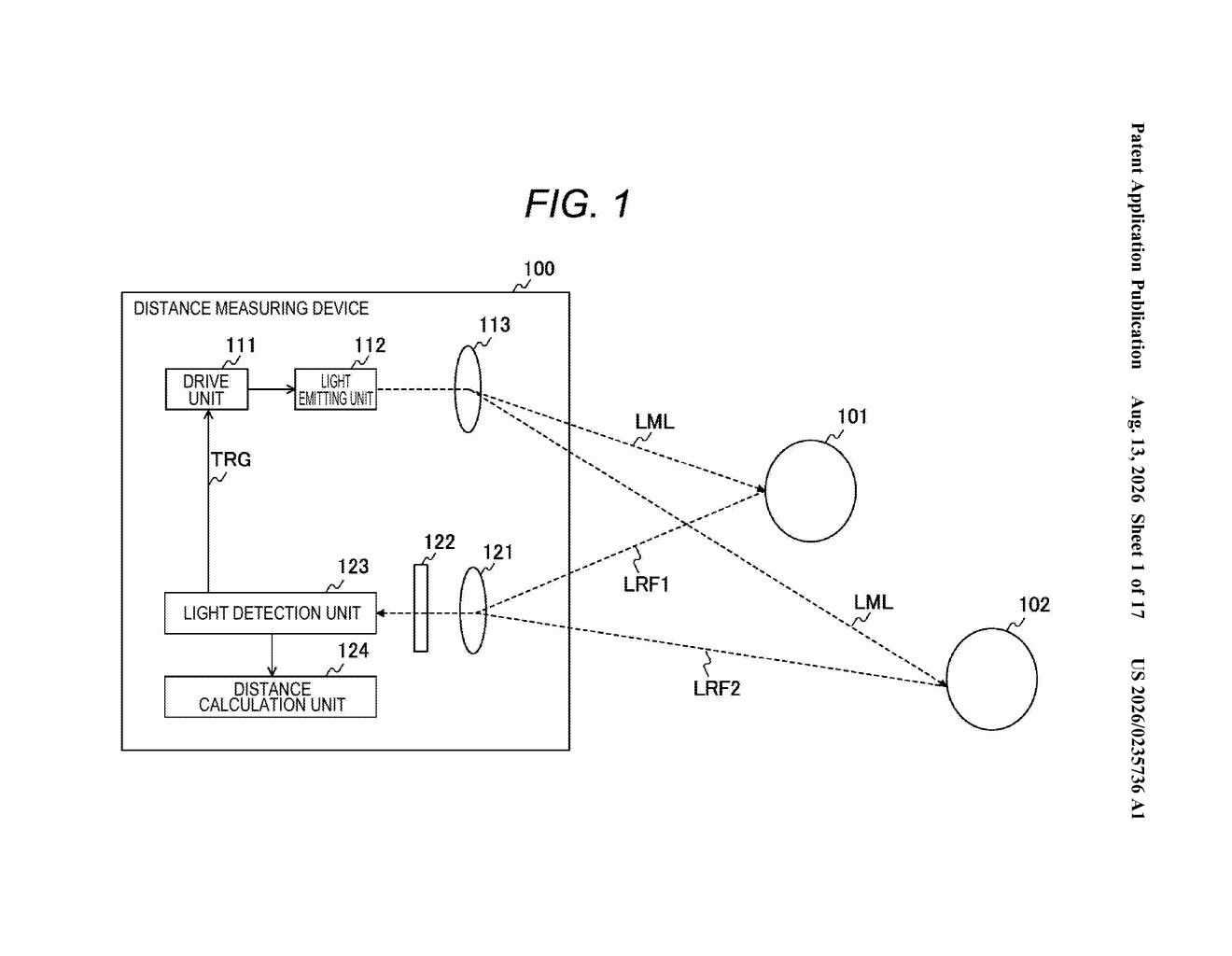
How Sony's ranging chip handles crowded reflections
Imagine you're in a self-driving car, and the distance sensor fires a laser at a scene where a pedestrian is standing just in front of a wall. The sensor gets two reflections back at almost the same time, and suddenly it's not sure which distance to report.
Sony's patent describes a smarter way to handle this. The chip runs two types of distance measurements back to back. In the first pass, it uses a fine-grained clock to catch subtle timing differences between nearby objects. In the second pass, it switches to a coarser, wider-range clock to make sure it doesn't miss objects that are far apart. Together, the two readings let the chip sort out crowded scenes that would trip up a single fixed setting.
You'd never see this happen, but you'd notice the result: fewer ghost readings, fewer missed obstacles, and distance estimates that hold up even when your surroundings are cluttered.
… a histogram generation section configured to generate histograms having TDC resolutions that are mutually different in TDC code circulation periods of the TDC that are mutually different.
Translation: The camera creates multiple data charts using different timing settings to better track light particles.
Inside the dual-histogram TDC timing system
The core component here is a Time-to-Digital Converter (TDC), a circuit that measures how long it takes for a photon (a single particle of light) to bounce off an object and return to the sensor. That travel time is converted into a distance estimate.
The challenge is a concept called TDC code circulation period: the TDC's internal clock loops around, like a stopwatch that wraps back to zero. If you set the clock to loop quickly, you get very precise measurements but only over short ranges. Set it to loop slowly and you cover longer distances but lose precision.
Sony's patent solves this by running two or more "first histograms" with different loop speeds during an initial measurement phase. A histogram here is just a tally of how many photons arrived at each moment in time. Running multiple tallies with different clock settings in parallel lets the chip cross-reference the results and resolve the ambiguity of which loop the photon arrived in.
Then, during a second measurement phase, it generates a coarser "second histogram" that trades precision for a wider detection window. The combination means the sensor can handle both nearby objects (where fine timing matters) and distant ones (where range matters) in the same scan cycle.
The histogram generation section may generate two or more first histograms having mutually different TDC code circulation periods in a first distance measuring period, and may generate a second histogram having a TDC resolution coarser than that of the first histogram, in a second distance measuring period.
Translation: The device switches between high precision and low precision modes to measure distances more effectively.
What this means for LiDAR accuracy in real scenes
Distance sensors are at the heart of autonomous vehicles, robotics, and augmented reality headsets, and their biggest practical failure mode is exactly the scenario this patent addresses: real environments are full of overlapping objects. A sensor that gets confused when a person stands near a wall, or when raindrops are in front of a road sign, is a sensor that can't be trusted in the real world.
Sony Semiconductor Solutions already supplies image sensors to a huge chunk of the smartphone and automotive camera market, so a filing like this fits squarely into that roadmap. The latest Big Tech patents in the LiDAR and time-of-flight sensor space show a steady push toward solving exactly these multi-object ambiguity problems, and Sony is staking out a specific hardware-level approach here.
For anyone who uses a device that measures distance, whether a phone that unlocks by scanning your face or a car that brakes before you notice the hazard, this chip-level fix has a direct payoff. The failure it prevents is invisible when it works and dangerous when it doesn't. Sony is addressing the problem at the hardware timing layer rather than patching it in software after the fact, which means the fix costs almost no extra processing power and doesn't depend on the software stack getting it right.
There are more where this came from
We read every patent application Big Tech publishes and send you the ones worth knowing. Plain English, free, every week.
The drawings
17 drawing sheets from US 2026/0235736 A1 · click any drawing to enlarge


Want this weekly breakdown for a company we don't cover? Patentlyze Pro →
Be the first to weigh in