
Sony Patents a Pixel Circuit That Fires the Instant Light Changes
Most camera sensors wait until they've captured a full frame before telling you what changed. Sony's new patent describes a pixel that fires a signal the instant it detects a shift in light, skipping the wait entirely.
What Sony's event-detection pixel actually does
You're watching a ball fly across a court, and your camera is doing what cameras always do: collecting light, building a complete picture, then handing it off. By the time it flags that the ball moved, the ball has already moved again. For slow scenes that's fine. For fast ones, that lag is a real problem.
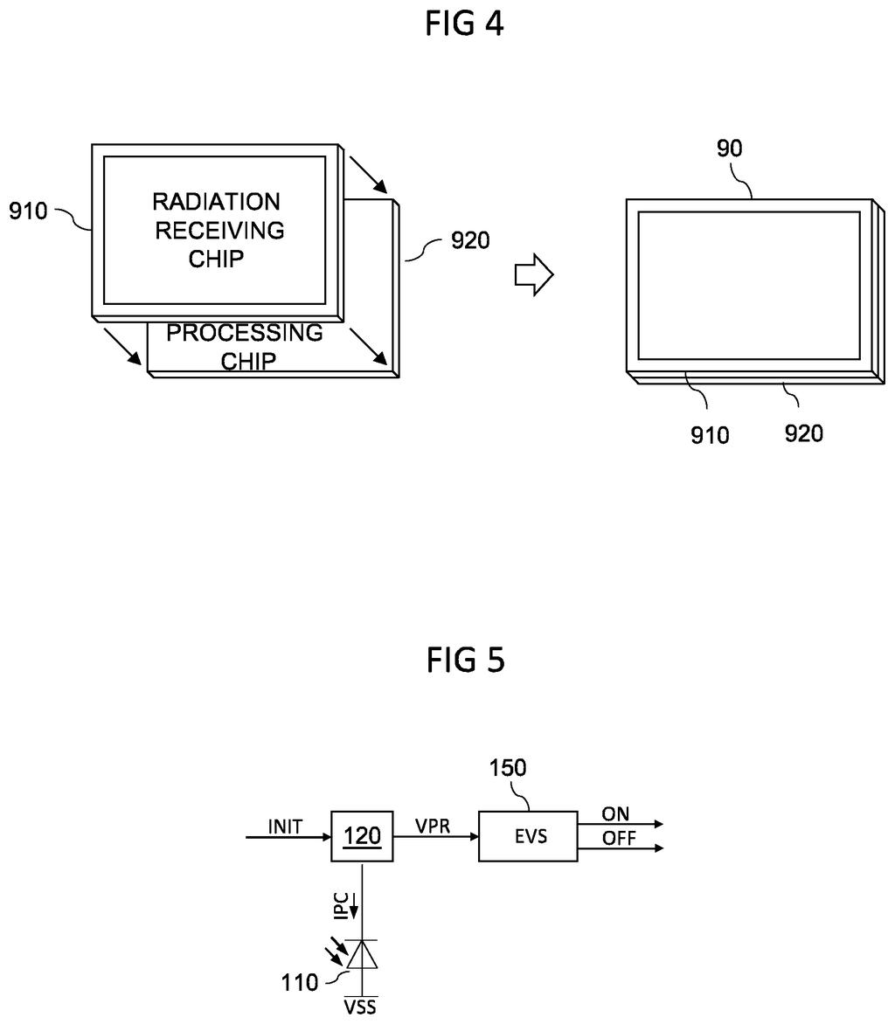
Sony's patent describes a different kind of pixel. Instead of waiting for a full image to be assembled, each pixel watches for a meaningful change in the light hitting it and immediately fires a digital signal when that change crosses a set threshold. The key is a small setup step called an initialization period: the pixel tunes itself before it starts watching, so it knows what counts as a real change versus ordinary noise.
The result is a sensor that reports events rather than frames. That's a fundamentally different model from the cameras in your phone, and it's particularly useful anywhere a fraction of a millisecond matters.
a photoelectric conversion element configured to convert incident radiation into a photoreceptor current IPC; a photoreceptor circuit configured to convert the photoreceptor current IPC into a photoreceptor voltage VPR in a conversion period …
Translation: This part turns incoming light into an electrical current and then into a voltage signal.
How the photoreceptor circuit catches changes mid-frame
The patent describes a pixel circuit built around three cooperating parts.
- Photoelectric conversion element: This is the light-sensing layer, converting incoming photons into an electrical current. Standard stuff so far.
- Photoreceptor circuit: This converts that current into a voltage the rest of the circuit can reason about. Before it starts monitoring, it runs through an initialization period, during which an "INIT" signal sets the circuit's operating point (think of it as zeroing a scale before you weigh something). This calibration step is what lets the circuit distinguish genuine light changes from electrical drift.
- Event detection circuit: This watches the resulting voltage and outputs a binary (on/off) digital signal whenever the voltage changes by a predefined amount. One pixel change equals one event signal, fired immediately.
This architecture is the foundation of what engineers call event-based vision or dynamic vision sensing (DVS). Unlike conventional image sensors that expose every pixel simultaneously on a fixed schedule, event sensors are asynchronous: each pixel acts independently and only reports when something actually changes in its patch of the scene.
The initialization mechanism is the specific contribution here. By actively resetting the photoreceptor circuit's operating point before each monitoring window, the design aims to reduce variation between pixels and improve the reliability of the threshold-crossing detection.
An event detection circuit outputs a digital event signal in response to a predefined change of the photoreceptor voltage VPR.
Translation: This sensor component triggers a digital alert the moment it detects a notable shift in voltage.
What this means for fast cameras and AI vision systems
Event-based sensors are already used in robotics, high-speed industrial inspection, and driver-assistance systems, anywhere conventional cameras are too slow or too power-hungry. The bottleneck has always been consistency: if each pixel drifts slightly in its baseline, you get false events or missed ones. A reliable initialization step attacks that problem directly, which could make the technology viable in more demanding applications.
For consumers, the most plausible near-term impact is in cameras that track fast motion without motion blur, or in always-on sensors that use almost no power because they only wake up when something actually moves. Sony is one of the world's largest image sensor suppliers, so improvements at the pixel level tend to find their way into phones, cameras, and cars within a few product cycles.
That makes this Sony's 82nd filing in our Display topic coverage since May, a group that includes one cutting capture delays and one on auto light adjustment.
Manufacturing variation is an invisible tax on every image sensor ever made. No two pixels behave identically, and in a sensor designed to catch rapid flickers of change rather than still frames, those tiny differences between neighbors generate constant false alarms, draining the core promise of the technology before it can deliver.
Sony's patent attacks that problem directly by giving each pixel a dedicated warm-up step, a brief moment to calibrate itself before it begins watching for events. The fix is narrow and specific, which is appropriate, because the problem itself is narrow and specific.
Whether that calibration step is enough to make event-based sensors reliable in demanding real-world conditions, from fast robotics to low-light surveillance, depends on how much of the false-alarm burden traces back to this one source. If it is most of it, this matters quite a lot.
There are more where this came from
We read every patent application Big Tech publishes and send you the ones worth knowing. Plain English, free, every week.
The drawings
14 drawing sheets from US 2026/0270573 A1 · click any drawing to enlarge


Want this weekly breakdown for a company we don't cover? Patentlyze Pro →