
Samsung Patents a Projector That Remembers How to Fix Its Own Picture
Projectors are only as good as their setup, and most people redo that setup every single time. Samsung's new patent describes a projector that saves the geometry fixes for each wall or surface you use, then applies them automatically the next time you point it there.
What Samsung's projector memory system actually does
Ever tried to aim a projector at a wall and got a trapezoid instead of a rectangle? That warped, skewed picture happens because projectors rarely sit at a perfect right angle to the surface they're hitting, and fixing it manually every time is tedious.
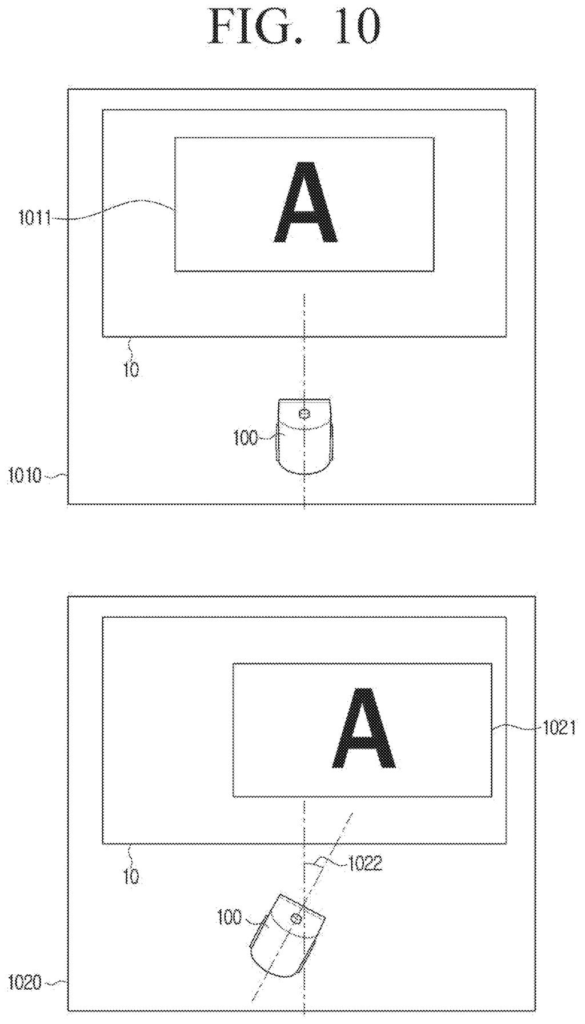
Samsung's patent describes a projector that stores a correction profile for each surface position you use. When you aim the device at a spot and give it a command, it looks up the saved profile for that location, moves itself to the right position, and fixes the distortion automatically. You don't have to fidget with alignment settings each time.
Keystone correction is the technical name for squaring up that trapezoid shape, and it's already common in projectors. What this patent adds is the memory layer: your living room wall, your bedroom ceiling, your office screen each get their own saved fix, applied instantly.
… acquire correction information included in projection information corresponding to the projection surface position among the at least one projection information stored in the memory …
Translation: It looks up the saved setup details for that exact spot.
How the correction profiles and keystone fix work together
The system has three main components working together: a projection unit (the light engine that throws the image), a memory that stores one or more correction profiles, and a processor that ties them together.
When a user command comes in, the processor does two things at once. First, it figures out the correct projection position and angle for the surface the user wants to use. Second, it looks up the correction information stored for that specific surface location. That correction data was presumably saved during an earlier calibration session.
Once it has that data, the processor physically moves the projector to the right position, then applies keystone correction (a digital fix that reshapes the image to compensate for the projector not being perfectly perpendicular to the wall). The correction uses the stored profile rather than starting from scratch.
- Surface position is identified from the user command
- A matching correction profile is pulled from memory
- The projector repositions itself based on that profile
- Keystone correction is applied using the stored geometric data
… move the projection position onto a region corresponding to the projection surface position that is corrected based on the correction information and control the projection unit to output the image which is acquired using keystone correction …
Translation: It automatically shifts the image and fixes the distortion for that location.
What this means for portable and smart-home projectors
For anyone who uses a portable or smart projector in more than one spot, this removes the most annoying part of the experience: re-doing the geometry fix every time. Products like Samsung's own Freestyle projector already let you point and play; this patent would let the device actually remember where you've pointed it before and skip the setup step entirely.
Samsung's run of smart-projector filings suggests the company sees the projector as a living-room appliance, not a conference-room tool. If this system ships in a consumer device, the practical payoff for your typical user is that switching between, say, projecting on a wall versus a ceiling becomes a one-tap action rather than a two-minute calibration ritual.
This is the 331st Samsung filing we've tracked in Display filings since May, a topic that already includes applications like one adjusting brightness by room light and one that frames its own picture.
Claim 1 covers any device that stores saved settings for a specific wall or surface location, retrieves those settings on command, physically moves the projector to that spot, and automatically corrects the image geometry to fit. The claim puts no limits on motor type, room size, or surface material, so those four steps taken together are what the claim owns.
That scope matters because it wraps a complete user workflow into a single protected package: point, recall, move, correct. Any projector that learns your preferred wall, saves those preferences, and snaps back to them at the press of a button would fall inside this boundary.
The real stakes sit in how broadly courts read "projection surface position" and "correction information," since those two phrases carry almost all the weight. Read generously, this claim reaches a wide family of smart projectors now hitting the consumer market.
There are more where this came from
We read every patent application Big Tech publishes and send you the ones worth knowing. Plain English, free, every week.
The drawings
28 drawing sheets from US 2026/0261636 A1 · click any drawing to enlarge


Want this weekly breakdown for a company we don't cover? Patentlyze Pro →