
Sony Patents a Wearable Tracker That Tells Your Game Controller Where You Are
Your game controller doesn't actually know where it is in the room. Sony thinks a wearable device worn on your body could fix that, by doing the location math itself and passing the answer to the controller.
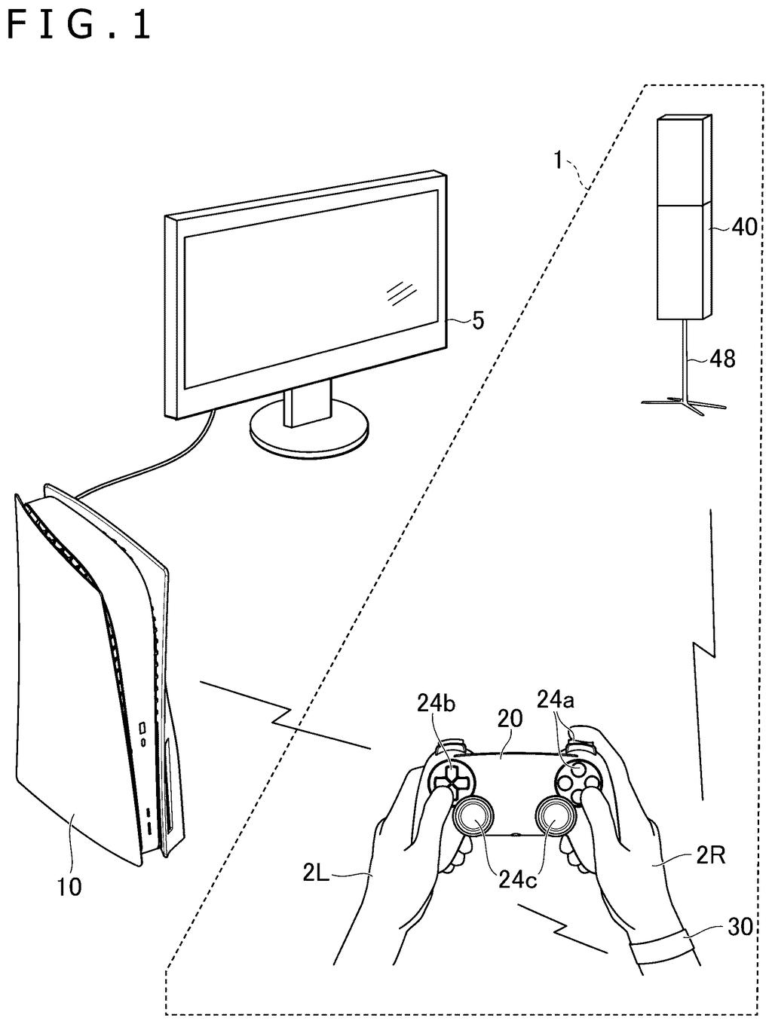
How Sony's body-worn locator feeds your controller its position
Today, most game controllers track button presses and thumbstick movements just fine, but they have no reliable way to know where in a room the person holding them actually is. Some systems rely on cameras or external sensors to handle that job, which means more setup and more things that can break.
Sony's idea is to shift that burden to something you wear, like a wristband or headset accessory. The wearable talks wirelessly to a fixed device placed across the room. Those two devices figure out the wearable's position together, and then the wearable passes that location data straight to your game controller.
The result is a controller that knows roughly where you and your hands are in physical space, without needing the controller itself to do any of the heavy lifting. That's a small architectural change with potentially real consequences for how physical movement maps into games.
a wearing fixture that is worn by a user and is capable of communicating with an operation device held by the user; and a communication device that is capable of wirelessly communicating with the wearing fixture and is arranged apart from the user …
Translation: A wearable device talks to a nearby wireless unit to track the player.
How the wearable and base station triangulate your location
The patent describes a three-part system. First, there is a wearing fixture, a device strapped to or worn by the player. Second, there is a communication device placed at a fixed point away from the player, think a base station on a shelf or wall. Third, there is the game operation device, meaning the handheld controller.
The wearing fixture and the fixed communication device exchange wireless signals. From those signals, one of them (the patent allows either to do the calculation) computes the wearing fixture's position in the room. The technical approach used to derive position from wireless communication isn't specified in the claim itself, but common methods include measuring signal arrival time or signal strength at multiple points.
Once the position is calculated, the wearing fixture sends that positional data to the controller over a separate wireless link. The controller can then incorporate that location into whatever the game needs to know.
- Wearing fixture: worn on the body, communicates with both the base station and the controller
- Communication device: fixed in the room, provides a reference point for location math
- Operation device: the handheld controller, receives position data passively
An object of the present disclosure is to enable an operation device to acquire the position of a user holding the operation device.
Translation: The goal is letting your game controller know exactly where you are sitting.
What this means for wireless VR and roomscale gaming
For players, this matters because location-aware controllers open the door to games that respond to where you move, not just how you press buttons. Walking toward something, stepping to the side, or physically leaning could all become inputs. That kind of interaction is already common in high-end VR setups, but those require cameras or lighthouse beacons pointed at the player. A wearable-first approach could make the setup simpler.
The design also keeps the controller itself simple. Because the position calculation happens in the wearable or the base station, the controller doesn't need dedicated positioning hardware. Sony could, in theory, add this capability to existing controller designs by pairing them with a new wearable accessory.
Sony's tenth filing in the Wearable patent filings we've tracked since June follows work on smoother compressed video edges and a signal-passing game controller.
Getting this from a patent to a product requires hardware that doesn't exist yet: a wearable accessory, a way for that accessory to talk to a game controller, and software that games can actually use to understand where the player is standing. The document describes none of those in finished form. It stakes out the architecture, not the assembly instructions.
The core idea is that a device worn on the body does the location math and passes the result to the controller in your hands, skipping the need for cameras mounted around the room. That is a reasonable way to solve a hard problem, and Sony has obvious reasons to care about it given how much the company has invested in immersive gaming over the years.
Nothing here signals that a product is close. A lot of separate pieces have to be built and connected before someone clips on a wristband to play a game, and this document does not promise that any of them are coming.
There are more where this came from
We read every patent application Big Tech publishes and send you the ones worth knowing. Plain English, free, every week.
The drawings
12 drawing sheets from US 2026/0284525 A1 · click any drawing to enlarge


Want this weekly breakdown for a company we don't cover? Patentlyze Pro →
Be the first to weigh in