
Sony Patents a Six-Lens Design for Compact Wide-Angle Cameras
Sony is patenting a specific six-lens arrangement that aims to squeeze wide-angle shooting and strong low-light performance into a physically small camera body, a combination that typically forces engineers to pick two out of three.
What Sony's compact lens arrangement actually does
Imagine trying to fit a high-quality camera into a device as thin as a smartphone or a security camera the size of a golf ball. The problem is that good low-light performance usually requires a wide opening in the lens (called a low F-number), and wide-angle shots require their own optical tricks. Combining both in a tiny package is genuinely hard.
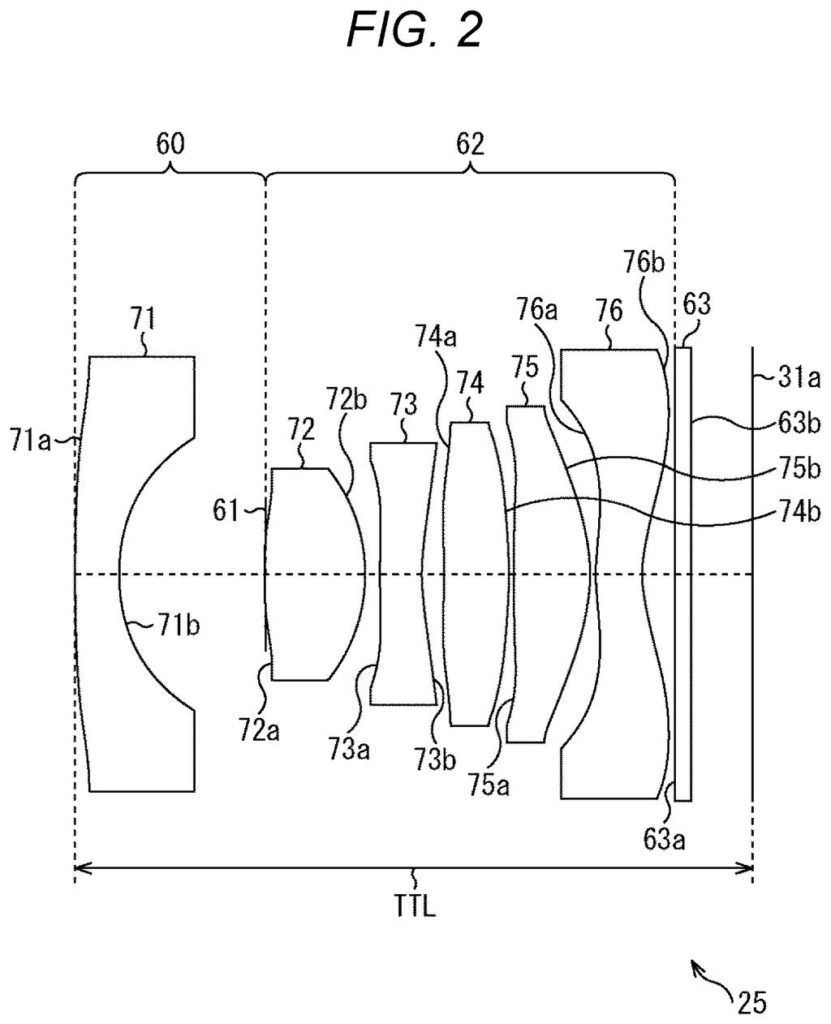
Sony's patent describes a precise arrangement of six lenses split into two groups. The first group bends incoming light outward (negative power) to capture a wide field of view. The second group, made up of five lenses, then pulls that light back together and focuses it cleanly onto the image sensor.
The specific math Sony locks in here, a ratio between the second group's focal length and the overall system's focal length kept between 1 and 2, is what keeps the whole stack from ballooning in size while still letting in plenty of light. It's an engineering trade-off spelled out in glass and geometry.
A lens optical system comprising: in order from an object side toward an image side, a first lens group having negative refractive power; and a second lens group having positive refractive power …
Translation: The camera lens is split into two main groups that bend light in opposite ways.
How the two lens groups balance wide angle and light intake
The patent describes a lens optical system using two lens groups arranged front to back. The first lens group contains a single lens with negative refractive power, meaning it spreads light rays apart to achieve a wide angle of view. The second lens group has five lenses arranged in a specific sequence: positive, negative, positive-or-negative, positive, and negative power.
This alternating pattern of converging and diverging lenses is a classic technique for correcting optical aberrations (the distortions and color fringing that make images look soft or smeared at the edges). The sixth lens, which ends the sequence with negative power, helps flatten the image field so the entire frame stays sharp.
The key engineering constraint Sony establishes is the ratio fa2/f, where fa2 is the focal length of the second group alone and f is the focal length of the entire combined system. The patent requires this ratio to fall between 1 and 2. In practical terms, this keeps the second group from either being too weak (producing a blurry, distorted image) or too strong (making the lens physically long to maintain proper focus distances).
The result is a system optimized for three things simultaneously: small physical size, a low F-number (meaning a wide aperture that admits more light), and a wide angle of view.
The present technology relates to a lens optical system and an imaging apparatus that can realize both good imaging quality and a small F-number in a small size and a wide angle.
Translation: Sony designed a wide lens that takes sharp photos while keeping the camera body small.
What this means for small cameras and imaging devices
Compact cameras, surveillance hardware, automotive imaging systems, and action cameras all face the same space constraint: the optics have to be small, but image quality cannot be sacrificed. Sony supplies imaging sensors and camera modules across all of those markets, so a validated lens design that satisfies all three constraints at once has real commercial value beyond any single product category.
For you as a consumer, designs like this are what eventually make it possible for small cameras to capture cleaner, wider images in dim environments without the manufacturer having to make the device thicker or heavier. Whether this particular arrangement ends up in a Sony action camera, a vehicle camera, or a licensed module used by another manufacturer, the underlying math here is doing real work.
This is a focused optical engineering patent, not a product announcement, and it covers fairly standard lens-group architecture dressed up with a specific focal-length ratio as the differentiating constraint. Sony files many lens patents and most never become standalone consumer products, but the company's position as a major imaging-module supplier means designs like this can end up in dozens of devices made by other brands.
There are more where this came from
We read every patent application Big Tech publishes and send you the ones worth knowing. Plain English, free, every week.
The drawings
28 drawing sheets from US 2026/0227597 A1 · click any drawing to enlarge


Want this weekly breakdown for a company we don't cover? Patentlyze Pro →
Be the first to weigh in