
Sony Files Patent for a Camera Lens That Focuses by Moving Only Its Middle Section
Most camera lenses move a lot of glass just to focus on something close up. Sony's new patent describes a design where only a small middle section of the lens shifts, while carefully arranged glass at both ends stays put.
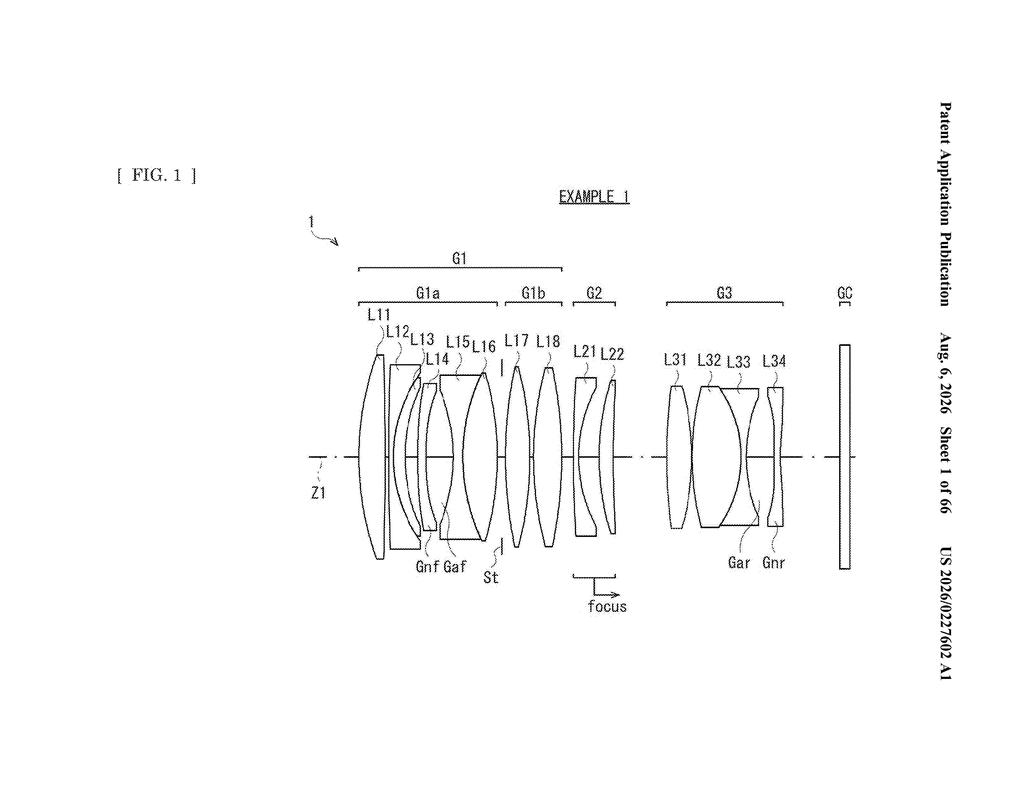
What Sony's inner-focusing lens design actually does
Imagine your camera trying to lock focus on a subject walking toward you. To do that, a lot of lenses physically push or pull a heavy chunk of glass back and forth inside the barrel, which takes motor power, time, and can throw off the image.
Sony's patent proposes a three-part lens design where the front group and rear group of glass never move at all during focusing. Only the middle group slides along the lens axis. Because that middle section is smaller and lighter than moving the whole optical assembly, the system can in theory focus faster and with less effort from the motor.
The front and rear groups aren't just passive passengers, though. Each is built with a specific arrangement of negative and positive lens elements, including what the patent calls "air lenses" (gaps between glass elements that act optically like a lens). These carefully tuned groups correct distortion and aberrations so the image stays sharp even as the middle section shifts around.
… upon focusing, the first lens group and the final lens group are each fixed, and the second lens group moves in an optical axis direction …
Translation: When you focus the camera, only the middle glass moves while the front and back stay still.
How the three lens groups divide focusing duties
The patent describes an imaging optical system built from three lens groups stacked in order from the front of the lens (facing the subject) to the back (facing the camera sensor).
- First lens group (front): Has positive refractive power, meaning it bends light inward to start converging it. It contains a negative lens, a cemented doublet (two pieces of glass bonded together), and an "air lens" between them. An air lens is just a gap whose curved surfaces act like a physical lens element, bending light without adding glass weight.
- Second lens group (middle): Has negative refractive power and is the only group that physically moves during autofocus. Shifting a lighter, negative group is a common optical engineering approach called inner focusing or floating element design.
- Final lens group (rear): Stays fixed like the front, and uses its own cemented doublet, a second negative lens, and another air lens to clean up any optical errors introduced as the middle group moves to different positions.
The use of two air lenses, one in the front group and one in the rear, is the structural detail Sony is specifically claiming. These air gaps give the designer extra variables to correct chromatic aberration (color fringing) and field curvature (edge softness) without adding more physical glass elements.
… a first air lens of negative refractive power sandwiched between the first negative lens and the first cemented lens …
Translation: The lens design includes a specific pocket of air inside the front glass group.
What this means for Sony's camera and lens lineup
For photographers and videographers, inner-focusing designs tend to mean faster, quieter autofocus because the motor is moving less mass. The lens barrel also doesn't change length as you focus, which matters for weather sealing and for keeping a stable center of gravity on a gimbal or rig.
For Sony specifically, this kind of optical architecture fits the company's ongoing push to refine its G Master and G lens lines for the full-frame mirrorless Alpha system. A patent alone doesn't confirm a product, but the specific prescription described here suggests a moderate telephoto or portrait-range prime lens, the kind of focal length where inner focusing and tight aberration control are most valued.
This is a narrow, technically specific optics patent, not a platform shift. Sony files lens design patents regularly, and most never become identifiable retail products. That said, the dual-air-lens architecture is a concrete and somewhat unusual structural choice worth noting if you follow Sony's lens roadmap closely.
There are more where this came from
We read every patent application Big Tech publishes and send you the ones worth knowing. Plain English, free, every week.
The drawings
66 drawing sheets from US 2026/0227602 A1 · click any drawing to enlarge


Want this weekly breakdown for a company we don't cover? Patentlyze Pro →
Be the first to weigh in