
Salesforce Patents a System That Checks Its Own Work While Building AI Datasets
Training an AI model requires enormous amounts of labeled data, and collecting that data by hand is slow and expensive. Salesforce's new patent describes a system that generates that training data automatically, and then grades its own output before deciding what to make next.
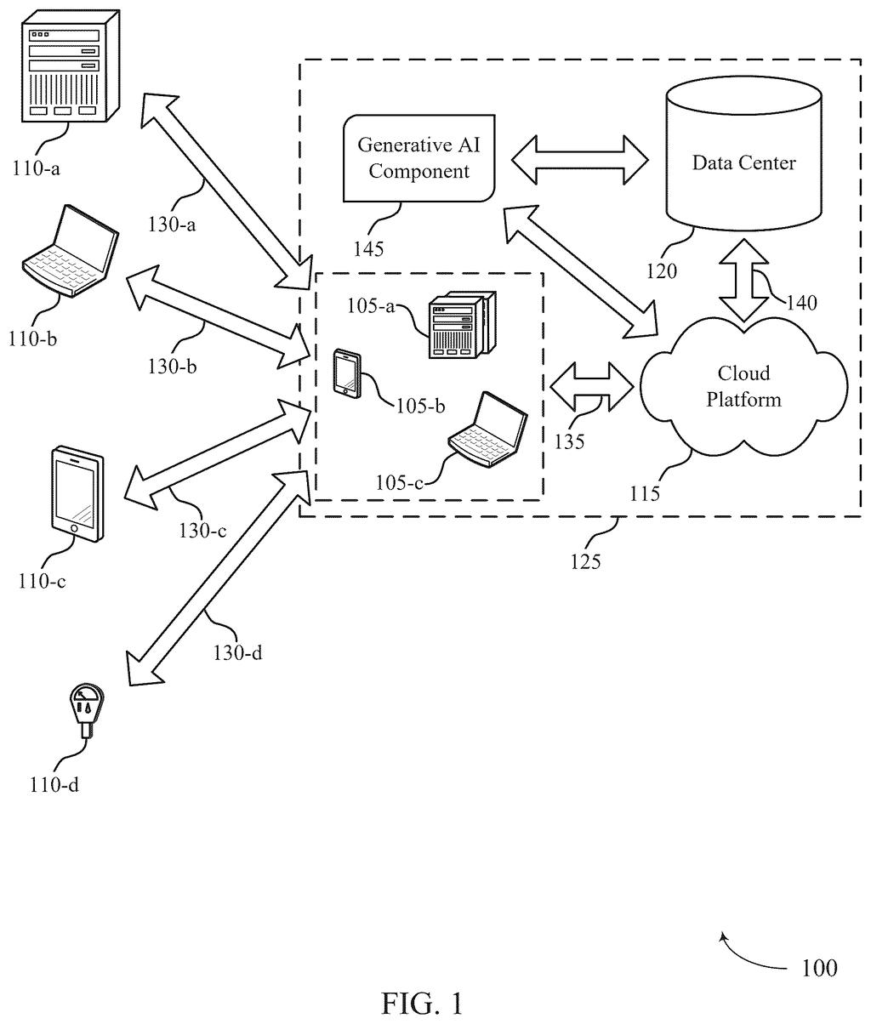
What Salesforce's self-improving data factory actually does
Imagine you're teaching someone a new job. You give them a few example tasks to learn from, watch how they do, and then adjust your teaching materials based on where they struggled. Salesforce's system does something very similar, but for AI models.
You start by giving the system a small set of examples (called seed data) and a description of the task you want the AI to learn. The system then goes out, finds relevant information from a large unstructured data source, and uses a language model to generate a batch of new training examples. Then it checks how useful those examples were.
The clever part is what happens next. Instead of just generating more of the same, the system figures out which of your original seed examples are working well and which aren't, weights them accordingly, and uses that information to fetch better raw material for the next batch. It keeps doing this until it has produced as much training data as you asked for.
How the retrieval-and-weighting loop runs each iteration
The patent describes an iterative pipeline for synthetic data generation, which means creating artificial examples that can be used to train or fine-tune AI models, rather than collecting real-world labeled data by hand.
The process starts with a user providing seed data (a small set of existing examples), a task description (what the AI should learn to do), a target language model to use for generation, and a requested volume of output. The system retrieves a batch of raw, unstructured information from a data source, then feeds that material to a large language model (LLM) to produce a first set of synthetic examples.
Next, a transformer-based model (an AI architecture used widely in text and code tasks) evaluates the seed data against those freshly generated examples, measuring performance metrics like coverage and diversity. Based on that evaluation, the system assigns weights to each piece of seed data, essentially scoring which examples have been well-represented and which haven't.
- Higher-weighted seed data points guide the next retrieval step, pulling in new raw material that fills the gaps.
- The system then generates a second batch of synthetic examples using this improved input.
- This loop repeats until the requested amount of data has been produced.
The goal is to avoid a common problem in synthetic data generation where the same kinds of examples get repeated over and over, leaving blind spots in the final training set.
What this means for companies building in-house AI models
Building a high-quality AI model requires large volumes of carefully labeled training data, and for enterprise use cases, that data often doesn't exist off the shelf. Companies either pay people to label thousands of examples by hand or use generic public datasets that don't fit their specific needs. A system that can generate task-specific, self-checked training data automatically could dramatically cut the time and cost of customizing AI for a particular business workflow.
For Salesforce, whose core business is enterprise software, this kind of technology would feed directly into products where customers want AI tuned to their own data and processes. You could, in theory, point a system like this at your company's internal documents and walk away with a ready-to-train dataset, without a team of annotators.
This is a real infrastructure problem with a practical solution. Synthetic data generation is already a legitimate technique in AI development, and the self-evaluation loop here addresses a genuine weakness: most generation systems don't check whether what they're producing is actually well-distributed or useful. It's not flashy work, but it's the kind of plumbing that makes enterprise AI projects actually ship.
There are more where this came from
We read every patent application Big Tech publishes and send you the ones worth knowing. Plain English, free, every week.
The drawings
8 drawing sheets from US 2026/0220428 A1 · click any drawing to enlarge


Want this weekly breakdown for a company we don't cover? Patentlyze Pro →