
Nvidia Patent Reduces Wasted Computing Power When Running Multiple Specialized AI Models
Running a massive AI model on a GPU is like trying to cook a 50-course meal in a tiny kitchen. Nvidia's new patent is essentially a prep-cook system that figures out which ingredients you'll need next and has them ready before you ask.
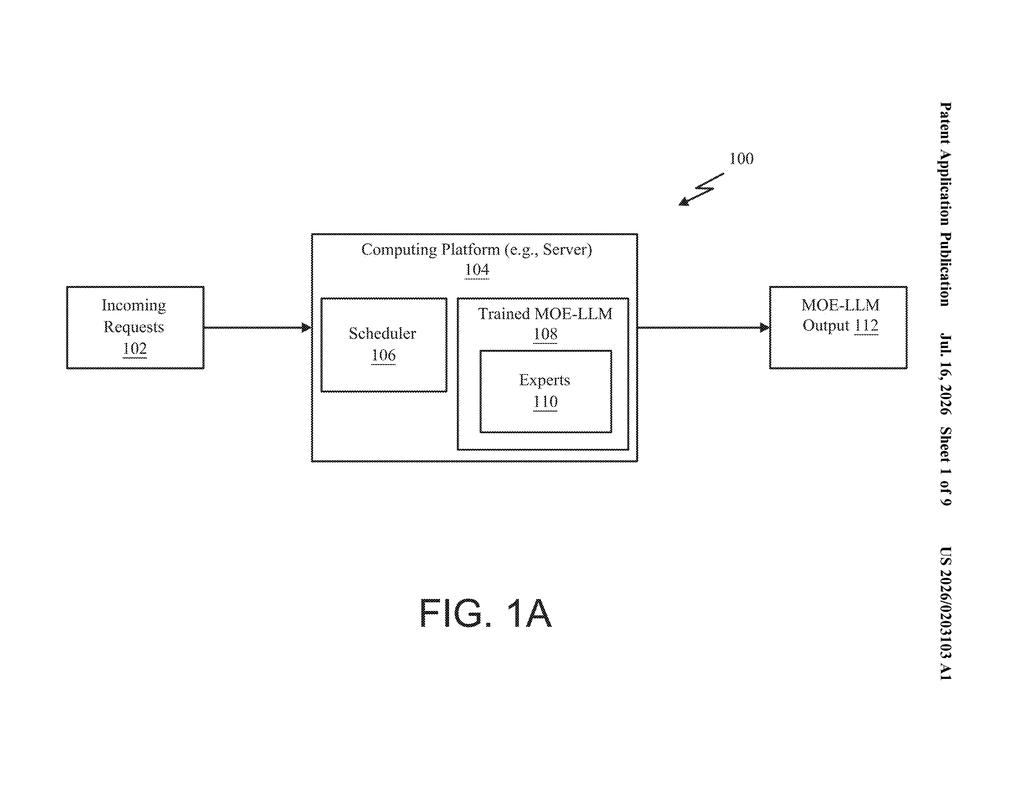
How Nvidia's scheduler picks only the AI pieces it needs
Imagine a giant AI model as a huge building with hundreds of specialized offices, each handling a different kind of question. When a question comes in, the AI has to visit a few of those offices to answer it. The problem: the building is too big to fit in the AI chip's fast memory all at once, so the system constantly has to shuffle offices in and out, which wastes time.
Nvidia's patent tackles this by grouping incoming questions before answering any of them. Questions that need the same set of offices get batched together, so the chip loads those offices once and answers a whole batch of questions without reshuffling. While that batch is being answered, the chip is already loading the next batch's offices in the background.
The result is less idle time waiting for memory loads and more time actually answering questions. That's important because memory bandwidth, not raw computing power, is often the real bottleneck when running large language models in production.
How the batch-sorting and preloading pipeline works
The patent describes a scheduling system for Mixture-of-Experts large language models (MoE-LLMs). In a MoE model, only a small subset of the model's total parameters, called feedforward network layers (FFNs), are activated for any given input. Think of them as specialist sub-networks: a question about chemistry might activate different experts than a question about poetry.
The core problem is that MoE models can be enormous. Their full set of FFN layers won't fit in a GPU's high-speed memory (VRAM) all at once, so layers have to be loaded on demand from slower storage. That loading is slow and causes gaps where the GPU sits idle.
Nvidia's approach:
- A scheduler inspects the incoming pool of requests and predicts which FFN subsets each request will need.
- Requests are sorted into groups that share the same (or overlapping) expert subsets, minimizing how often memory has to be swapped.
- While the GPU services one group using its loaded FFN subset, the next group's FFN subset is preloaded in the background, a technique called prefetching.
This pipelining means the GPU rarely has to stop and wait for a memory load. The net effect is higher throughput: more responses generated per second using the same hardware.
What this means for AI inference costs and speed
For anyone running AI services at scale, GPU time is expensive. MoE models are attractive because they can be very capable while activating only a fraction of their parameters per request, but that efficiency breaks down if the memory-shuffling overhead is large. Nvidia's scheduling approach addresses that specific bottleneck directly.
This is also relevant to Nvidia's broader data-center ambitions. As MoE architectures (used in models like Mixtral and reportedly in some versions of GPT-4) become more common in production deployments, the ability to run them efficiently on Nvidia hardware becomes a competitive advantage. A patent like this signals that Nvidia is building scheduling intelligence into the software stack that accompanies its GPUs, not just improving the chips themselves.
This is unglamorous but genuinely useful infrastructure work. Memory bandwidth is a real, well-documented bottleneck for MoE inference, and smarter batching is a legitimate way to address it. The patent is narrow enough in scope that it has a reasonable shot at grant, and the technique is practical enough that you could plausibly see it show up in Nvidia's TensorRT-LLM or a future inference runtime.
Get our take in your Top Stories
Liked this breakdown? Add Patentlyze as a preferred source on Google, and our plain-English take shows up more often in your Top Stories the next time Nvidia patent news breaks.
There are more where this came from
We read every patent application Big Tech publishes and send you the ones worth knowing. Plain English, free, every week.
Want this weekly breakdown for a company we don't cover? Patentlyze Pro →