
Samsung's New Patent Wants AI to Write the Rules That Teach Robots How to Move
Training a robot to walk, jump, or pick things up is painstaking work — engineers spend months writing the rules that tell a robot whether it's doing well or poorly. Samsung's new patent wants to hand that job to an AI.
How Samsung wants AI to coach robots like a human trainer would
Imagine trying to teach a dog a new trick, but instead of giving the dog treats, you have to write out every single rule for what counts as 'good' behavior — in mathematical code. That's roughly what engineers do when training robots today, and it takes a long time.
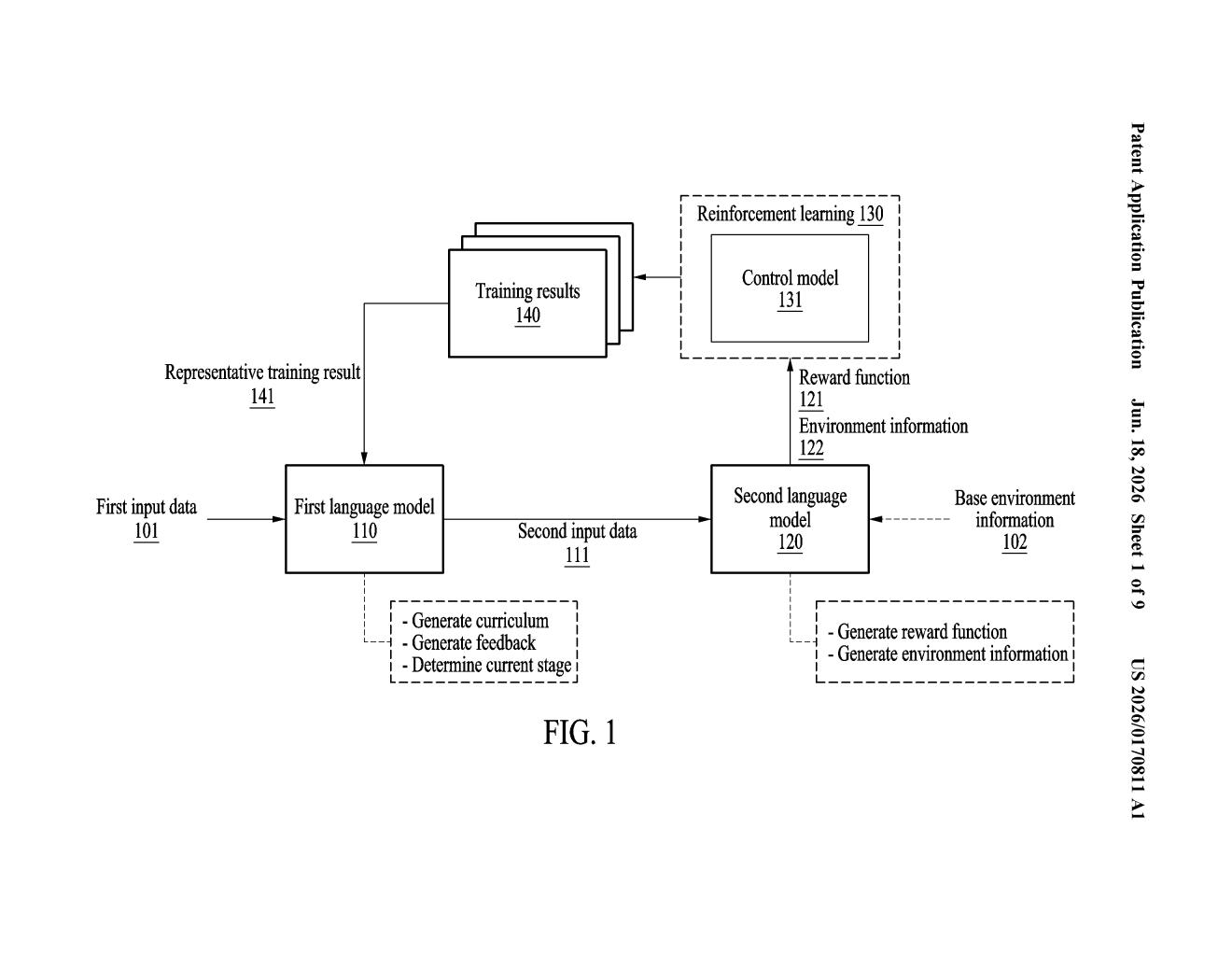
Samsung's patent describes a system where you simply describe the movement skill you want a robot to learn — say, "climb a set of stairs" — and two AI language models handle the rest. The first AI breaks that goal down into a step-by-step training plan (called a curriculum), similar to how a personal trainer might build a workout program with progressively harder exercises. The second AI then writes the specific scoring rules the robot uses to figure out whether it's making progress at each stage.
The robot practices, gets scored, and gradually improves — all without an engineer writing a single line of training code by hand.
How two language models split the robot training workload
The system chains two large language models (LLMs) — the kind of AI that powers text-based chatbots — together to automate robot training from end to end.
- First LLM — the curriculum planner: Takes a plain-text description of a target skill (e.g., "the robot should jump over an obstacle") and generates a multi-stage training curriculum — a structured sequence of progressively harder practice scenarios, similar to chapters in a textbook.
- Second LLM — the reward writer: Takes the description of each training stage from that curriculum and automatically generates reward functions (mathematical scoring rules that tell the robot how well it's doing at that stage during reinforcement learning).
- Reinforcement learning loop: The robot's control model — the neural network that decides what its motors should do — then trains against those reward functions through trial and error, improving over many practice runs.
Reinforcement learning (having a system learn by receiving positive or negative feedback on its actions, rather than from pre-labeled examples) is already the dominant method for training agile robot movements. The bottleneck has always been that humans must manually craft reward functions for each new skill. This patent proposes automating that bottleneck entirely through language model generation.
What this means for the future of Samsung's robotics push
Writing reward functions for robots is currently one of the most specialized and time-consuming jobs in robotics engineering. If an AI can do it from a plain-text description, the time to teach a robot a new physical skill could shrink from weeks to hours. That changes who can build capable robots — you'd need far fewer specialized ML engineers per skill developed.
Samsung has been quietly expanding its robotics ambitions, including investments in Boston Dynamics and internal humanoid robot research. A system that lets engineers describe what they want a robot to do in plain language — and have AI handle the training scaffolding automatically — fits squarely into a strategy of building robots that are faster and cheaper to develop than competitors.
This is genuinely interesting work in a very active research area — automated curriculum and reward generation for robotics is one of the hottest problems in the field right now. Samsung filing here signals it's trying to build infrastructure, not just buy robotics companies. Whether this specific two-LLM architecture proves better than the open-source alternatives already circulating in academia is another question, but the directional bet is clearly the right one.
There are more where this came from
We read every patent application Big Tech publishes and send you the ones worth knowing. Plain English, free, every week.
Want this weekly breakdown for a company we don't cover? Patentlyze Pro →