
Tesla Patents a System to Sync Camera and Radar Identifications for Self-Driving AI
Training a self-driving car's AI requires enormous amounts of labeled data, and right now humans often have to label the same object twice across different sensors. Tesla has filed a patent for a system that does the second round of labeling automatically.
What Tesla's sensor cross-labeling actually does
Ever wondered why teaching a computer to recognize a stop sign takes so long? Labeling data is the answer: a human has to look at thousands of images and draw a box around every stop sign, every car, every pedestrian. And if your car uses both a camera and a radar, someone often has to do that work twice, once for each sensor's data.
Tesla's new patent describes a system that skips the second round of manual labeling. Once an object has been marked in one sensor's view (say, a 2D camera image), the system figures out where that same object must appear in the other sensor's data (a 3D radar or lidar scan) and labels it there automatically.
The practical result is that Tesla's AI training teams can annotate data once and have the second set of labels generated for them. That's a significant time-saver when you're building a dataset that needs millions of labeled examples to teach a car to drive itself.
annotating, by a processor, first data corresponding to a scene using a location of at least one object in a first representation space of the first data …
Translation: The system labels an object in data from one sensor type, like a camera.
How the system maps 2D annotations into 3D sensor space
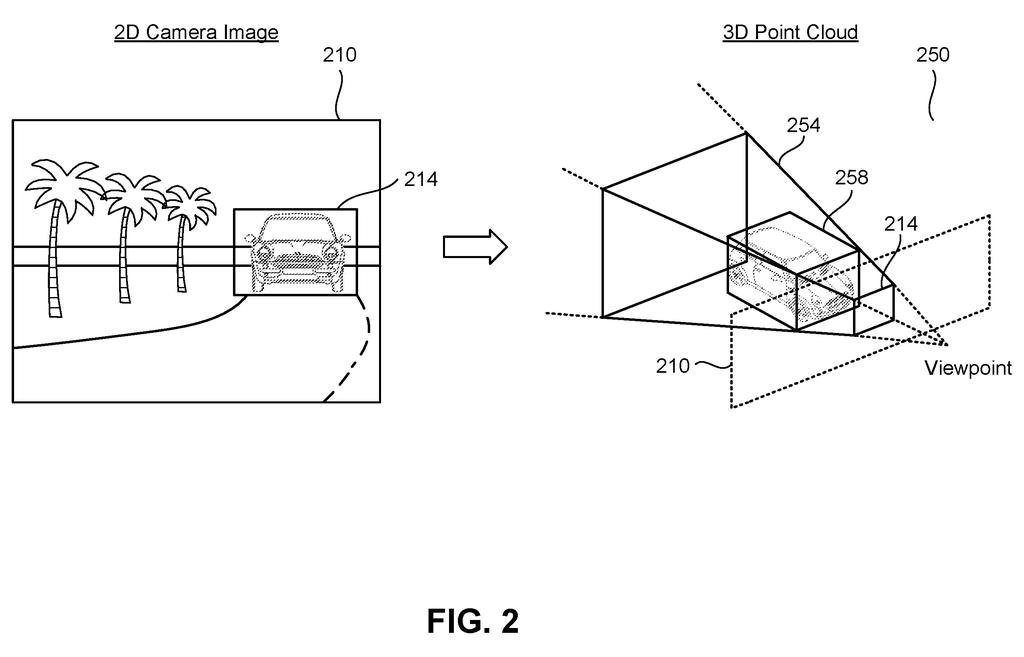
The patent describes an annotation cross-labeling system for autonomous vehicles. When a self-driving car's sensors capture a scene, different sensors represent that scene in different formats: a camera produces a flat, 2D image, while a radar or lidar produces a 3D point cloud (essentially a map of distances and positions in space).
The system starts with reference annotations on the camera image. These are the labeled bounding boxes or markers that a human (or an earlier AI step) has drawn around objects like cars, pedestrians, or traffic cones, each tagged with a location in 2D image space.
From those 2D annotations, the system calculates a corresponding spatial region in the 3D sensor data. This works by using the known geometric relationship between the camera's viewpoint and the second sensor's coordinate system (think of it like knowing exactly where two cameras are mounted relative to each other, so you can predict where an object seen by one will appear in the other's field of view).
Finally, the system finds or assigns annotations within that 3D region that confirm the object's location in the new representation space. The key insight is that annotations done on cheaper-to-label 2D image data can be automatically propagated to harder-to-label 3D data, reducing human effort without losing precision.
The annotation system determines a spatial region in the three-dimensional space of the second set of sensor measurements that corresponds to a portion of the scene represented in the annotation of the first set of sensor measurements.
Translation: It then maps that exact spot into the three dimensional data of another sensor, like radar.
What this means for Tesla's self-driving training pipeline
Labeling data is one of the most expensive and time-consuming parts of building a self-driving AI. Each hour of driving footage can take many more hours to label by hand, and that cost multiplies when you have multiple sensor types producing data simultaneously. A system that cuts that labor in half, even partially, has real financial and speed implications for Tesla's investment in autonomous driving data infrastructure.
For drivers, the downstream effect is that Tesla's Autopilot and Full Self-Driving systems could improve faster because the AI can be trained on larger, richer datasets without proportionally larger annotation teams. It's a back-end efficiency play that doesn't show up on a spec sheet, but shapes how quickly the product gets better.
That makes this Tesla's tenth filing we've tracked since May in our self-driving sensing race watchlist, joining earlier applications on an emergency alert system and a suspension that reads roads.
Teaching a self-driving car to recognize a stop sign means labeling that stop sign separately in footage from every camera and every sensor on the vehicle, by hand, every time. Across millions of miles of driving data, that repetitive labor becomes one of the heaviest costs in autonomous vehicle development, and it grows with every new mile driven.
This patent describes a system that transfers labels automatically from one sensor's data to another's by using known positions of the cameras and sensors to do the math. Annotators mark something once, and the system figures out where that same object appears in the other data streams.
The scope of the solution fits the scale of the burden. If the system holds up in practice, it removes a category of duplicated work that currently expands in direct proportion to how much driving data a program collects, which is precisely what makes autonomous vehicle development so expensive to sustain.
There are more where this came from
We read every patent application Big Tech publishes and send you the ones worth knowing. Plain English, free, every week.
The drawings
4 drawing sheets from US 2026/0276823 A1 · click any drawing to enlarge


Want this weekly breakdown for a company we don't cover? Patentlyze Pro →