
Google Patent Reveals Self-Driving Cars That Dynamically Adjust Sensor Fields of View
When a self-driving car's sensors start struggling in fog or heavy rain, Waymo's latest patent would let the car shrink or reshape what its sensors are watching so they stay reliable instead of guessing.
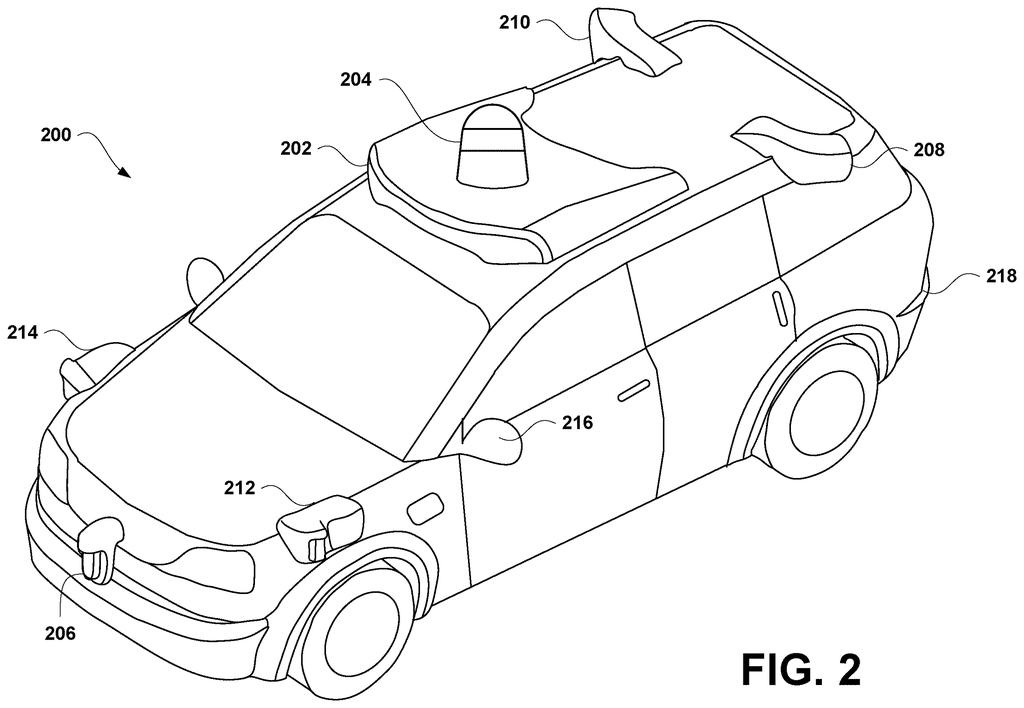
What Waymo's adaptive sensor focus actually does
Every time a Waymo robotaxi rolls through a patch of heavy rain, its sensors face a real problem: objects that were easy to spot in clear conditions become harder to track, and the car has to keep making decisions anyway.
Waymo's patent describes a system that notices when sensor readings are getting worse and responds by adjusting the sensor's field of view, basically the bubble of space around the car that the sensor is responsible for watching. Instead of one fixed setting, the sensor can switch between several preset viewing modes. When conditions are bad, it might zoom in on a tighter, more reliable area rather than straining to cover a wide zone it can no longer see clearly.
The system figures out what conditions it's dealing with by comparing how well it sees objects close up versus objects far away. That comparison tells it whether it's dealing with fog, heavy rain, or something else entirely, and it picks the right sensor mode accordingly.
… each operating field of view volume represents a space within which the sensor is expected to detect objects outside the autonomous vehicle at a minimum confidence level …
Translation: The car tracks how reliably its sensors can spot things around it in different zones.
How the car compares near and far sensor data to pick a new view
The patent describes a sensor system with multiple preset operating field of view volumes (think of each one as a differently shaped bubble around the car that the sensor monitors). The sensor can switch between these presets depending on what the car detects in its environment.
The core logic works like this:
- The system reads two separate slices of sensor data: one from objects at close range, one from objects farther away.
- It compares how well objects are being detected at each range to figure out the current environmental condition (fog reduces long-range returns more than short-range ones, for example).
- Based on that diagnosis, it selects a different field of view volume better suited to those conditions and switches the sensor into that mode.
An earlier version of the claim also checks whether a specific tracked object is degrading in quality over time by comparing current sensor readings to past readings of the same object. If the car was tracking a pedestrian clearly ten seconds ago and that track is now fuzzy, the degradation triggers a field of view adjustment.
Key detail: each field of view volume is defined not just by its shape or size, but by a minimum confidence level at which the sensor is expected to reliably detect objects inside it. Switching modes is effectively the car admitting the old detection zone is no longer trustworthy and trading coverage area for reliability.
… based on the degradation, adjusting the operating field of view volume of the at least one sensor to a different one of the operating field of view volumes …
Translation: The vehicle automatically changes its sensor range when performance drops.
What this means for self-driving cars in bad weather
Weather is one of the most stubborn unsolved problems for autonomous vehicles. A human driver who can't see clearly through fog slows down and narrows their mental focus to what's immediately ahead. This patent is Waymo's attempt to build an equivalent instinct into the sensor layer itself, below the level of route planning or braking decisions.
The approach is practical rather than flashy: instead of requiring a completely new sensor design, it works with sensors that already support multiple operating modes and adds decision logic on top. That means it could apply to lidar, radar, or cameras already in the field. Waymo's autonomous vehicle sensor work is part of a broader wave of latest Big Tech patents focused on making machine perception hold up under real-world conditions rather than controlled test environments.
The problem this patent attacks is serious: sensor degradation in adverse weather is one of the few remaining failure modes that autonomous vehicle makers have not convincingly solved at scale, and every incident tied to weather conditions raises the liability and public-trust stakes for the entire industry. Waymo's approach, dynamically shrinking the sensor's responsible zone rather than letting it report unreliable data at full width, matches the scale of the problem because it targets the source of the uncertainty rather than trying to correct for it downstream in software. Whether the preset-volume approach is flexible enough to handle the full range of real-world weather conditions is the real open question.
There are more where this came from
We read every patent application Big Tech publishes and send you the ones worth knowing. Plain English, free, every week.
The drawings
9 drawing sheets from US 2026/0238743 A1 · click any drawing to enlarge


Want this weekly breakdown for a company we don't cover? Patentlyze Pro →
Be the first to weigh in