
Meta Patents a Way to Copy Motion From One Video and Paste It Into a 3D Scene
Imagine being able to take the swaying dance moves from one video clip and automatically apply them to a completely different 3D scene — without touching a single keyframe. That's the core idea behind Meta's latest patent filing.
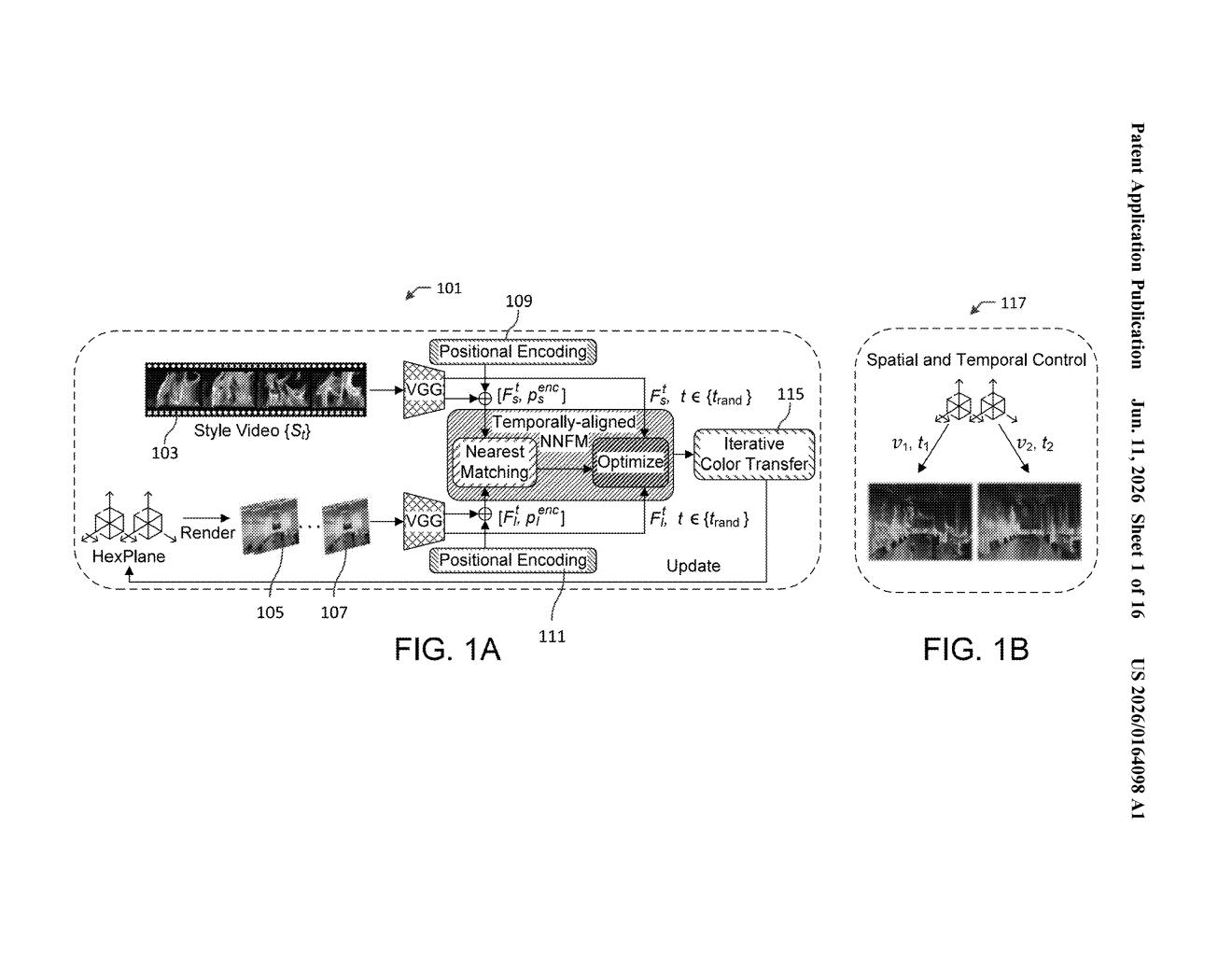
What Meta's motion-transfer system actually does
Picture a video of a campfire with flames flickering in a specific, dramatic way. Now imagine you want those exact same flickering patterns applied to a different scene — say, glowing lanterns in a virtual forest. Right now, getting that kind of stylistic consistency requires a lot of manual animation work. Meta's patent describes a system that could handle that transfer automatically.
The system picks a source video that has a motion style you like — think wind-blown grass, flowing water, or a person dancing — and analyzes how things are moving across its frames. It then applies that movement pattern to a separate scene's images, generating a new version of that scene where things move in the same style, viewed from any angle and across time.
This is specifically designed to work with 3D scenes, not just flat video. That means the transferred motion holds up no matter which direction you're looking from — a key requirement for virtual reality or augmented reality environments where your viewpoint is always changing.
How the system reads motion and rebuilds it in 3D
The patent describes a three-step pipeline. First, the system selects a reference video that contains the motion style to be borrowed — this could be anything from a specific style of human movement to environmental motion like fire or water.
Second, it analyzes a target scene represented as images. In practice this likely involves a radiance field (a technique — sometimes called NeRF — that encodes a 3D scene as a mathematical volume that can be rendered from any camera angle). The title of the patent explicitly calls these "radiance fields," which are the backbone of many modern 3D scene reconstruction systems.
Third, the system applies the extracted motion pattern to the target scene, producing a new version of that scene where the content moves according to the borrowed style. Crucially, the motion is consistent across:
- Different viewpoints (you can look at the scene from any angle)
- Different timesteps (the motion evolves correctly over time)
The technical challenge here is non-trivial: motion that looks right from one camera angle can look broken from another, so the system has to encode motion in a way that is view-consistent in 3D space, not just in a flat 2D frame.
What this means for AR, VR, and creator tools
For Meta, this filing sits squarely in its AR/VR ambitions. The Quest headsets and any future mixed-reality glasses need 3D content that feels alive — static scenes break immersion fast. A tool that lets creators (or an AI pipeline) quickly stylize how objects move inside a virtual world, by pointing to a reference video, could dramatically reduce the cost and time of building compelling VR environments.
For everyday users, this is the kind of technology that could eventually show up in a creator-facing app — imagine an Instagram or Horizon Worlds tool where you upload a clip of waves crashing, and the system makes your 3D avatar's hair flow in exactly the same rhythm. It's not there yet, but this patent lays groundwork for that kind of experience.
This is a legitimate research-level idea that addresses a real pain point in 3D content creation. Motion stylization for view-consistent 3D scenes is a hard problem, and Meta's AI research team has published credible work in this space before. Whether it ships as a product feature is a different question — but it's worth tracking as a signal of where Meta's generative 3D tools are heading.
There are more where this came from
We read every patent application Big Tech publishes and send you the ones worth knowing. Plain English, free, every week.
Want this weekly breakdown for a company we don't cover? Patentlyze Pro →